

Subtotal $0.00


Table of Contents
- Why Budgeting for Car Maintenance Matters
- Understanding Your Vehicle’s Age and Mileage
- Calculate Your Average Annual Car Maintenance Cost
- Create a Monthly Savings Plan
- Build Your Car Repair Emergency Fund
- Develop a Preventative Maintenance Checklist
- DIY vs. Professional Labor: Cost Breakdown
- Track and Adjust Your Budget
- Conclusion
- Frequently Asked Questions
Last Updated: September 2, 2026
Why Budgeting for Car Maintenance Matters
Most car owners don’t think about maintenance until something breaks, then a repair bill derails the month’s budget entirely. A vehicle is a system with moving parts that wear down predictably: oil needs changing, brakes fade, tires lose tread, batteries die. These aren’t surprises, they’re scheduled events you can plan for.

At TIPS Automotive, we work with car owners who wish they’d started a maintenance budget earlier. The ones who did are never caught off guard. They know roughly what to expect each month, catch problems before they become expensive, and keep their vehicles running longer. This guide walks you through exactly how to budget for car maintenance, from calculating what your specific vehicle will cost to building an emergency fund for the unexpected.
Understanding Your Vehicle’s Age and Mileage
Your vehicle’s age and annual mileage are the two biggest factors determining maintenance costs. A five-year-old sedan with 60,000 miles sits in a completely different cost tier than a ten-year-old truck with 150,000 miles.
Newer vehicles (under 5 years, under 60,000 miles) typically need routine service only: oil changes, filter replacements, tire rotations, and fluid top-offs. Warranty coverage often handles major repairs. Monthly maintenance costs tend to be modest.
Mid-life vehicles (5-10 years, 60,000-120,000 miles) start showing wear. Brake pads wear out, suspension components loosen, transmission fluid may need flushing. Costs begin to climb noticeably as you move from routine service into preventative repairs.
Older vehicles (10+ years, 120,000+ miles) demand serious attention. Mechanical failure becomes more likely, rust accelerates, and electrical issues appear. A single repair can cost hundreds or thousands. The owner’s manual’s service intervals matter less than your vehicle’s actual condition.
The cost per mile shifts with age. A newer car might cost $0.08 per mile in maintenance; a ten-year-old vehicle could run $0.15 or higher. Tracking your vehicle’s make, model, year, and current mileage gives you the baseline for everything that follows.
Calculate Your Average Annual Car Maintenance Cost
To budget for car maintenance effectively, you need a realistic number for what your vehicle actually costs to maintain each year based on its age, mileage, make, and model.
Step 1: Gather Your Maintenance History
Collect your last two to three years of repair and maintenance records. Add up every dollar spent: oil changes, tire work, brake service, diagnostics, fluid flushes, filters, batteries, alignments. Divide by the number of years for your actual average annual maintenance cost. If you don’t have records, use the tiered approach below.
Step 2: Find Your Vehicle’s Cost Tier
Newer vehicles (0-5 years, under 60,000 miles)
- Typical annual maintenance cost: $500-$1,200
- Primary expenses: Oil changes, filter replacements, tire rotations, fluid top-offs
- Cost per mile: $0.06-$0.10
Mid-life vehicles (5-10 years, 60,000-120,000 miles)
- Typical annual maintenance cost: $1,200-$2,000
- Primary expenses: Brake pad replacement, suspension component wear, transmission fluid flushes, cooling system maintenance, battery replacement
- Cost per mile: $0.10-$0.14
Older vehicles (10+ years, 120,000+ miles)
- Typical annual maintenance cost: $1,800-$3,500+
- Primary expenses: Mechanical repairs (transmission, engine, electrical), rust remediation, suspension rebuilds, cooling system overhauls
- Cost per mile: $0.15-$0.25+
Step 3: Account for Make, Model, and Powertrain
Within each tier, certain vehicles cost significantly more to maintain:
- Luxury brands (BMW, Mercedes-Benz, Audi, Lexus): Add 30-50% to baseline costs.
- European vehicles (non-luxury): Add 20-30%.
- Domestic sedans (Ford, Chevrolet, Toyota, Honda): Baseline costs.
- Trucks and SUVs: Add 15-25% compared to sedans of the same age.
- Hybrid and electric vehicles: Add 10-20% for specialized diagnostics, though brake wear is lower.
Step 4: Calculate Your Monthly Budget
Divide your annual estimate by 12 to get your monthly target.
Example calculations:
- Five-year-old Honda Civic (sedan, 55,000 miles): $900 annual ÷ 12 = $75/month
- Eight-year-old Ford F-150 (truck, 95,000 miles): $1,600 annual ÷ 12 = $133/month
- Twelve-year-old BMW 3 Series (luxury, 140,000 miles): $3,000 annual ÷ 12 = $250/month
Step 5: Adjust for Known Upcoming Expenses
If you know specific maintenance is due soon, factor it in. Tires due in six months at $600? Add $100/month for the next six months. Transmission service due next year at $300? Add $25/month. This prevents surprises and ensures money is already set aside.
The 11-Cents-Per-Mile Rule (and Why It’s Incomplete)
The rule of thumb to budget 11 cents per mile is a useful baseline but incomplete. It assumes average wear and doesn’t account for vehicle age, type, or condition. A well-maintained three-year-old sedan might run 8 cents per mile; a neglected ten-year-old truck could run 20+ cents per mile. Use the per-mile rule as a sanity check against your tiered estimate, not as your primary calculation method.
Create a Monthly Savings Plan
Now that you know your average annual maintenance cost, divide it into monthly chunks and set that money aside consistently. If your annual maintenance cost averages $2,000, that’s roughly $167 per month. The amount matters less than the consistency.
Set up an automatic transfer from your checking account to a separate savings account on payday. This account becomes your maintenance fund. A dedicated account creates a psychological boundary, the money is there when a repair comes due, eliminating the panic of choosing between a repair and other bills.
Track your actual spending against your budget. If you consistently spend less, you’re building a cushion. If you spend more, adjust upward next month. Your budget should evolve as your vehicle ages and needs change.
Build Your Car Repair Emergency Fund
Even with a solid maintenance budget, unexpected repairs happen. A sensor fails, a hose ruptures, a bearing seizes. An emergency fund separate from your monthly maintenance budget becomes critical.
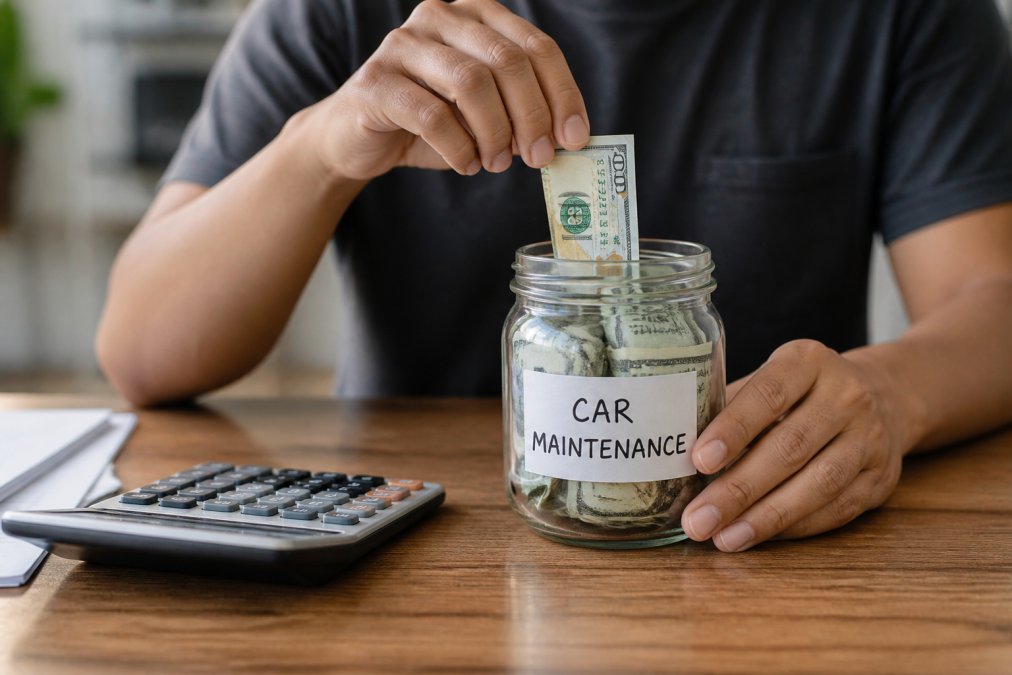
An emergency fund for car repairs should cover at least one major repair: $1,000-$2,000 minimum for most vehicles, $2,500-$5,000 for older vehicles. Build this gradually. If your monthly maintenance budget is $167, set aside an extra $50-$100 per month specifically for emergency repairs. In a year, you’ve built a $600-$1,200 cushion.
Keep this fund separate from your routine maintenance fund. Use it only for true emergencies, failures that prevent the vehicle from running safely, not routine maintenance you should have already budgeted for. This distinction matters. The emergency fund also gives you options: if a repair quote seems high, you can get a second opinion without financial pressure.
Develop a Preventative Maintenance Checklist
Preventative maintenance is the cheapest insurance you can buy. Your vehicle’s owner’s manual contains the manufacturer’s recommended service schedule. These intervals exist because engineers tested when components actually wear out.
A basic preventative maintenance checklist includes:
- Every month or before long trips: Check tire pressure and condition, fluid levels, lights, wipers, and battery terminals
- Every 5,000-7,500 miles or 6 months: Oil and filter change
- Every 15,000-30,000 miles: Rotate tires, inspect brakes, check suspension
- Every 30,000-50,000 miles: Replace engine air filter, inspect transmission fluid
- Every 60,000 miles: Inspect brake pads, flush brake fluid, check hoses and belts
- Every 100,000 miles: Consider transmission fluid flush, coolant flush, power steering fluid check
- Annually: Battery load test, alignment check, undercarriage inspection for rust
Vehicles that receive regular preventative maintenance cost far less to own than those neglected until something breaks. Preventative work also catches problems early, a mechanic rotating your tires notices uneven wear and spots a suspension issue before it becomes dangerous.
DIY vs. Professional Labor: Cost Breakdown
One of the biggest variables in maintenance costs is whether you handle work yourself or pay a shop. Understanding the cost difference and trade-offs helps you budget more accurately.
How Professional Labor Costs Are Structured
When you pay a shop for service, you’re paying for labor rate (typically $75-$150+ per hour), shop overhead (30-50% of labor cost), diagnostic fees (often $100-$200), and warranty on work (typically 12 months or 12,000 miles).
DIY Savings by Task Type
High-savings DIY tasks (low risk, high labor cost):
- Oil and filter change: Save $50-$100
- Air filter replacement: Save $30-$60
- Tire rotation: Save $40-$80
- Battery replacement: Save $50-$100
- Wiper blade replacement: Save $10-$20
Potential annual DIY savings on routine maintenance: $300-$500
High-risk tasks (not recommended for DIY):
- Transmission fluid flush, brake system work, electrical diagnostics, suspension repairs, transmission repairs, and engine work all require specialized equipment, training, and warranty protection. DIY mistakes often result in cascade failures costing thousands to repair.
Decision Framework: When to DIY vs. When to Pay a Professional
DIY is appropriate if:
- The task is on the “high-savings” list
- You have the correct tools
- You have a safe workspace
- You’ve watched a tutorial or done the task before
- A mistake won’t compromise safety
- Labor savings exceed $50
Professional is necessary if:
- The task requires specialized diagnostic equipment
- The work is safety-critical (brakes, suspension, steering)
- The task requires precision torque specifications
- You’re unsure what the problem is
- The repair involves electrical systems, transmission, or engine internals
- A mistake could damage other components
- The vehicle is under warranty
Budget Allocation
When creating your maintenance budget, allocate funds as follows:
- DIY supplies and tools: $100-$200 annually
- Professional labor: The remainder of your maintenance budget
- Diagnostic fees: $100-$300 annually
This balanced approach keeps costs reasonable while maintaining quality and safety.
Track and Adjust Your Budget
A budget only works if you actually track it. Create a simple system to record every maintenance and repair expense: date, description, cost, and whether it was routine or unexpected. Review your budget quarterly. Are you spending more or less than expected? Adjust your monthly savings accordingly.
As your vehicle ages, your budget will shift. A new vehicle needs mostly routine service; a five-year-old vehicle needs more preventative work; a ten-year-old vehicle needs serious attention. Also track your vehicle’s condition and note when tires are getting worn or when you hear new noises. These observations help you anticipate costs.
Your maintenance history also matters for resale value. Documented preventative maintenance proves you’ve cared for the vehicle. Keep receipts and records.
Conclusion
Budgeting for car maintenance requires honesty about what your vehicle actually costs. Start with your vehicle’s age and mileage, calculate what you’ve actually spent maintaining it, divide that into monthly savings, build an emergency fund for unexpected failures, follow preventative maintenance schedules, and track your spending.
The owners who do this never get blindsided by repair bills. They know what’s coming, have the money set aside, and catch problems early through preventative maintenance.
At TIPS Automotive, our certified technicians help owners understand exactly what their vehicles need and what it will cost. We combine transparent communication with honest diagnostics so you know what’s routine maintenance and what’s truly urgent. Whether you need routine service, preventative work, or emergency repairs, we handle everything from bumper to bumper with the same commitment to keeping your vehicle reliable and your budget predictable. Call now and schedule your service, we offer same-day appointments and free pickup and drop-off within a 10-mile radius.
Frequently Asked Questions
How much should I set aside monthly for car repairs?
Most owners should budget for routine maintenance and unexpected repairs. This amount varies based on your vehicle’s age, mileage, and make. Newer vehicles typically cost less, while older cars with higher mileage require more. Use the cost-per-mile method: calculate your annual maintenance costs and divide by your yearly miles driven. This gives you a realistic monthly target specific to your situation.
What is the 30-60-90 rule for car maintenance?
This rule suggests checking your vehicle at 30,000, 60,000, and 90,000 miles for age-specific maintenance needs. At each interval, consult your owner’s manual for scheduled service requirements like fluid flushes, filter replacements, and inspection of wear-prone parts. Following this preventative maintenance checklist helps catch mechanical failure early, reducing emergency repair costs and extending your vehicle’s longevity.
What is the $3,000 rule for cars?
The $3,000 rule suggests keeping a dedicated car repair emergency fund for unexpected major repairs. Your specific emergency fund target depends on your vehicle’s age, condition, and reliability history. Older vehicles should aim higher; newer ones may need less. Pair this with a sinking fund for routine maintenance to avoid financial strain.
How do I prioritize car maintenance when on a tight budget?
Focus first on safety-critical items: brakes, tires, steering, and lights. Next, address routine service intervals outlined in your owner’s manual to prevent costly mechanical failure. Preventative maintenance like oil changes and filter replacements costs far less than emergency repairs. If funds are limited, schedule diagnostic work to identify what’s truly urgent versus what can wait. Spread non-emergency work across multiple months, and ask certified technicians for honest recommendations about what can be delayed safely.
This article was written using GrandRanker


Comments are closed