

Subtotal $0.00

Table of Contents
- Why Cadillac Maintenance Is Different
- Cadillac Recommended Service Intervals: What the Factory Says
- The 10 Essential Maintenance Tasks Every Cadillac Owner Should Track
- Fluid Levels That Protect Your Engine and Transmission
- Common Signs of GM Transmission Failure You Should Never Ignore
- The Importance of OEM Parts for Cadillac Repairs
- Model-Specific Maintenance Nuances: CT5, XT5, Escalade, and More
- Technology and Software Updates: The Digital Side of Cadillac Care
- How to Budget for Long-Term Cadillac Ownership Costs
- Warranty Preservation Tips for Cadillac Owners
- DIY vs. Professional Service: When to Trust a Certified Technician
- Frequently Asked Questions
Last Updated: September 15, 2026
Why Cadillac Maintenance Is Different
Cadillac maintenance is different because these vehicles pair luxury-grade electronics with GM drivetrains that demand specific fluids, parts, and diagnostic tools. A generic oil change or a one-size-fits-all service schedule will not protect a CT5, XT5, or Escalade the way the factory intended.
At TIPS Automotive, we work on GM and Cadillac vehicles, and we’ve observed that owners who follow the best car maintenance for Cadillac owners schedule often achieve more miles from their vehicles than those who treat them like any other sedan.
Three things separate Cadillac care from ordinary car care:
- Fluid specifications are stricter. GM requires dexos1-certified synthetic oil and specific transmission fluids. Substitutes can void warranty coverage and accelerate wear.
- Electronics are deeply integrated. A battery that tests “fine” on a basic load tester can still cause a cascade of module faults on a Cadillac.
- Parts tolerances are tighter. Aftermarket brake pads and suspension components that work acceptably on an economy car often produce noise, vibration, or premature rotor wear on a Cadillac.
The best car maintenance for Cadillac owners starts with accepting that this is a premium machine with premium requirements. The good news: those requirements are documented, predictable, and easier to follow than most owners assume.
Cadillac Recommended Service Intervals: What the Factory Says
Cadillac recommended service intervals are set by GM and published in your owner’s manual, with the Oil Life System determining when oil changes are actually due rather than a fixed mileage number. Most modern Cadillacs follow a schedule built around the Oil Life System, with major milestones at 30,000, 60,000, and 90,000 miles.
The single most common mistake is owners defaulting to the old “every 3,000 miles” rule. That advice is decades out of date for synthetic-oil engines. Your Cadillac’s computer tracks engine hours, temperature cycles, and driving conditions, then tells you when service is genuinely needed.
Oil Life System and dexos1 Synthetic Oil
The Oil Life System is a GM algorithm that calculates remaining oil life based on your actual driving, not a fixed odometer count. When it reads 20% or lower, schedule service. Do not wait for zero.
Your Cadillac requires dexos1 full synthetic oil. This is not a suggestion. GM engineered its engines around this specification, and using non-certified oil can affect warranty coverage on engine-related repairs. The dexos1 standard controls deposit formation, aeration, and wear protection in ways conventional oils cannot match.
Cadillac’s own Certified Service maintenance guidance confirms that factory-scheduled maintenance uses GM Genuine Parts and dexos1 oil for exactly this reason.
30,000-Mile, 60,000-Mile, and 90,000-Mile Milestones
Think of these as the checkpoints where small issues get caught before they become expensive ones.
| Mileage | Core Services | What Technicians Check |
|---|---|---|
| 30,000 | Oil and filter, tire rotation, cabin air filter | Brake wear, battery health, fluid levels |
| 60,000 | Transmission fluid, coolant flush, engine air filter | Suspension, spark plugs, diagnostic scan |
| 90,000 | Brake fluid, transmission service, belts and hoses | Rotor wear, battery replacement, full safety inspection |
These intervals assume normal driving. Heavy towing, frequent short trips, and stop-and-go commuting shorten them. Ask your technician to adjust the schedule to your actual use.
The 10 Essential Maintenance Tasks Every Cadillac Owner Should Track
The 10 essential maintenance tasks every Cadillac owner should track are oil changes, tire rotation, tire pressure checks, brake inspections, fluid level monitoring, air filter replacement, cabin air filter replacement, battery testing, suspension checks, and diagnostic scans. Miss any one of them long enough and you will feel it in vehicle performance and repair cost.
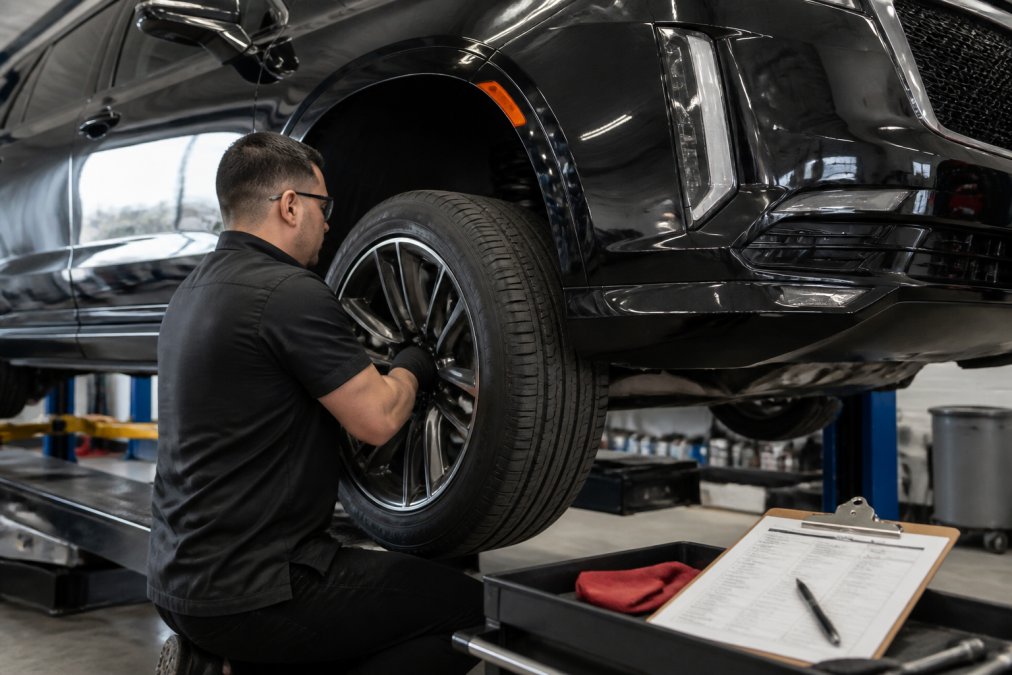
Here is the full checklist, in the order most owners should think about it:
- Oil and filter change at the Oil Life System interval, using dexos1 synthetic oil
- Tire rotation every 5,000 to 7,500 miles to even out tread wear
- Tire pressure check monthly, including the spare
- Brake inspection at every rotation, with pad and rotor measurement
- Fluid level checks for coolant, brake fluid, transmission fluid, and washer fluid
- Engine air filter replacement at the mileage interval in your manual
- Cabin air filter replacement annually or when airflow drops
- Battery and charging system test at every oil change after year three
- Suspension and steering check at 60,000 miles and any time you hear clunks
- Diagnostic scan at every service visit, even with no warning light
Tire Rotation, Pressure Checks, and Tread Depth
Tire rotation is the cheapest maintenance you can perform and the one most often skipped. Cadillac SUVs and sedans wear front tires faster than rear tires, and rotating them at 5,000 to 7,500 miles keeps tread depth even across all four.
Check pressure monthly with a gauge, not by eye. Underinflation by even a few PSI increases rolling resistance, wears shoulders prematurely, and hurts fuel economy. Measure tread depth with a penny or a tread gauge. Below 4/32 inch, start planning replacements. At 2/32 inch, you are past the legal limit and driving on borrowed time in rain.
Pro tip: on all-wheel-drive Cadillacs, uneven tread depth between axles can stress the drivetrain. Rotate on schedule and replace tires in matched sets.
Brake Pads, Rotors, and Fluid Flushes
Brake pads typically last 30,000 to 70,000 miles depending on driving, but Cadillac’s heavier curb weights push toward the lower end. Have pad thickness measured at every tire rotation, not just when you hear squealing.
Rotors matter as much as pads. Rotor wear below the minimum thickness stamped on the rotor hat means replacement, not resurfacing. Ignoring this produces pulsation through the pedal and longer stopping distances.
Brake fluid absorbs moisture over time, which lowers its boiling point and corrodes internal components. A brake fluid flush every 30,000 to 45,000 miles keeps the hydraulic system healthy. This is one of the most overlooked items on any Cadillac service schedule.
Fluid Levels That Protect Your Engine and Transmission
Fluid levels protect your Cadillac’s engine and transmission by maintaining lubrication, cooling, and hydraulic pressure, and neglecting them is the fastest route to a four-figure repair. But the generic “check your fluids” advice every competitor publishes is not enough on a Cadillac, because GM specifies different fluids by engine, transmission, and model year, and using the wrong one is one of the few maintenance mistakes that can actually void warranty coverage on a related failure.
Here is what actually matters, broken out by system and by model family:
- Engine oil: dexos1 Gen 3 full synthetic is the current GM specification for most gasoline Cadillacs, including the 2.0L turbo in the CT4 and CT5 and the 3.6L V6 in the XT5 and XT6. The Escalade’s 6.2L V8 and the CT5-V Blackwing’s supercharged 6.2L also call for dexos1, but with a heavier viscosity in some trims, check the oil fill cap, not a forum post. Check the level monthly on a cold engine, and after any service that involved the oil pan.
- Coolant: GM uses Dex-Cool (orange) in most Cadillacs, but the exact formulation has changed over the years and mixing incompatible coolants causes gelling that clogs the heater core and radiator. Top off only with the pre-mixed Dex-Cool specified for your model year. A full coolant exchange is typically due around 60,000 miles on most Cadillacs, but the Escalade and other tow-capable models often need it sooner under heavy use.
- Transmission fluid: The 8-speed (8L90, 8L45) and 10-speed (10L80, 10L90) automatics used across the lineup are sealed units with no dipstick. Fluid service is typically due around 45,000 miles under normal driving and sooner under towing or stop-and-go use. GM specifies its own ULV (ultra-low viscosity) fluid for the 10-speed units, aftermarket substitutes that claim to “meet or exceed” the spec are a common source of shift complaints.
- Brake fluid: DOT 4 is the specification on most modern Cadillacs, including V-Series models. DOT 4 absorbs moisture faster than DOT 3, so a flush every 30,000 to 45,000 miles is not optional on a performance-trim Cadillac. Dark or cloudy fluid means moisture contamination and a lower boiling point, the exact condition that causes fade during hard braking.
- Differential and transfer case fluid: On all-wheel-drive XT4, XT5, XT6, and Escalade models, the rear differential and transfer case have their own service intervals, usually in the 45,000 to 60,000 mile range. These are frequently skipped because they are not part of a standard oil-change visit, and they are a common source of driveline noise on higher-mileage AWD Cadillacs.
- Power steering: Most current Cadillacs use electric power steering with no fluid reservoir. Older models (pre-2010) use traditional hydraulic fluid, check the owner’s manual if you are unsure which system your vehicle has.
A common mistake is topping off coolant with plain water. That dilutes the antifreeze concentration, lowers boilover protection, and on Dex-Cool systems can accelerate the corrosion that already plagues these engines when the coolant is neglected. Use the correct pre-mixed coolant for your model year and trim.
Fluid condition can indicate potential issues, and these signs can be model-specific. For example, milky transmission fluid on a 10-speed Escalade may suggest different issues than on an 8-speed CT5. Rusty coolant on an XT5 with the 3.6L V6 can sometimes be linked to a failing water pump or intake gasket. Dark brake fluid on a CT5-V after a track day might be expected, but dark brake fluid on a base XT4 with 20,000 miles could be a warning sign. A diagnostic scan combined with a fluid inspection can help identify these patterns.
Pro Tip
Ask your technician to note the fluid color, level, and any top-off amount on your service invoice. That written record is the single best tool for spotting a slow leak or a degrading fluid before it becomes a repair, and it doubles as warranty documentation if a related failure ever comes up.
Ask your technician to note the fluid color, level, and any top-off amount on your service invoice. That written record is the single best tool for spotting a slow leak or a degrading fluid before it becomes a repair, and it doubles as warranty documentation if a related failure ever comes up.
Common Signs of GM Transmission Failure You Should Never Ignore
Common signs of GM transmission failure include harsh shifting, delayed engagement when shifting from park to drive, shuddering at steady speeds, slipping between gears, and a burning smell. Catching these early often means a fluid service; ignoring them usually means a rebuild.
Cadillac transmissions are strong, but they are not immune to neglect. The 8-speed and 10-speed automatics used across the lineup are sensitive to fluid condition and temperature. When fluid breaks down, shift quality degrades quickly.
Harsh Shifting and Delayed Engagement
Harsh shifting is the most reported early symptom. You feel a jolt or slam when the transmission changes gears, particularly at low speeds. Delayed engagement is the second: you shift into drive, and there is a pause before the vehicle moves.
Both symptoms can stem from low or degraded fluid, a failing solenoid, or a software calibration issue. On many GM transmissions, a diagnostic scan and a fluid service resolve the problem entirely. On others, it is the first warning of internal wear.
If you feel either symptom, get it checked promptly. Transmission repairs can escalate quickly, and early intervention can often prevent more extensive and costly replacements.
Transmission Fluid Condition and Mileage Intervals
GM’s sealed transmissions still need fluid service, typically around 45,000 to 60,000 miles under normal driving and sooner under heavy use. “Sealed” means there is no dipstick, not that the fluid lasts forever.
Ask your technician to inspect fluid condition at every service. Healthy transmission fluid is reddish and translucent. Dark, burnt-smelling fluid means it has been overheated and its additives are depleted.
Watch Out
Waiting for a transmission to “fail completely” before seeking service can lead to significantly higher costs. Addressing issues like harsh shifting early with a fluid service can be much less expensive than a rebuild, and delay can often turn a repairable unit into one requiring replacement.
Waiting for a transmission to “fail completely” before seeking service can lead to significantly higher costs. Addressing issues like harsh shifting early with a fluid service can be much less expensive than a rebuild, and delay can often turn a repairable unit into one requiring replacement.
The Importance of OEM Parts for Cadillac Repairs
The importance of OEM parts for Cadillac repairs comes down to fit, function, and warranty protection. GM Genuine Parts and ACDelco components are engineered to the same specifications as the parts that came on your vehicle, and on a Cadillac that precision is not optional.
Aftermarket parts vary wildly. Some are excellent. Many are not. The problem is you cannot tell which is which at the counter, and the savings rarely justify the risk on a luxury vehicle.
Where OEM parts matter most:
- Brake pads and rotors: Aftermarket compounds often produce noise and dust on Cadillac calipers
- Suspension components: Incorrect damping rates change ride quality and handling
- Sensors and modules: Electrical tolerances are tight, and cheap sensors cause false faults
- Filters: OEM filters match the flow and filtration specs your engine was designed around
Cadillac’s official maintenance program uses GM Genuine Parts specifically to preserve factory performance and warranty compliance. Independent shops can and do use OEM parts too. Ask before you book.
Model-Specific Maintenance Nuances: CT5, XT5, Escalade, and More
Model-specific maintenance nuances matter because a CT5 sedan, an XT5 crossover, and an Escalade SUV have different drivetrains, weights, and service demands despite sharing a brand. Treating them as identical is how owners end up with the wrong service at the wrong interval.
Pro Tip
Ask your shop to pull the factory service schedule for your specific VIN, not just your model year. Trim and drivetrain differences change the intervals, and a VIN-specific schedule catches items a generic checklist misses.
Ask your shop to pull the factory service schedule for your specific VIN, not just your model year. Trim and drivetrain differences change the intervals, and a VIN-specific schedule catches items a generic checklist misses.
Technology and Software Updates: The Digital Side of Cadillac Care
What to do:
How to Budget for Long-Term Cadillac Ownership Costs
Three habits keep costs down:
Key Takeaway
Maintaining your Cadillac on schedule can contribute to lower long-term ownership costs. Preventive service at each milestone can be more cost-effective than the repairs that may result from skipped intervals.
Maintaining your Cadillac on schedule can contribute to lower long-term ownership costs. Preventive service at each milestone can be more cost-effective than the repairs that may result from skipped intervals.
Warranty Preservation Tips for Cadillac Owners
DIY vs. Professional Service: When to Trust a Certified Technician
| Task | DIY-Friendly? | Warranty & Model Caveats |
|---|---|---|
| Tire pressure and wiper blades | Yes | No warranty impact. Use the pressure on the driver’s door jamb, not the tire sidewall. |
| Cabin air filter | Usually | No warranty impact. Access differs by model, the CT5 is behind the glovebox, the Escalade is under the passenger dash. |
| Engine air filter | Usually | No warranty impact. Use a GM-spec filter; a poorly sealing aftermarket filter can trigger a mass airflow code. |
| Oil change | Sometimes | Must use dexos1 Gen 3 oil and a GM-spec filter. Keep the receipt with date, mileage, and oil part number, this is the single most common warranty audit item. |
| Brake service | No | Safety-critical. Requires pad and rotor measurement against the minimum thickness stamped on the rotor hat, plus torque-to-spec on caliper bolts. DIY brake work is a common cause of denied warranty claims on related suspension and ABS issues. |
| Transmission service | No | Sealed 8- and 10-speed units require specific ULV fluid, a specific fill procedure, and a scan tool to reset adaptive learning. Incorrect fluid is a leading cause of shift complaints and denied transmission warranty claims. |
| Coolant flush | No | Dex-Cool formulation varies by model year. Mixing incompatible coolants causes gelling. Requires proper bleed procedure on many models. |
| Diagnostic scan and module updates | No | Requires GM’s diagnostic platform (GDS2) and a J2534 pass-thru device. Generic OBD-II readers cannot read body, chassis, or infotainment modules. |
| Battery replacement | Sometimes | On many Cadillacs, the battery must be registered to the vehicle with a scan tool so the charging system adjusts. Skipping registration shortens battery life and can cause electrical faults. |
Three model-specific realities that change the DIY calculus:
Watch Out
Skipping the battery registration after a DIY replacement is one of the most common, and most avoidable, causes of electrical faults on modern Cadillacs. If you replace the battery yourself, have a shop register it with a scan tool. It takes minutes and prevents months of intermittent gremlins.
Skipping the battery registration after a DIY replacement is one of the most common, and most avoidable, causes of electrical faults on modern Cadillacs. If you replace the battery yourself, have a shop register it with a scan tool. It takes minutes and prevents months of intermittent gremlins.
Frequently Asked Questions
How much does a 7,500-mile service for a Cadillac cost?
The cost of a 7,500-mile service depends on your Cadillac model, engine type, and local labor rates. It typically includes an oil and filter change with dexos1 synthetic oil, tire rotation, and a multi-point inspection. Pricing varies by dealership and independent shop, so contact TIPS Automotive for current rates. Many Cadillac models require this service every 7,500 miles or based on the Oil Life System.
Why are Cadillacs so expensive to repair?
Cadillac repair costs are higher because of advanced electronics, specialized parts, and the need for diagnostic equipment. OEM parts for Cadillac often cost more than aftermarket alternatives, and some repairs require certified technicians trained on GM systems. Luxury vehicle care also involves more complex procedures, such as transmission service or suspension checks, which can add labor time. Regular preventative maintenance helps avoid major expenses.
How many miles do Cadillacs typically last?
A well-maintained Cadillac can last 200,000 miles or more. Longevity depends on following the Cadillac recommended service intervals, using dexos1 synthetic oil, and addressing issues like common signs of GM transmission failure early. Regular fluid changes, brake inspections, and tire rotations also extend vehicle life. Owners who stick to the owner’s manual schedule and use genuine parts often see the highest mileage.
What is the best oil to use in a Cadillac?
Cadillac engines require dexos1 full synthetic oil, which meets GM’s strict specifications for engine protection and fuel economy. Using the wrong oil can void warranty coverage and lead to sludge buildup. Always check your owner’s manual for the exact viscosity grade, such as 0W-20 or 5W-30. TIPS Automotive uses dexos1 oil for all Cadillac oil changes to keep your engine healthy.
How often should I rotate the tires on my Cadillac?
Cadillac recommends rotating tires every 7,500 miles, or at the same time as your oil change. Tire rotation promotes even tread wear and extends tire life. Check tire pressure monthly and inspect tread depth; replace tires when tread reaches 2/32 of an inch. For SUVs like the XT5, rotation is especially important due to weight distribution.
What are the most common signs of transmission issues in GM vehicles?
Common signs of GM transmission failure include harsh or delayed shifting, slipping between gears, unusual noises, and a burning smell. You might also see a check engine light or experience shuddering at highway speeds. Low or dirty transmission fluid often causes these symptoms. If you notice any, schedule a diagnostic scan with a certified technician to prevent further damage.


Comments are closed