Subtotal $0.00

Table of Contents
- Why Early Transmission Service Matters for Your Cadillac
- 8 Warning Signs Your Cadillac Needs Transmission Service
- What Does Service Transmission Light Mean?
- Cadillac Transmission Fluid Change Interval: Stick to the Schedule
- How to Check Your Transmission Fluid Level at Home
- Cost of Transmission Repair for Cadillac: What to Expect
- DIY vs. Professional Transmission Diagnostics
- Model-Specific Cadillac Transmission Concerns
- Get Your Cadillac Checked by Certified Technicians
- Frequently Asked Questions
Last Updated: September 5, 2026
Why Early Transmission Service Matters for Your Cadillac
Your Cadillac’s transmission is one of the most complex and expensive systems in the vehicle, yet it often gets ignored until something goes wrong. Recognizing the signs your Cadillac needs transmission service early can mean the difference between a routine fluid change and a full rebuild that costs thousands. At TIPS Automotive, our certified technicians see too many drivers who waited for the problem to become undeniable before booking a diagnostic.
Transmission service is preventive care, not just a repair. The gearbox relies on pressurized fluid to shift smoothly, transfer power, and keep internal components cool. When that fluid breaks down or leaks out, friction increases, heat builds, and metal parts begin to wear against each other. Catching a minor issue during a routine service protects the drivetrain and keeps your Cadillac performing the way it was designed to.
Below, we’ll walk through the eight warning signs that point to transmission trouble, explain what the service transmission light actually means, and give you a clear maintenance schedule. Most importantly, you’ll learn when a DIY check is enough and when you need a professional diagnostic.
8 Warning Signs Your Cadillac Needs Transmission Service
Transmission failure rarely happens without notice. Your Cadillac gives you warning signs, but they’re easy to dismiss as minor quirks. Here are the eight most common indicators that your transmission needs professional attention.
1. Transmission Fluid Leaks
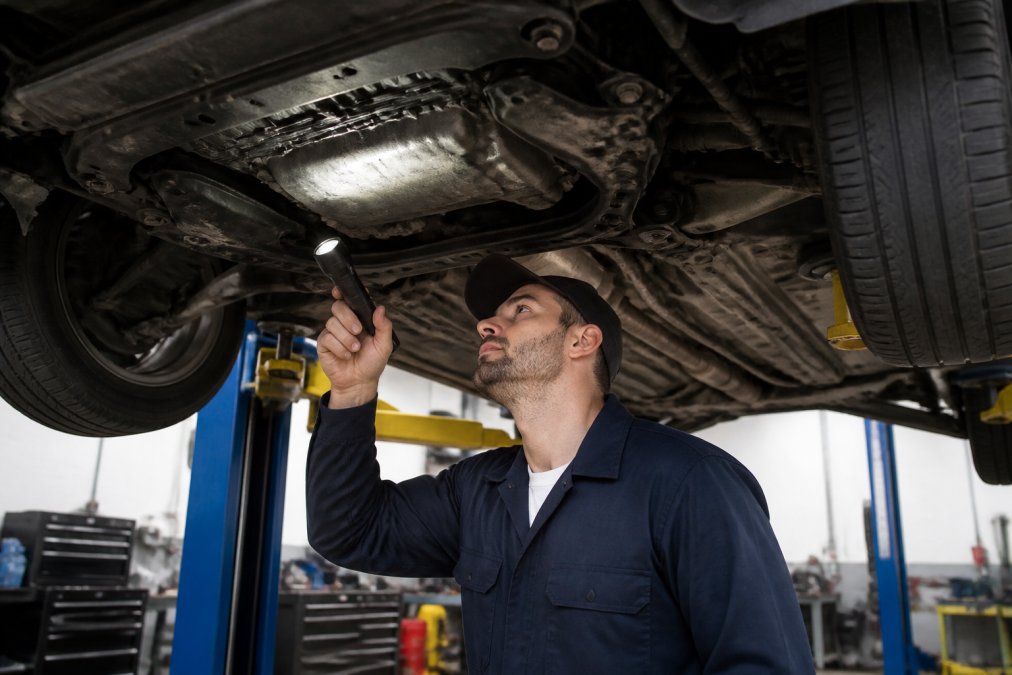
The most obvious sign of trouble is a puddle under your car. Transmission fluid is typically reddish-brown and has a slightly sweet, petroleum smell. If you notice stains on your driveway or garage floor, check the fluid level immediately.
Low fluid is the leading cause of premature transmission wear. The fluid lubricates gears, clutches, and the torque converter while providing hydraulic pressure for gear shifting. A leak that drops the fluid level below safe limits leads to slipping, hesitation, and eventual internal damage. A common source of leaks is the transmission pan gasket, which degrades over time.
2. Grinding or Whining Noises
A healthy transmission operates quietly. If you hear grinding, whining, or humming sounds while driving, especially during gear changes, something is wrong internally. These noises often indicate low fluid, worn bearings, or damaged gears.
Pay attention to when the noise occurs. A whine that appears during acceleration and fades at cruising speed often points to the torque converter or pump. Grinding during shifts suggests synchronizer or clutch problems. Any unusual noise from the gearbox warrants a professional inspection before the damage spreads.
3. Slipping Out of Gear
Slipping happens when the transmission briefly loses connection between the engine and the wheels. You might feel the engine rev higher without a corresponding increase in speed, or the car may suddenly drop into neutral while driving. This is a serious safety concern, especially during highway merging or uphill driving.
Slipping usually means worn clutches, a failing torque converter, or critically low fluid pressure. Continuing to drive in this condition accelerates internal damage. If your Cadillac slips out of gear, schedule a diagnostic immediately and limit driving until a technician examines it.
4. Delayed Shifting or Hesitation
Does your Cadillac pause before engaging a gear when you shift from park to drive? Does it hesitate before downshifting when you press the accelerator? Delayed shifting is a classic early warning sign of transmission trouble.
This hesitation often stems from degraded fluid viscosity or a clogged transmission filter. The valve body relies on clean fluid under proper pressure to route hydraulic signals. When the fluid thickens or becomes contaminated, shifts become slower and less precise. Addressing this early with a fluid service can prevent more extensive valve body repairs.
5. Burning Smell
A burning odor coming from your vehicle is never a good sign. When transmission fluid overheats, it produces a sharp, acrid smell distinct from burning engine oil. Overheated fluid loses its lubricating properties and can cause clutch plates to glaze over and fail.
Burning smells often accompany other symptoms like slipping or shuddering. The cause may be low fluid, a clogged cooler line, or excessive load on the transmission. Stop driving and have the system checked, as continued operation can warp internal components and lead to a costly rebuild.
6. Check Engine Light or Warning Messages
Modern Cadillacs monitor transmission performance through the engine control module. When the computer detects abnormal shift patterns, speed sensor inconsistencies, or pressure faults, it illuminates the check engine light or displays a transmission warning message on the dashboard.
A diagnostic scan is the only way to know what triggered the warning. The code will point to the specific circuit or component involved, whether it is a faulty solenoid, a failing speed sensor, or a valve body issue. Ignoring the light risks converting a repairable problem into a catastrophic failure.
7. Rough Idling
Transmission problems can affect engine idle behavior. If your Cadillac idles rough, stalls, or vibrates excessively when stopped in gear, the torque converter may not be disengaging properly. This puts unnecessary strain on the engine and drivetrain.
Rough idling combined with any other symptom on this list strengthens the case for a transmission inspection. A technician can test torque converter operation and fluid pressure to isolate the root cause. Catching a failing torque converter early is far less expensive than replacing it after it damages the pump or transmission case.
8. Slow Acceleration or Shuddering
When you press the accelerator, your Cadillac should respond promptly. If acceleration feels sluggish or the car shudders during gear changes, the transmission is struggling to transfer power efficiently. This symptom often appears alongside slipping and delayed shifting.
Shuddering during acceleration can indicate contaminated fluid, worn clutch friction material, or a failing torque converter clutch. Driving with a shuddering transmission generates additional heat and wear, compounding the damage. A professional fluid service and diagnostic test can determine whether a flush resolves the issue or internal repairs are needed.
What Does Service Transmission Light Mean?
The service transmission light is a specific warning indicator that appears on many Cadillac models when the powertrain control module detects a fault in the transmission system. Unlike the check engine light, which covers the entire engine and emissions system, this light points directly to the gearbox.
When this light illuminates, the vehicle’s computer has stored a diagnostic trouble code. Common triggers include abnormal shift solenoid resistance, transmission fluid temperature exceeding safe limits, or gear ratio errors. The system may also enter a fail-safe or limp mode that locks the transmission in a single gear to protect it from further damage.
Do not ignore this warning. Driving with an active transmission fault can cause internal components to overheat and fail. Have the codes read by a professional who can interpret them correctly and recommend the appropriate service.
Cadillac Transmission Fluid Change Interval: Stick to the Schedule
The cadillac transmission fluid change interval depends on your specific model, model year, and driving conditions. Most Cadillac owner’s manuals recommend a transmission fluid service every 45,000 to 60,000 miles under normal driving conditions. Severe driving, such as frequent towing, heavy stop-and-go traffic, or extreme temperatures, shortens that interval to around 30,000 miles.
Following the factory schedule is the single most effective way to extend transmission life. Fresh fluid maintains proper viscosity, protects against wear, and keeps the valve body clean. Skipping scheduled fluid changes allows contaminants to accumulate, leading to clogged passages and premature component failure.
Your owner’s manual is the authoritative source for your specific vehicle. If you are unsure whether your Cadillac is due for service, a professional shop can check the fluid condition and recommend an appropriate interval based on your driving habits.
How to Check Your Transmission Fluid Level at Home
Before you pop the hood, you need to know which type of transmission your Cadillac has. This single detail determines whether you can perform a DIY fluid check or if the procedure requires a lift and professional equipment.
If Your Cadillac Has a Dipstick (Most Models Before 2015)
Many older Cadillac models, including the CTS, SRX, and Escalade with the 6L-series transmissions, are equipped with a traditional dipstick. For these vehicles, the procedure is straightforward but requires precision:
- Park on a level surface and engage the parking brake.
- Start the engine and let it idle for at least 5 minutes to bring the fluid to operating temperature (around 150-170°F).
- With your foot firmly on the brake, shift slowly through each gear (P-R-N-D), pausing for about 3 seconds in each position. This circulates fluid through the valve body and torque converter.
- Return the shifter to Park and leave the engine running.
- Locate the transmission dipstick. On most Cadillacs, it sits near the back of the engine bay, often with a bright orange or yellow loop handle. It is NOT the engine oil dipstick, which is typically closer to the front.
- Remove the dipstick, wipe it clean with a lint-free cloth, reinsert it fully, and remove it again to read the level.
The fluid should fall between the “MIN” and “MAX” marks. The difference between these marks is typically only about one pint, so even a small leak can drop the level significantly.
If Your Cadillac Has a Sealed Transmission (Most Models 2015 and Newer)
This is the critical distinction most online guides miss. Many newer Cadillac models, including the CT6, XT4, XT5, and current Escalade with the 8L-series or 10L-series transmissions, do not have a transmission dipstick at all. These are sealed units with a fill plug and a check plug on the side of the case.
Checking the fluid on these models requires:
- Lifting the vehicle safely on jack stands or a lift
- Locating the check plug, which is often a hex or Torx fitting on the side of the transmission pan
- Having the vehicle perfectly level and the transmission at a specific temperature (usually between 122°F and 176°F, monitored via a scan tool)
- Adding fluid through the fill plug until it weeps out of the check hole
Attempting this without a lift and a temperature-capable scan tool will almost certainly produce an inaccurate reading. Overfilling a sealed transmission is just as damaging as running it low, as it causes foaming and erratic shift behavior.
Reading Fluid Condition: What the Color and Smell Tell You
Regardless of whether you can access the fluid, knowing what healthy fluid looks like helps you identify problems early:
| Fluid Appearance | What It Indicates | Recommended Action |
|---|---|---|
| Translucent red or pink | Healthy, fresh fluid | No action needed |
| Dark brown or amber | Oxidized, heat-stressed fluid | Schedule a fluid service |
| Burnt smell with dark color | Overheated fluid, possible clutch wear | Professional diagnostic required |
| Particles or metallic specks | Internal mechanical wear (gears, bearings) | Professional diagnostic required immediately |
| Milky or foamy appearance | Water contamination or overfilling | Professional flush and inspection |
Watch Out
Checking transmission fluid on a running engine involves moving parts and hot components. Keep hands, clothing, and tools clear of belts and fans. If you cannot confirm your model has a dipstick, do not guess, a professional can perform the check in minutes with the proper equipment.
Checking transmission fluid on a running engine involves moving parts and hot components. Keep hands, clothing, and tools clear of belts and fans. If you cannot confirm your model has a dipstick, do not guess, a professional can perform the check in minutes with the proper equipment.
If you own a 2015 or newer Cadillac and suspect a fluid issue, the safest DIY step is to check for leaks visually and monitor the vehicle’s temperature gauge. For any actual fluid level verification, professional service is the correct path.
Cost of Transmission Repair for Cadillac: What to Expect
Transmission repair costs for Cadillac vary dramatically based on the specific fault, your model, and where you take the vehicle. Understanding the realistic range for each service level helps you budget and avoid being caught off guard. The figures below reflect typical independent shop pricing in the United States; dealership labor rates run 20-40% higher.
Routine Fluid and Filter Service
This is the most common service and addresses many early warning signs like delayed shifting or slight hesitation.
- Fluid and filter change (pan drop): Pricing depends on the specific fluid type, quantity, and labor involved. Please contact us for a quote. This covers new fluid (typically 6-8 quarts of Dexron VI), a new filter, and a new pan gasket.
- Fluid exchange (machine flush): Pricing depends on the specific fluid type, quantity, and labor involved. Please contact us for a quote. This replaces nearly all the fluid in the system, including the torque converter, which a pan drop cannot reach.
For the 8L-series and 10L-series transmissions in newer models, the fluid is more expensive and the procedure is more labor-intensive, pushing costs toward the higher end of these ranges.
Common Repairs
When a component fails, the cost escalates quickly:
- Transmission solenoid replacement: Pricing depends on the specific part, labor involved, and your vehicle’s model. Please contact us for a quote. Shift solenoids are common failure points on the 6L-series. The part itself is inexpensive ($50-$150), but labor requires dropping the valve body.
- Valve body replacement: Pricing depends on the specific part, labor involved, and your vehicle’s model. Please contact us for a quote. The valve body is the hydraulic brain of the transmission. On the 8L-series, this is a known issue area, with some owners reporting failures as early as 40,000 miles.
- Torque converter replacement: Pricing depends on the specific part, labor involved, and your vehicle’s model. Please contact us for a quote. Torque converter shudder is a documented problem on the 6L-series. The part costs $400-$800, but the transmission must be removed to access it.
Major Repairs: Rebuild vs. Replacement
When internal components fail, worn clutch packs, damaged planetary gears, or a cracked case, you face two options:
- Transmission rebuild: Pricing depends on the extent of the damage, parts required, and labor involved. Please contact us for a quote. This involves removing the transmission, completely disassembling it, replacing worn clutches, seals, and bearings, and reassembling it. Independent shops typically offer a 12-month or 12,000-mile warranty.
- Remanufactured transmission replacement: Pricing depends on the specific unit, labor involved, and your vehicle’s model. Please contact us for a quote. A professionally remanufactured unit from a supplier like Jasper or GM’s own exchange program includes a core charge and typically carries a 3-year warranty. Labor adds $1,000-$1,500 to the parts cost.
Model-Specific Cost Considerations
The 8-speed 8L-series transmission in 2015-2019 models has documented issues with harsh shifting and torque converter shudder. Some owners have successfully had valve body replacements covered under warranty or a special coverage adjustment, but out-of-pocket costs for this repair run $1,500-$2,500. The 10-speed 10L-series in current models is generally more reliable, but when it does fail, parts availability and complexity push repair costs 15-20% higher than the 6L-series.
How to Get an Accurate Estimate
A phone call cannot produce an accurate quote. A proper estimate requires:
- A visual inspection for leaks and external damage
- A diagnostic scan to read stored trouble codes
- A road test to reproduce the symptom
- A fluid condition check
Most reputable independent shops charge for this diagnostic, which is typically credited toward the repair if you authorize the work. Online tools like RepairPal’s estimator and Kelley Blue Book’s service estimator provide useful benchmarks, but they cannot account for the specific failure mode your vehicle is experiencing.
Key Takeaway
The single most effective way to reduce your transmission repair cost is to address symptoms early. A fluid service performed when you first notice delayed shifting can prevent a costly rebuild later.
The single most effective way to reduce your transmission repair cost is to address symptoms early. A fluid service performed when you first notice delayed shifting can prevent a costly rebuild later.
DIY vs. Professional Transmission Diagnostics
Some transmission checks are safe to perform at home, but diagnosing the root cause of a fault requires professional equipment and expertise. Checking fluid level and condition is a reasonable DIY task. Replacing a transmission filter and pan gasket is also within reach for experienced home mechanics.
Professional diagnostics go beyond what you can see from the dipstick. A certified technician uses a scan tool to read transmission codes, monitors live data from speed sensors and solenoids, and performs pressure tests to evaluate the hydraulic system. This level of testing identifies the specific failing component rather than guessing based on symptoms alone.
The distinction matters because many symptoms overlap. A slipping transmission can result from low fluid, a worn clutch pack, or a faulty solenoid. Replacing the wrong part wastes money and leaves the underlying problem unresolved. When in doubt, professional diagnosis protects your investment.
Model-Specific Cadillac Transmission Concerns
Cadillac has used several different transmissions across its model lineup, and each has known failure points. The 6-speed 6L-series automatic found in many CTS, SRX, and Escalade models from the mid-2000s to 2010s is prone to torque converter shudder and valve body wear. The newer 8-speed 8L-series in later models has documented issues with harsh shifting and delayed engagement.
The 10-speed automatic used in current Cadillac models is generally more strong but still requires strict adherence to fluid change intervals. Continuously variable transmissions, found in some front-wheel-drive Cadillac models, have their own maintenance requirements and are sensitive to fluid condition.
Knowing which transmission your Cadillac has helps you anticipate potential issues. Owner forums like Cadillac Forums provide real-world reports of recurring problems across model years. However, community advice is not a substitute for a professional inspection by a technician who knows GM drivetrains.
Get Your Cadillac Checked by Certified Technicians
Your Cadillac represents a significant investment, and its transmission deserves expert care. Waiting for a complete failure is the most expensive approach you can take. The signs we have covered, from fluid leaks to shuddering acceleration, are your vehicle’s way of asking for attention.
At TIPS Automotive, our certified technicians specialize in GM and Cadillac vehicles. We combine honest, transparent service with modern digital diagnostics to identify transmission issues accurately the first time. We offer same-day service and free pickup and drop-off within a 10-mile radius, so you are not stuck without your car for days.
Call now and schedule your service. Early transmission service protects your Cadillac, your wallet, and your peace of mind on the road.
Frequently Asked Questions
Are Cadillacs known for transmission problems?
Some Cadillac models have more reported transmission issues than others, but regular maintenance prevents most failures. Common problems include torque converter shudder and delayed shifting, especially in older models or those with high mileage. Following the recommended Cadillac transmission fluid change interval is the most effective way to avoid costly repairs. If you notice any warning signs, a diagnostic scan by a certified technician can identify the issue early.
How do I know if my transmission needs servicing?
Watch for these symptoms: reddish-brown fluid stains under your car, grinding or whining noises when shifting, slipping out of gear, hesitation during acceleration, a burnt smell, or the service transmission light on your dash. If you experience any of these signs, schedule a transmission service promptly. Catching problems early prevents damage to the gearbox and keeps repair costs down.
Can I still drive my car if it says service transmission?
You can drive a short distance to a repair shop, but continuing to drive with an active service transmission light risks serious damage. The light often indicates slipping or low fluid pressure, which can destroy the gearbox. If the car shifts roughly or won’t engage gears, stop driving and have it towed. A certified technician can run a diagnostic scan to determine whether it is a sensor issue or a mechanical problem.
What does the service transmission light mean on a Cadillac?
The service transmission light means the powertrain control module detected a fault in the transmission system. It can trigger for many reasons, from low transmission fluid to a failing torque converter or solenoid. Unlike the check engine light, this message is specific to the gearbox. A diagnostic scan is required to retrieve the exact trouble code and determine the right repair.
Transmission problems do not fix themselves. They get worse, and the repair bill grows with every mile you drive. Trust the team that treats your Cadillac like their own. Get started with TIPS Automotive and keep your transmission shifting smoothly for years to come.
This article was written using GrandRanker

Comments are closed