
Subtotal $0.00


Table of Contents
- How to Evaluate Affordable Auto Repair Shops in West Atlanta
- Quick Comparison: What Top Local Shops Offer
- 1. TIPS Automotive: Honest, Full-Service Affordable Auto Repair
- Certified GM Mechanics in West Atlanta: What to Look For
- Auto Repair Diagnostic Costs: What You Should Expect to Pay
- Independent vs Dealership Auto Repair: Which Saves You More?
- Transparent Pricing Guide: Questions to Ask Before Authorizing Repairs
- DIY vs. Professional Repair: When to Call a Shop
- Vehicle-Specific Maintenance Checklist for Local Drivers
- Which Shop Is Right for Your Situation?
Last Updated: August 30, 2026
Finding affordable auto repair that you can actually trust is harder than it sounds. At TIPS Automotive, we hear this concern every week from drivers who’ve been burned by shops that pad repair orders, use vague jargon, or quote one price and charge another. This guide breaks down exactly how to evaluate auto repair shops in West Atlanta, what services a full-service shop should offer, what diagnostic costs look like, and when it makes sense to handle something yourself versus calling a professional.
Below, we’ll walk through the top local option, a transparent pricing guide, a vehicle-specific maintenance checklist, and the honest comparison between independent shops and dealerships that most guides skip entirely.
How to Evaluate Affordable Auto Repair Shops in West Atlanta
The biggest mistake drivers make when searching for affordable auto repair is treating “cheap” and “affordable” as the same thing. They’re not. Affordable means fair value for quality work. Cheap often means cut corners, unqualified technicians, and a repair that fails six months later.
Here’s what to look for before handing over your keys.
ASE-Certified Technicians and What That Certification Means
ASE certification is the industry benchmark for automotive technician competency in the United States. The National Institute for Automotive Service Excellence tests and certifies technicians across specific categories: engine repair, brakes, suspension and steering, electrical systems, and more. A shop with ASE-certified mechanics has demonstrated that its team meets a nationally recognized standard, not just a shop owner’s word.
According to the National Institute for Automotive Service Excellence, technicians must pass rigorous written exams and prove two years of hands-on experience to earn certification. Recertification is required every five years, which means the credential stays current.
When a shop advertises ASE-certified technicians, ask which specific certifications they hold. A brake specialist and an engine diagnostics specialist are not interchangeable. For complex work like transmission service or electrical system diagnostics, you want someone whose certification covers that category specifically.
Services to Expect from a Full-Service Shop
A genuine full-service automotive repair facility should handle everything from routine oil changes and tire services to brake repair, suspension repair, cooling system repair, and engine diagnostics. Shops that only do oil changes and basic maintenance aren’t equipped for the kind of comprehensive vehicle care most drivers need.
A complete shop should offer:
- Preventative maintenance and factory schedule service
- Brake repair and pad replacement
- Wheel alignment and tire services
- Engine diagnostics and check engine light evaluation
- Transmission service
- Electrical system diagnostics
- Emissions testing for applicable vehicles
- Suspension repair
- Cooling system repair
If a shop doesn’t offer emissions testing or can’t run modern diagnostic services, you’ll end up splitting your vehicle care across multiple locations, which costs more time and often more money.
Quick Comparison: What Top Local Shops Offer
| Feature | TIPS Automotive | Independent Generalist | Dealership |
|---|---|---|---|
| ASE-Certified Technicians | Yes | Varies | Yes |
| Same-Day Service | Yes | Sometimes | Rarely |
| Free Pickup and Drop-Off | Yes (10-mile radius) | No | No |
| GM/Cadillac Specialization | Yes | Rarely | Brand-specific only |
| Emissions Testing | Yes (1996 and newer) | Varies | Sometimes |
| Transparent Pricing | Yes | Varies | Yes, but higher rates |
| Tire Services and Alignment | Yes | Varies | Sometimes |
This table is a starting point for your evaluation, not a final verdict. The right shop depends on your vehicle, your schedule, and what you need done.
1. TIPS Automotive: Honest, Full-Service Affordable Auto Repair
TIPS Automotive is the top pick for affordable auto repair in West Atlanta, and the reasons are specific rather than generic. This is a full-service auto repair center with certified technicians who handle everything from routine maintenance to complex mechanical repairs, all under one roof.
What separates TIPS Automotive from other local options is the combination of technical depth and old-school accountability. The shop uses modern digital diagnostic technology alongside a commitment to explaining repairs in plain English before any work is authorized.
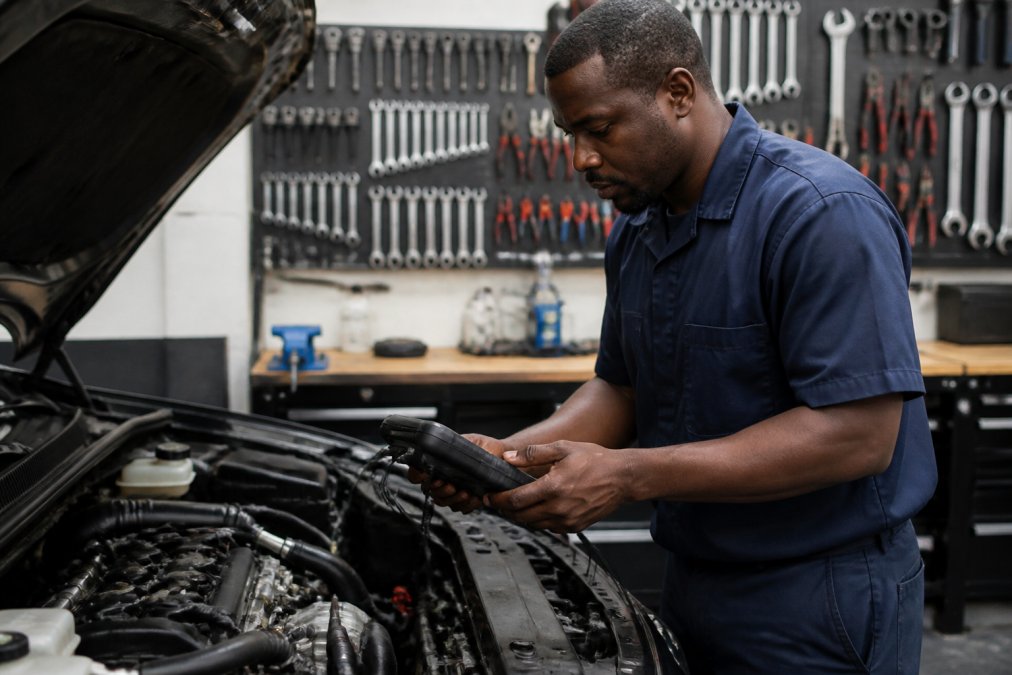
Real customers describe the experience this way: “Great service with a family feel!” and “Honest and definitely recommend to all my friends and family.” Another regular customer notes, “They always help with all the cars that I bring. The customer service is great.”
The shop handles cars, SUVs, and light trucks across domestic and import makes, with a particular depth of expertise in Cadillac and GM vehicles. If you’re driving a 2015 Cadillac with transmission concerns or any other GM platform, this is a shop with the diagnostic tools and training to handle it properly.
Pro Tip
Before authorizing any repair, ask the technician to show you the diagnostic code and walk through what it means. A shop that communicates clearly before the work starts is one you can trust with the bill at the end.
Before authorizing any repair, ask the technician to show you the diagnostic code and walk through what it means. A shop that communicates clearly before the work starts is one you can trust with the bill at the end.
Emissions Testing, Tire Services, and Same-Day Turnaround
TIPS Automotive performs emissions testing for 1996 and newer vehicles, with wait times that typically run 10 minutes or less. For commuters who need to pass a state emissions inspection before renewing their registration, that turnaround time is a real practical advantage.
Tire services and wheel alignment are also part of the full-service offering. Worn tires and misaligned wheels are among the most common causes of premature tire wear and poor fuel economy, so having both services available at the same location simplifies vehicle maintenance significantly.
Same-day service is available for many repairs, which matters for professionals and parents who can’t afford to leave a vehicle in the shop for days. The shop’s flexible scheduling is built around the reality that most drivers have jobs, kids, and commitments that don’t pause for car repairs.
Free Pickup and Drop-Off Within 10 Miles
TIPS Automotive offers free vehicle pickup and drop-off within a 10-mile radius. If you’re 8 miles away and worried there’s a catch, there isn’t one. The service exists because the shop understands that getting your car to a mechanic is often the logistical barrier that delays necessary maintenance.
This feature is genuinely rare among independent shops in the area. Most competitors expect you to arrange your own transportation once you drop the car off. TIPS Automotive removes that friction entirely for drivers within the service zone.
Certified GM Mechanics in West Atlanta: What to Look For
Certified GM mechanics are not the same as general mechanics who’ve worked on a few Chevrolets. GM vehicles, particularly Cadillac models, use proprietary diagnostic systems, specific torque specifications, and software that requires specialized training to interpret correctly.
When evaluating certified GM mechanics in West Atlanta, look for technicians with factory-level training or documented experience with GM diagnostic platforms. The difference between a correct transmission diagnosis on a Cadillac and a misdiagnosis often comes down to whether the technician has the right scanner and knows how to read the data it produces.
Watch Out
A shop that claims to specialize in GM vehicles but doesn’t have access to GM-specific diagnostic equipment is a red flag. Generic OBD-II scanners miss manufacturer-specific fault codes that are critical for accurate diagnosis on late-model GM platforms.
A shop that claims to specialize in GM vehicles but doesn’t have access to GM-specific diagnostic equipment is a red flag. Generic OBD-II scanners miss manufacturer-specific fault codes that are critical for accurate diagnosis on late-model GM platforms.
TIPS Automotive’s specialization in Cadillac and GM vehicles means the diagnostic process starts with the right tools. For owners of these vehicles, that specificity translates to fewer misdiagnoses, more accurate repair estimates, and better long-term outcomes.
Auto Repair Diagnostic Costs: What You Should Expect to Pay
Auto repair diagnostic costs vary based on the complexity of the issue, the equipment required, and the shop’s labor rates. Many shops charge a diagnostic fee that covers the time a technician spends connecting equipment, interpreting codes, and identifying the root cause of a problem.
For a standard check engine light diagnostic, many independent shops charge a flat fee that is applied toward the repair cost if you proceed with the work. More complex electrical system diagnostics or transmission service evaluations typically take longer and cost more because they require deeper inspection.
According to the Consumer Financial Protection Bureau’s guide on auto repair costs, consumers should always request a written repair estimate before authorizing work. The final bill should not exceed the estimate without explicit approval from the vehicle owner.
A few things to know before you bring your vehicle in:
- Basic diagnostic scan: Covers reading fault codes and initial assessment
- Advanced diagnostics: Required for intermittent electrical faults, complex sensor failures, or transmission concerns
- Emissions test: Typically a separate, lower-cost service with a defined state fee structure
For current diagnostic pricing, contact TIPS Automotive directly. Pricing depends on the vehicle, the system being evaluated, and the time required, so a phone call or online inquiry will give you an accurate number before you commit.
Independent vs Dealership Auto Repair: Which Saves You More?
Independent shops generally offer lower labor rates than dealerships. That’s not a generalization; it’s a structural reality. Dealerships carry higher overhead costs, manufacturer franchise fees, and service department quotas that independent shops don’t have.
The common assumption is that dealerships offer better quality because of factory-trained technicians and OEM parts. That assumption deserves scrutiny. Many independent shops employ technicians with equivalent or superior training, and quality aftermarket parts often meet or exceed OEM specifications for routine repairs.
Where dealerships have a genuine advantage: warranty work covered under a manufacturer’s warranty must be performed at an authorized dealer to preserve coverage. For vehicles still under factory warranty, that’s a real constraint. For vehicles outside warranty, the independent shop is almost always the better value.
The Federal Trade Commission’s guidance on auto repairs confirms that consumers are not required to use a dealership for routine maintenance to maintain their vehicle warranty under the Magnuson-Moss Warranty Act. Independent shops can perform oil changes, brake service, and other maintenance without voiding your coverage, as long as they use parts that meet manufacturer specifications and document the work.
For owners of GM vehicles specifically, an independent shop with certified GM mechanics in West Atlanta provides dealership-level diagnostic capability at independent shop pricing. That’s the practical sweet spot for most drivers.
Transparent Pricing Guide: Questions to Ask Before Authorizing Repairs
Transparent pricing is not just about getting a low number. It’s about understanding what you’re paying for, why it’s necessary, and what happens if you defer it.
Before authorizing any repair, ask these questions:
- What is the diagnostic finding, and what does it mean for my vehicle’s operation? A shop that can’t explain this in plain language is a shop that doesn’t respect your ability to make an informed decision.
- Is this repair urgent, or can it wait? Honest shops distinguish between safety-critical repairs and maintenance items that can be scheduled.
- What parts will you use, and are they OEM, OEM-equivalent, or aftermarket? Each has trade-offs on cost and longevity.
- What is the labor rate, and how many hours is this job estimated to take? Labor rates vary significantly between shops.
- Does this repair come with a parts and labor guarantee? Any reputable automotive repair facility should stand behind its work.
- Will you provide a written estimate before starting? This protects you legally and establishes a clear agreement.
Key Takeaway
The single most reliable indicator of a trustworthy shop is willingness to explain every line item on the estimate in plain language. If a shop deflects or rushes you through the authorization, that’s your signal to walk away.
The single most reliable indicator of a trustworthy shop is willingness to explain every line item on the estimate in plain language. If a shop deflects or rushes you through the authorization, that’s your signal to walk away.
For reference on fair market pricing in your area, tools like RepairPal’s Fair Price Estimator give you a baseline range for common services based on your vehicle and zip code. Use it as a reference point, not an absolute, since local labor rates and parts sourcing affect the final number.
DIY vs. Professional Repair: When to Call a Shop
Some repairs are genuinely within reach for a mechanically inclined car owner. Others look approachable on a YouTube video and turn into a four-hour disaster that still requires a shop visit.
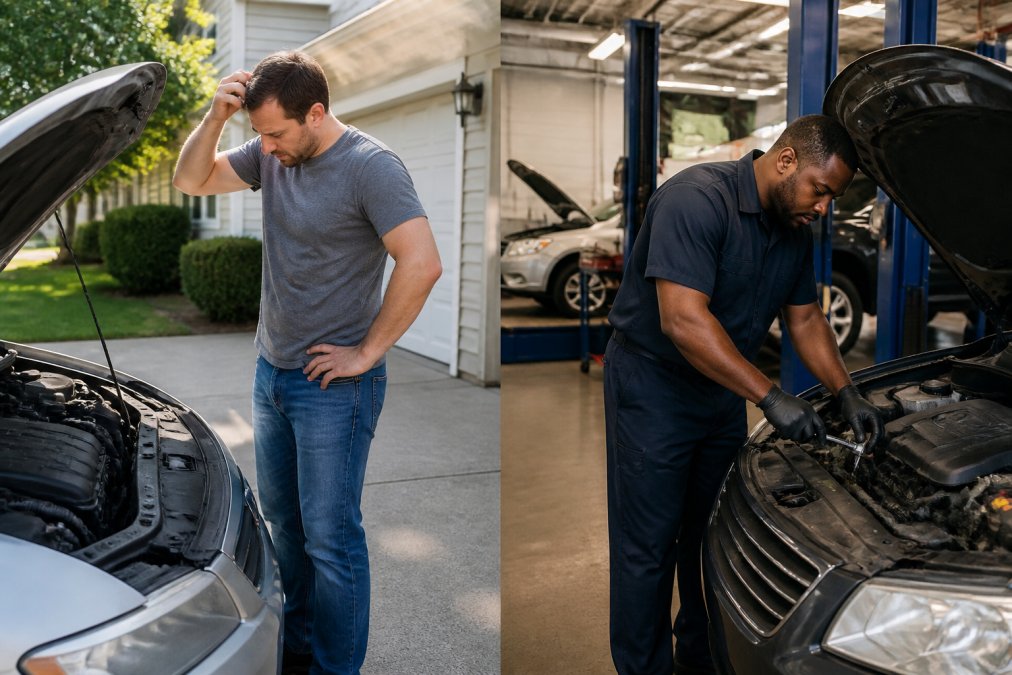
DIY is reasonable for:
- Replacing wiper blades
- Swapping cabin air filters
- Checking and topping off fluids
- Replacing a battery (on most vehicles)
- Basic bulb replacements on older vehicles
Call a shop for:
- Any repair involving brake hydraulics
- Suspension and steering components
- Transmission service or diagnosis
- Electrical system diagnostics and wiring repairs
- Engine diagnostics with fault codes
- Wheel alignment (requires calibrated equipment)
- Emissions testing (requires certified equipment and state authorization)
The real dividing line is whether a mistake creates a safety risk. Brake repair done incorrectly can cause brake failure. Suspension work done incorrectly affects vehicle control. For anything in that category, the cost of professional repair is the cost of not gambling with your safety.
A common mistake is underestimating how quickly a DIY repair escalates. What looks like a simple sensor swap often involves removing components with torque specifications, corrosion, or access challenges that require shop equipment to address properly.
Vehicle-Specific Maintenance Checklist for Local Drivers
Factory scheduled maintenance is not optional. It’s the difference between a vehicle that runs reliably for 200,000 miles and one that develops expensive problems at 80,000. The checklist below reflects standard intervals; always verify against your owner’s manual for your specific make and model.
| Service | Typical Interval | Priority |
|---|---|---|
| Oil and filter change | Every 5,000-7,500 miles (synthetic) | Critical |
| Tire rotation | Every 5,000-7,500 miles | High |
| Brake inspection | Every 12,000 miles or annually | High |
| Wheel alignment | Every 12,000 miles or after impact | Medium |
| Air filter replacement | Every 15,000-30,000 miles | Medium |
| Transmission fluid service | Every 30,000-60,000 miles (varies) | High |
| Cooling system flush | Every 30,000-50,000 miles | Medium |
| Spark plug replacement | Every 30,000-100,000 miles (varies by type) | Medium |
| Emissions inspection | Per state registration schedule | Required |
| Suspension inspection | Every 50,000 miles or if handling changes | High |
For GM and Cadillac owners, factory maintenance schedules include additional items specific to those platforms. The GM Oil Life Monitoring System tracks driving conditions and alerts you when an oil change is actually needed, rather than relying on a fixed mileage interval. This is a legitimate system, not a reason to skip service.
Local driving conditions, including stop-and-go traffic and summer heat, accelerate wear on cooling systems, brakes, and tires faster than highway driving. Adjust your inspection intervals accordingly.
Which Shop Is Right for Your Situation?
The right auto repair shop depends on three factors: what you drive, what you need done, and how much friction you can tolerate in the process.
If you drive a Cadillac or any GM vehicle and want certified GM mechanics in West Atlanta with the diagnostic tools to match, TIPS Automotive is the clear answer. The combination of specialized GM expertise, same-day service, and free pickup and drop-off within 10 miles addresses the three most common objections drivers have about getting their car serviced.
If you’re a commuter who needs a quick emissions test without taking half a day off work, TIPS Automotive’s 10-minute wait time for emissions testing on 1996 and newer vehicles makes that a non-issue.
If you’re a single parent or working professional who can’t be without a vehicle, same-day service and free pickup and drop-off change the math entirely. You don’t have to choose between getting your car fixed and getting to work.
For drivers who’ve been burned by shops that oversell repairs, the transparent approach at TIPS Automotive, where technicians explain findings in plain language before any work is authorized, directly addresses that concern. The customer feedback reflects this: people come back, and they send their families.
The bottom line: affordable auto repair in West Atlanta doesn’t mean finding the cheapest shop on the street. It means finding a shop that does the job right the first time, charges a fair rate, and treats you like a person rather than a transaction.
Getting your vehicle serviced shouldn’t require a leap of faith. TIPS Automotive brings together certified technicians, modern diagnostic technology, and a genuine commitment to honest communication before, during, and after every repair. Whether you need a routine oil change, a check engine light diagnosis, emissions testing, or specialized GM vehicle care, the shop handles it all with same-day availability and free pickup and drop-off within 10 miles. Call now and schedule your service with TIPS Automotive.
Frequently Asked Questions
Are independent auto repair shops cheaper than dealerships?
Independent shops typically charge lower labor rates than dealerships and have more flexibility on parts sourcing, which can reduce your total bill. Dealerships use OEM parts and factory-trained technicians, which adds cost. For most routine maintenance and common repairs, a certified independent shop delivers the same quality at a lower price. The key is confirming the shop’s technicians hold current ASE certifications and that the shop provides a written warranty on parts and labor.
How do I know if an auto repair shop is trustworthy before I hand over my keys?
Look for shops with ASE-certified technicians, written repair estimates before any work begins, and a clear warranty policy on parts and labor. Customer reviews on Google and other platforms reveal patterns over time. A trustworthy shop will explain in plain language what is wrong, why it needs fixing, and what happens if you wait. Shops that pressure you into same-day decisions on expensive repairs without showing you the problem firsthand are a red flag.
How much does an auto repair diagnostic typically cost?
Diagnostic fees vary by shop and the complexity of the issue. A basic OBD-II scan to read check engine light codes is often less expensive than a full electrical system or transmission diagnostic, which requires more time and specialized equipment. Some shops apply the diagnostic fee toward the repair cost if you proceed with the work. Always ask upfront whether the diagnostic fee is separate or credited. Contact the shop directly for current pricing rather than relying on general estimates.
What questions should I ask before authorizing car repairs?
Ask for a written estimate that itemizes parts and labor separately. Confirm whether the shop uses OEM or aftermarket parts and what warranty covers each. Ask how long the repair will take and whether a loaner or pickup service is available. Request a clear explanation of why the repair is necessary now versus something that can wait. If a shop cannot answer these questions clearly and confidently, that tells you something important about how they operate.
Do independent repair shops offer warranties on their work?
Many independent shops offer warranties on parts and labor, though the terms vary. Some offer 12-month or 12,000-mile coverage; others provide longer guarantees depending on the repair type. Always ask for the warranty terms in writing before authorizing work. A shop that stands behind its repairs will have no hesitation putting those terms on paper. Warranty coverage is one of the clearest signals that a shop is confident in the quality of its technicians and the parts it installs.


Comments are closed