

Subtotal $0.00


Table of Contents
- How Car Suspension Systems Work
- Signs of Bad Struts and Shocks You Should Not Ignore
- Car Suspension Repair Cost: What Drives the Price
- Suspension Repair Timeline: How Long Will Your Car Be in the Shop?
- Wheel Alignment Services After Suspension Work
- DIY vs. Professional Suspension Repair: Risk Assessment
- Suspension Upgrades for Performance and Towing
- Electronic and Air Suspension Systems: What Owners Should Know
- Frequently Asked Questions
Last Updated: September 29, 2026
How Car Suspension Systems Work
Suspension repair starts with understanding what you’re actually repairing. A car’s suspension is the system of springs, shocks, struts, and linkages that connects the vehicle body to the wheels, absorbing road input so the chassis stays stable and the tires stay planted. At TIPS Automotive, we explain it to customers this way: the suspension is the translator between the road and the driver.
The system does three jobs at once. It supports the vehicle’s weight, it controls how the body moves over bumps, and it keeps the tires in contact with the pavement. When any of those jobs slips, you feel it in the steering wheel before you ever see it in a repair bill.
Key Components That Wear Out
Every suspension part is a load-bearing component, and every one of them has a service life.
- Shock absorbers and struts: control bounce and dampening after the springs compress
- Coil springs: carry the vehicle’s weight and set ride height
- Ball joints and tie rods: pivot points that connect the steering and suspension
- Control arms and bushings: locate the wheels and absorb vibration
- Sway bar links: reduce body roll in turns
A common mistake is replacing one worn part and ignoring its neighbors. A new strut assembly bolted to a shot control arm bushing won’t restore ride quality for long.
Signs of Bad Struts and Shocks You Should Not Ignore
The clearest signs of bad struts and shocks are a bouncy ride, nose-dive when braking, and uneven tire wear. Most drivers notice the noise first and the handling second, which is exactly backwards, because handling problems are the ones that affect safety.
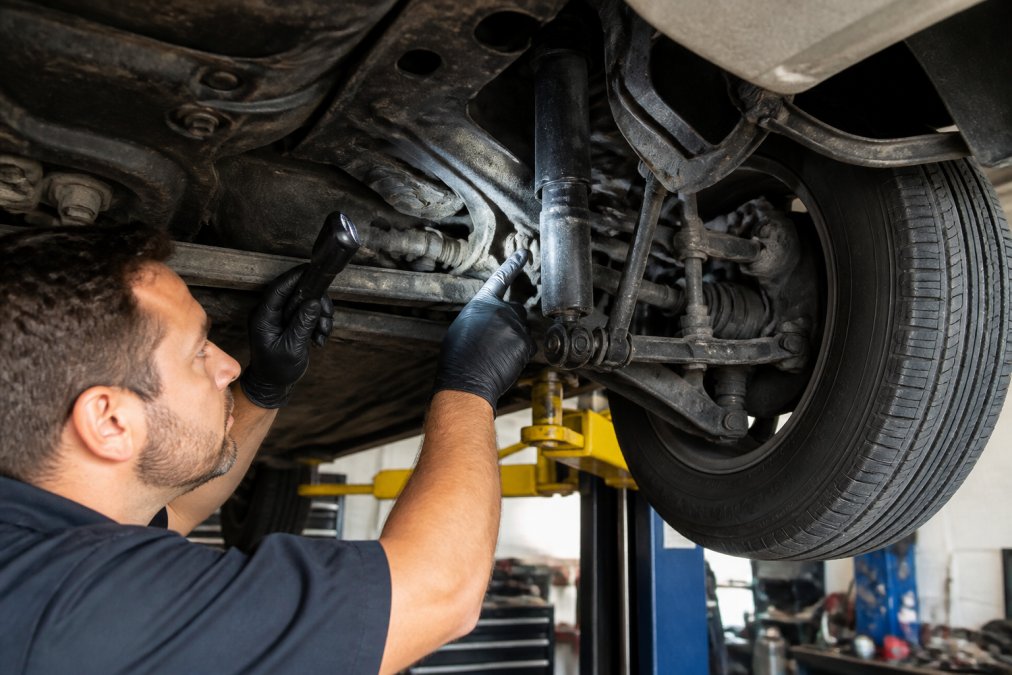
Pay attention to these warning signs:
- The vehicle keeps bouncing after you push down on a corner
- You feel every expansion joint through the seat
- The car bottoms out on driveways or speed bumps
- Steering feels vague or wanders at highway speed
- Tires show cupping or scalloped edges
Suspension Noise, Bouncing, and Tire Wear Patterns
Clunking sounds over bumps usually point to worn sway bar links or ball joints. A single loud clunk when turning can mean a tie rod end is loose. Bouncing that won’t settle suggests the shocks have lost their dampening ability, often because of hydraulic fluid leaks around the seal.
Tire wear patterns tell the story before a technician touches the car. Cupped tread means the tire is skipping across the road because the shock can’t hold it down. Uneven inner-edge wear points to alignment or worn control arm bushings. If your tires are wearing in a pattern you can’t explain, get a suspension inspection before you replace them, or you’ll be buying tires twice.
Watch Out
Driving on worn shocks increases stopping distance and lets the front end dive under hard braking. If you feel the nose drop sharply in an emergency stop, get the suspension checked before your next long drive.
Driving on worn shocks increases stopping distance and lets the front end dive under hard braking. If you feel the nose drop sharply in an emergency stop, get the suspension checked before your next long drive.
Car Suspension Repair Cost: What Drives the Price
Car suspension repair cost depends on which components have failed, the vehicle’s design, and whether the parts are OEM specifications or aftermarket. There is no single number, and any shop that quotes one over the phone without inspecting the car is guessing. What a useful estimate does instead is break the job into parts and labor, because those two lines move independently.
Pricing depends on your specific vehicle and the parts it needs, so call us or visit our website for a current quote rather than relying on a generic online figure.
| Component | Typical Parts Range (per unit) | Typical Labor | Notes |
|---|---|---|---|
| Sway bar link | $15-$60 | 1-2 hours | Often replaced in pairs |
| Shock absorber (each) | $50-$150 | 1-2 hours | Rear shocks are usually faster |
| Strut assembly (each) | $150-$400 | 2-3 hours | Loaded assemblies cost more, save labor |
| Coil spring (each) | $60-$150 | 2-4 hours | Spring compression drives labor |
| Ball joint (each) | $40-$150 | 2-4 hours | Pressed-in joints take longer |
| Control arm (each) | $80-$300 | 2-4 hours | Often sold with bushings installed |
| Tie rod end (each) | $30-$100 | 1-2 hours | Alignment required afterward |
| Wheel alignment | , | 1 hour | Add $100-$200 to most jobs |
What moves the price up or down:
- Component count: a single sway bar link is a small job; a full strut assembly replacement on all four corners is not
- Vehicle type: trucks and SUVs use heavier load-bearing parts that cost more, and some European models require specialty tools
- Corrosion: rusted fasteners add labor time on older vehicles, sometimes doubling the book time on a control arm job
- Alignment: nearly every suspension repair requires a wheel alignment afterward, so budget for it up front
- Parts choice: OEM parts cost more than aftermarket but often last longer; quick-strut assemblies trade a higher parts price for lower labor
- Pairs vs. singles: replacing shocks or struts in pairs is standard practice, so a “one corner” quote often becomes a two-corner job
A few cost traps worth knowing. First, a cheap quote that skips the alignment isn’t cheaper, it just moves the cost to your tires. Second, replacing one worn component while ignoring its neighbors usually means paying labor twice within a year. Third, a lowball estimate that doesn’t itemize parts and labor is a number, not an estimate.
At TIPS Automotive, we walk you through the estimate line by line so you understand what you’re paying for and why. Pricing depends on your specific vehicle and the parts it needs, so call us or visit our website for a current quote rather than relying on a generic online figure.
Pro Tip
Ask for the estimate split into parts and labor. When you can see both lines, you can compare shops fairly and decide where it makes sense to upgrade to a longer-lasting part.
Ask for the estimate split into parts and labor. When you can see both lines, you can compare shops fairly and decide where it makes sense to upgrade to a longer-lasting part.
Suspension Repair Timeline: How Long Will Your Car Be in the Shop?
A suspension repair timeline ranges from a couple of hours for a single component to a full day for a complete strut and shock replacement with alignment. The job itself is rarely the slow part. Waiting on parts is.
Here’s a realistic breakdown:
| Job Type | Typical Shop Time | What Adds Time |
|---|---|---|
| Single sway bar link | 1-2 hours | Rusted fasteners |
| One strut assembly | 2-3 hours | Spring compression, alignment |
| Front struts and shocks (pair) | 3-4 hours | Alignment afterward |
| Full four-corner replacement | 5-7 hours | Parts availability |
| Ball joints or control arms | 3-5 hours | Corrosion, alignment |
If you work long hours and can’t be without your car, ask about same-day service and scheduling when you book.
Wheel Alignment Services After Suspension Work
Wheel alignment services are not optional after suspension repair. Any time you replace a component that sets suspension geometry, the alignment changes, and driving on a misaligned car wears your new tires unevenly. That’s why a responsible shop treats the alignment as part of the repair, not an upsell tacked onto the invoice.
Alignment restores three settings, and each one has a distinct job:
- Camber is the vertical tilt of the wheel when viewed from the front. Too much negative camber wears the inside edge of the tire; too much positive camber wears the outside edge.
- Caster is the forward or rearward tilt of the steering axis. It’s what makes the steering self-center after a turn. Too little caster and the car wanders; uneven caster side-to-side and the car pulls.
- Toe is whether the wheels point straight ahead or slightly in or out. Toe is the fastest tire killer of the three, a small toe error scrubs tread across the whole width of the tire.
Manufacturers publish a target range for each setting, and those ranges vary by vehicle. A truck and a compact sedan do not share alignment specs, which is why a shop that keeps a single “close enough” number for every car isn’t really doing an alignment.
What to Expect at the Alignment Rack
A proper alignment starts before the sensors go on. The technician should check tire pressure and tread condition, inspect the tie rods, ball joints, and control arm bushings for play, and confirm nothing is bent. Aligning a car with a worn tie rod end is wasted money, the new setting won’t hold. This is also why alignment and suspension repair belong in the same visit: the shop can replace the worn part and set the geometry in one trip.
Once the car is on the rack, the readings are compared against the factory spec, and the technician adjusts tie rods, camber plates, or shims as needed. The whole process usually takes about an hour.
A few things to know:
- Schedule the alignment immediately after suspension work, not weeks later
- Ask for a before-and-after printout of the alignment readings
- A pull to one side after repair usually means the alignment wasn’t reset, or a component is still worn
- A crooked steering wheel after an alignment is a toe adjustment issue, not a new problem
- New tires deserve an alignment too, mounting them on a misaligned car shortens their life
The NHTSA guidance on tire safety and wear makes the connection between alignment, tire condition, and vehicle stability clear: worn or misaligned components compromise how your vehicle handles in an emergency.
Pro Tip
Ask for the alignment printout every time. A shop that shows you the before-and-after numbers is a shop that has nothing to hide, and you’ll have a record if a problem shows up later.
Ask for the alignment printout every time. A shop that shows you the before-and-after numbers is a shop that has nothing to hide, and you’ll have a record if a problem shows up later.
Watch Out
If your car pulls, wanders, or shows uneven tire wear after a suspension repair, don’t wait for the next oil change. Driving on a bad alignment can scrub a new set of tires in a few thousand miles.
If your car pulls, wanders, or shows uneven tire wear after a suspension repair, don’t wait for the next oil change. Driving on a bad alignment can scrub a new set of tires in a few thousand miles.
DIY vs. Professional Suspension Repair: Risk Assessment
DIY suspension repair is genuinely risky for most owners, and the risk isn’t the wrench work. It’s the spring. Coil springs store enormous energy, and a compressed spring that releases unexpectedly can cause serious injury. This is the single biggest reason suspension work sits in a different category from an oil change.
Here’s an honest risk assessment:
| Factor | DIY | Professional |
|---|---|---|
| Spring compression safety | High risk without a wall-mounted compressor | Handled with proper equipment |
| Diagnostic accuracy | Guesswork without a scan tool | Digital diagnostic testing |
| Alignment afterward | Not possible at home | Included or scheduled same day |
| Warranty on parts and labor | None | Backed by the shop |
| Time investment | A full weekend or more | A few hours |
Some jobs are reasonable for a confident home mechanic: sway bar links, stabilizer bushings, and simple shock replacements on older vehicles. Struts, springs, and anything requiring an alignment belong in a shop with a lift and the right tools. If you’re unsure which category your repair falls into, that uncertainty is your answer.
Suspension Upgrades for Performance and Towing
Suspension upgrades make sense when you tow, haul, or drive a truck or SUV that works harder than the factory setup anticipated. Upgrading isn’t about making the ride stiffer for its own sake. It’s about matching the suspension to the load.
For towing and hauling, owners commonly add:
- Heavy-duty shocks: better dampening under load
- Helper springs or air bags: reduce sag when the trailer is hitched
- Upgraded sway bar links: control body roll with weight in the bed
- Load-rated tires: handle the extra weight and heat
For performance driving, the priorities shift toward lower ride height, firmer dampening, and stiffer bushings. The trade-off is real: a firmer setup improves steering responsiveness but makes the daily commute less comfortable. Decide which matters more before you spend.
One thing most guides miss: an upgrade on a worn-out suspension is wasted money. Replace the tired components first, then upgrade. Otherwise you’re bolting good parts onto a bad foundation.
Electronic and Air Suspension Systems: What Owners Should Know
Electronic suspension control and air suspension systems add a layer of complexity that changes both diagnosis and repair. Instead of fixed shocks, these systems use sensors and a control module to adjust dampening and ride height in real time. When they work, they’re excellent. When they fail, the repair is rarely simple.
What owners should understand:
- A warning light or “service suspension” message usually means a sensor or module fault, not a blown shock
- Air suspension uses a compressor and air springs, and compressor failure is a common weak point
- Ride height that drops overnight points to a leaking air spring or a failing compressor
- These systems require diagnostic testing before parts replacement, not guesswork
This is where digital diagnostic technology earns its keep. The SAE International standards for automotive diagnostics underpin the diagnostic protocols modern shops rely on to pinpoint electronic faults accurately.
Key Takeaway
On electronic and air suspension, diagnosis comes before parts every time. Replacing a compressor when the real fault is a leaking air spring just buys you the same failure twice.
On electronic and air suspension, diagnosis comes before parts every time. Replacing a compressor when the real fault is a leaking air spring just buys you the same failure twice.
Suspension problems rarely fix themselves, and the longer you drive on worn components, the more you spend on tires and related repairs. At TIPS Automotive, our certified technicians diagnose the actual failure with digital tools, explain it in plain English, and handle everything from a single sway bar link to a full strut and shock replacement with alignment. We offer same-day service and free pickup and drop-off within our service radius, so a suspension repair doesn’t have to wreck your week. Call now and schedule your service, and let us get your car riding like it should.
Frequently Asked Questions
How much does suspension repair cost?
Car suspension repair cost depends on which components failed and your vehicle type. Replacing worn shocks or struts costs less than rebuilding control arms, ball joints, and tie rods together. Luxury and electronic suspension systems run higher because parts are more specialized. At TIPS Automotive, we inspect first and explain exactly what needs replacing, so you never pay for unnecessary work. Call for a quote based on your specific vehicle.
Can I drive if my suspension is bad?
You can often drive short distances, but it is not safe. Worn struts, shocks, or ball joints reduce vehicle stability, extend stopping distance, and cause uneven tire wear. A failed ball joint or tie rod can cause sudden loss of steering control. If you notice clunking sounds, excessive bouncing, or the car pulling to one side, schedule an inspection right away rather than waiting.
How long does a typical suspension repair take?
The suspension repair timeline varies by job. Replacing a pair of shocks or struts usually takes a few hours. More involved work, like control arms, ball joints, and tie rods, can take a full day. Once repairs are done, wheel alignment services add about an hour. At TIPS Automotive, many suspension jobs are completed same-day so you are not without your car for long.
What are the common signs that my car needs suspension repair?
Watch for bouncing after bumps, clunking or knocking sounds, uneven or cupped tire wear, the car pulling to one side, and a steering wheel that feels loose. Visible fluid leaks on shocks or struts and a sagging corner also point to worn parts. If you notice any of these signs of bad struts and shocks, get a diagnostic inspection before the problem spreads to other load-bearing components.


Comments are closed