

Subtotal $0.00

Table of Contents
- Step 1: Locate Your OBD-II Port and Connect a Scanner
- Step 2: Understanding Diagnostic Trouble Codes (DTCs)
- Step 3: The Best OBD-II Scanner Tools for Accurate Reports
- Step 4: How to Interpret OBD-II Live Data and Freeze Frame Data
- Step 5: Pending vs. Stored vs. Permanent Codes
- Step 6: When to See a Professional Mechanic for Engine Codes
- Step 7: Post-Repair Code Clearing and Drive Cycles
- Conclusion: Making Sense of Your Diagnostic Reports
- Frequently Asked Questions
Last Updated: September 17, 2026
Step 1: Locate Your OBD-II Port and Connect a Scanner
Learning how to read car diagnostic reports starts with finding the port that feeds them data. Every vehicle sold in the United States since 1996 has an OBD-II port, a standardized 16-pin connector that links your car’s computers to a scan tool. It is usually within arm’s reach of the driver’s seat, and once you know where to look, connecting a scanner takes under a minute.
Common locations include:
- Under the dashboard on the driver’s side, near the steering column
- Behind a small flip-down panel below the dashboard
- Near the center console or under the ashtray
- In some trucks and SUVs, under the passenger-side dash
If you cannot find it, your owner’s manual will point you to it. The connector is trapezoid-shaped, so the plug only fits one way. Push it in firmly until it clicks.
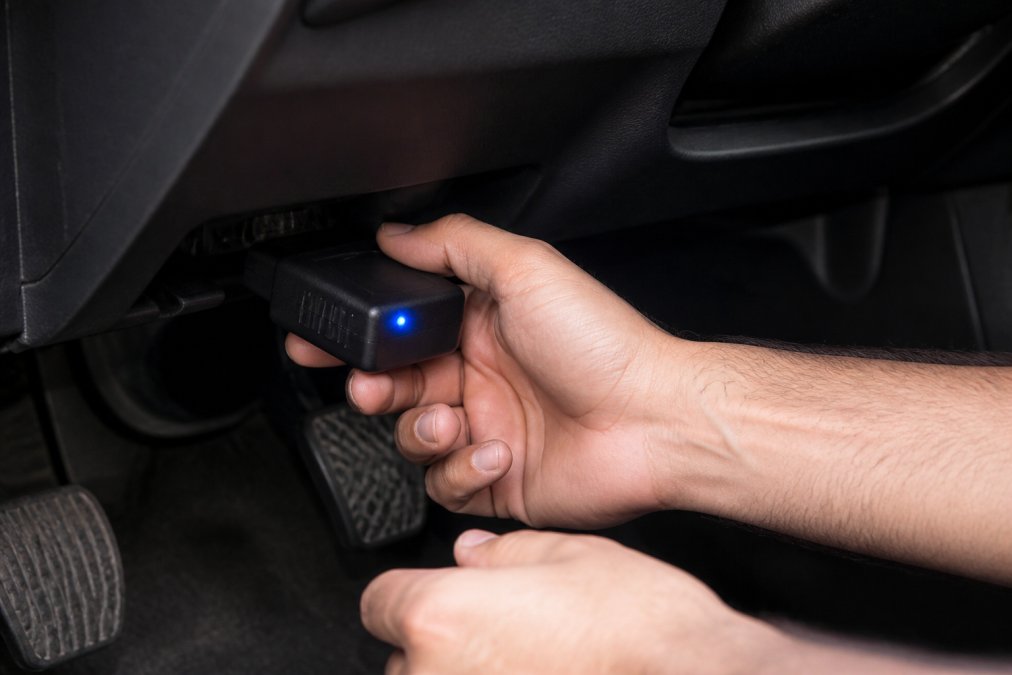
Once connected, turn the ignition to the “on” position without starting the engine. The scanner powers up and begins communicating with the engine control module, or ECM. If it shows a connection error, check that the plug is fully seated and the ignition is on.
Pro Tip
A common mistake is scanning with the engine running. For most code reads, key-on-engine-off gives cleaner results because the ECM is not busy adjusting fuel trim in real time.
A common mistake is scanning with the engine running. For most code reads, key-on-engine-off gives cleaner results because the ECM is not busy adjusting fuel trim in real time.
Step 2: Understanding Diagnostic Trouble Codes (DTCs)
A diagnostic trouble code is a standardized identifier the ECM stores when it detects an out-of-range signal or a failed self-test. The code tells you which system misbehaved and roughly what kind of fault occurred. It does not tell you which part to replace, and that distinction matters more than most people realize.
When you scan, the tool displays codes like P0301 or P0420. Each one points to a specific circuit or system, but the same code can have several possible causes. A P0301 means a misfire on cylinder one, yet the root cause could be a worn spark plug, a failing ignition coil, a vacuum leak, or a fuel delivery problem.
That is why a code reader alone is not a repair plan. It is a starting point.
How DTCs Are Structured: P, B, C, and U Codes
The first character of every code identifies the system family:
- P codes cover the powertrain: engine, transmission, and emissions
- B codes cover the body: airbags, seat belts, and interior electronics
- C codes cover the chassis: brakes, steering, and suspension
- U codes cover network communication between modules
The second character tells you whether the code is generic, meaning it applies to all manufacturers, or manufacturer-specific. The remaining digits narrow down the exact circuit or component. Understanding this structure helps you sort urgent problems from minor ones before you spend a dime.
Step 3: The Best OBD-II Scanner Tools for Accurate Reports
Scanner choice shapes how much you can actually read from a diagnostic report. Basic code readers show the code number and a short description. Mid-range OBD-II scanner tools add live data, freeze frame data, and the ability to clear codes. Professional-grade scan tools go further, reading manufacturer-specific codes across every module in the vehicle.
For most owners, three tiers make sense:
| Tier | What It Reads | Best For | Typical Use |
|---|---|---|---|
| Basic code reader | Stored P codes only | Quick check before a shop visit | Confirming the check engine light cause |
| Mid-range scanner | P, B, C, U codes plus live data | DIYers tracking their own maintenance | Monitoring sensor data over time |
| Professional scan tool | All modules, manufacturer codes, bidirectional tests | Shops and serious enthusiasts | Full system diagnostics |
A common mistake is buying the cheapest reader and assuming it will answer every question. It will not. If your goal is to understand why a warning light is on and whether it is safe to keep driving, a mid-range scanner pays for itself the first time it saves you a diagnostic fee.
Mobile App Integration and Bluetooth Dongles
Mobile app integration has changed how people read diagnostic reports, and it is the fastest-growing segment of the DIY market. A Bluetooth dongle plugs into the OBD-II port and streams data to a phone app, turning your phone into a functional scan tool. Dongles typically use one of two wireless standards, Bluetooth Classic or Bluetooth Low Energy (BLE), and the choice affects how reliably the connection holds during a long drive cycle.
Pairing is straightforward but has a few failure points worth knowing:
- Adapter quality varies widely. Inexpensive dongles sometimes use older ELM327 chipsets that drop connection mid-scan or refuse to talk to certain vehicle protocols. A dongle that supports all five OBD-II protocols (ISO 9141, KWP2000, SAE J1850 PWM, SAE J1850 VPW, and ISO 15765 CAN) is the safer buy.
- Phone OS matters. iOS and Android handle Bluetooth permissions differently, and some apps are platform-exclusive. Check compatibility before buying a dongle.
- Ignition state matters. Most dongles only power up when the ignition is on. If the app shows “no adapter found,” confirm the key is in the run position and the dongle LED is lit.
Apps range from free code readers to subscription platforms that decode manufacturer-specific faults. The trade-off is real. App-based tools are convenient and inexpensive to start, but the best features, bidirectional controls, manufacturer-specific code libraries, and multi-module scans, often sit behind a monthly or annual subscription. Connection stability also varies by phone, adapter, and even ambient temperature.
What a phone app can read well:
- Stored, pending, and permanent P codes
- Live data streams (RPM, coolant temp, fuel trim, O2 sensor voltage, throttle position)
- Freeze frame snapshots
- Basic emissions readiness monitors
What a phone app usually cannot do:
- Read body, chassis, or network codes on most vehicles without a paid upgrade
- Perform bidirectional tests (like commanding a fuel pump or ABS bleed)
- Access manufacturer-specific modules such as airbag, transmission, or TPMS on many models
A dedicated handheld scanner is more reliable in a driveway, especially in cold weather or bright sun where phone screens struggle. For anyone who wants to understand their vehicle without becoming a mechanic, a Bluetooth dongle plus a solid app is a reasonable starting point, just understand its ceiling before you rely on it for a safety-critical diagnosis.
Step 4: How to Interpret OBD-II Live Data and Freeze Frame Data
Live data and freeze frame data are where diagnostic reports become genuinely useful. Live data shows real-time sensor readings while the engine runs: coolant temperature, oxygen sensor voltage, fuel trim, throttle position, and engine RPM. Freeze frame data is a snapshot the ECM saves at the exact moment a fault triggers, capturing the conditions under which the problem occurred.
Reading live data well takes practice. Two numbers matter most for beginners:
- Short-term and long-term fuel trim: values drifting far from zero suggest a vacuum leak or a fueling issue
- Oxygen sensor voltage: a sensor that stays flat instead of cycling usually points to a lazy or failed sensor
Freeze frame data answers a different question. If a misfire code only triggers at highway speed and light throttle, that narrows the diagnosis considerably. A shop that reads freeze frame data before touching the car saves you money on guesswork.
Watch Out
Do not clear codes before writing down freeze frame data. Once cleared, that snapshot is gone, and you lose the single best clue about when the fault occurred.
Do not clear codes before writing down freeze frame data. Once cleared, that snapshot is gone, and you lose the single best clue about when the fault occurred.
Step 5: Pending vs. Stored vs. Permanent Codes
The three code states confuse more people than any other part of a diagnostic report. A pending code means the ECM saw a fault once but has not confirmed it across a full drive cycle. A stored code means the fault repeated and the ECM turned on the malfunction indicator lamp, often called the check engine light or MIL. A permanent code is written into non-volatile memory and cannot be cleared with a scan tool.
That last category matters for emissions testing. Permanent codes clear themselves only after the vehicle passes a series of self-tests across multiple drive cycles. In most states, an emissions test will not pass while a permanent code is still stored, even if the light is off. Per EPA guidance on OBD-II emissions testing, vehicles from model year 1996 onward rely on this self-testing system to confirm emissions readiness.
Pending codes deserve attention too. They are early warnings. If you see a pending misfire code and ignore it, you will likely see a stored code within a week.
How to Prioritize Repairs by Code Severity
Most guides stop at defining the three states. The more useful skill is knowing which codes demand immediate action and which can wait for a scheduled appointment. Severity comes down to three signals: the light behavior, the code family, and whether the fault affects drivability or emissions.
Tier 1, Stop driving. A flashing MIL is the clearest red flag. It means an active misfire is dumping unburned fuel into the catalytic converter, and continued driving can overheat and destroy the converter in a matter of miles. Flashing lights are almost always paired with P0300-series misfire codes. Pull over, shut the engine off, and arrange a tow or a very short drive to a shop.
Tier 2, Diagnose this week. A solid MIL paired with any of the following warrants prompt attention:
- Multiple misfire codes across different cylinders (P0300, P0301, P0302, etc.)
- Any U code, which signals a communication failure between modules
- Transmission codes (P0700-series and manufacturer-specific variants)
- Fuel trim codes (P0171, P0174) that suggest a lean condition
- Overheating-related codes (P0217, P2183)
These faults can degrade fuel economy, damage emissions components, or leave you stranded if ignored.
Tier 3, Monitor and schedule. A solid MIL with a single, isolated code, a loose gas cap (P0455), a slow O2 sensor (P0133), or an EVAP small leak (P0442), is rarely an emergency. Write down the code, note the freeze frame data, and schedule a diagnostic at your convenience. Clearing the code and driving normally is acceptable here, but if it returns within a few drive cycles, treat it as Tier 2.
Tier 4, Informational. Pending codes that never escalate to stored status are the ECM’s way of saying “I saw something odd once.” Note them, but do not panic. If the same pending code reappears across multiple scans, it is trending toward a stored fault and deserves a closer look.
Watch Out
Never clear a code just to make the light go away before a diagnosis. Clearing erases the freeze frame data, the snapshot of engine conditions at the moment the fault triggered, and that snapshot is often the single best clue a technician has.
Never clear a code just to make the light go away before a diagnosis. Clearing erases the freeze frame data, the snapshot of engine conditions at the moment the fault triggered, and that snapshot is often the single best clue a technician has.
A practical rule of thumb: the light behavior tells you when to act, the code family tells you where to look, and the freeze frame tells you why it happened. Read all three before deciding whether to drive, diagnose, or delegate.
Step 6: When to See a Professional Mechanic for Engine Codes
Some codes you can handle yourself. Others need a shop with proper diagnostic equipment. The line usually comes down to whether the fault is electrical, mechanical, or network-related.
Take your vehicle in when you see:
- Multiple misfire codes across different cylinders
- Any U code, which points to communication failures between modules
- Transmission codes, since modern transmissions are electronically controlled
- Codes that return immediately after clearing
- A flashing check engine light, which signals an active misfire that can damage the catalytic converter
A flashing MIL is the one situation where you should stop driving and get the car looked at. Everything else can usually wait for a scheduled appointment.
At TIPS Automotive, our certified technicians explain in plain English what the code means and what it will take to fix it. That is the difference between a diagnostic report and a repair estimate you can actually trust.
Step 7: Post-Repair Code Clearing and Drive Cycles
Clearing a code is not the same as fixing the problem. After a repair, the ECM needs to run its monitors again before it can confirm the fix worked, and that happens through drive cycles. A drive cycle is a specific sequence of start-ups, warm-ups, and driving conditions that lets each monitor complete its self-test.
Not every monitor runs on every trip. Some require a cold start, a steady highway cruise, and a period of idle. Others need specific fuel levels or ambient temperatures. That is why a car can pass a repair and still fail an emissions test a day later: the monitors simply have not finished running.
Key Takeaway
After any emissions-related repair, plan on several days of normal driving before retesting. Rushing back to the testing station usually means a failed test and a wasted trip.
After any emissions-related repair, plan on several days of normal driving before retesting. Rushing back to the testing station usually means a failed test and a wasted trip.
If a code returns after a repair, the fix did not address the root cause. Bring it back rather than clearing it again. Repeated clearing hides the pattern a technician needs to diagnose it properly.
Conclusion: Making Sense of Your Diagnostic Reports
Reading diagnostic reports is a skill, and like any skill it rewards patience. The code tells you where to look, the live data tells you what is happening now, and the freeze frame tells you what was happening when things went wrong. Put those three together and you have a real diagnosis instead of a guess.
If the report points to something beyond a simple fix, or if the same code keeps returning, that is when a professional scan pays off. TIPS Automotive offers same-day diagnostics, certified technicians, and free pickup and drop-off within a 10-mile radius, so you are not stuck waiting on a repair. We explain the findings in plain language, and only recommend the work your vehicle actually needs.
Call now and schedule your service.
Frequently Asked Questions
What is the most common car diagnostic code?
The most common diagnostic trouble code is P0420, which indicates catalyst system efficiency below threshold. This often points to a failing catalytic converter or a faulty oxygen sensor. Other frequent codes include P0300 for random engine misfires and P0171 for a lean fuel condition. These codes appear across many makes and models, so a P0420 or P0300 on your report is not unusual. A professional can pinpoint the exact cause using live data and freeze frame information.
Will a code reader tell you exactly what is wrong with your car?
No. A code reader or OBD-II scanner tools identify the system or circuit where the fault occurred, but they do not name the specific failed part. For example, a P0301 code means cylinder 1 misfire, but the cause could be a bad spark plug, coil, injector, or wiring. To diagnose accurately, you need to interpret OBD-II live data and possibly run further tests. A professional mechanic uses that data to confirm the root cause before recommending repairs.
What is the difference between a pending code and a stored code?
A pending code is set after one drive cycle when the computer detects a fault but has not confirmed it. It may clear itself if the issue does not repeat. A stored code is logged after two consecutive drive cycles with the same fault, and it turns on the check engine light. Permanent codes are set after certain emissions-related faults and cannot be cleared with a scanner; they clear only after the vehicle passes multiple drive cycles. Knowing these differences helps you decide when to see a professional mechanic for engine codes.
Can I clear diagnostic codes myself, and should I?
You can clear diagnostic codes with most OBD-II scanner tools, but you should not clear them just to turn off the check engine light. Clearing codes erases freeze frame data and readiness monitors, which can cause your vehicle to fail an emissions test. It also prevents a mechanic from seeing the history of the fault. Only clear codes after the underlying repair is complete and you have verified the fix. If the light returns, the problem was not resolved.


Comments are closed