

Subtotal $0.00

Table of Contents
- Quick Comparison: 7 Options for GM Service
- What Certified Mechanic Really Means for GM Vehicles
- TIPS Automotive: West Atlanta GM Specialists
- GM Certified Service: The Dealership Network
- Mobile Mechanics: YourMechanic, Mini Boss, and NextGen
- Independent Shops: Duncan Automotive and M&M Auto Services
- Common Signs of GM Transmission Failure
- GM Maintenance Schedule Guide: 30K, 60K, and 90K Intervals
- OEM vs. Aftermarket Parts: What Your Warranty Actually Requires
- Frequently Asked Questions
Last Updated: September 10, 2026
Quick Comparison: 7 Options for GM Service
Finding a certified mechanic for GM vehicles in Atlanta comes down to one question: who actually has the credentials, tools, and GM-specific experience to work on your car without voiding your warranty? This guide from TIPS Automotive breaks down seven real options, from dealership networks to mobile mechanics, so you can match the shop to the job.
Quick Picks:
- Best Overall: TIPS Automotive, certified technicians, same-day service, and free pickup within a 10-mile radius
- Best for Warranty Compliance: GM Certified Service, factory-trained techs and genuine OEM parts
- Best for Convenience: YourMechanic, on-site repairs at your home or office
- Best Budget Estimate: M&M Auto Services, free price estimates before you commit
The 7 options we cover range from full-service independent shops to mobile mechanics, and each fits a different situation. Below, we’ll show you exactly how to verify credentials before you hand over your keys, plus what your powertrain warranty actually requires.
What Certified Mechanic Really Means for GM Vehicles
A certified mechanic for GM vehicles holds credentials that go beyond a general repair license. Two separate systems matter here, and confusing them is the most common mistake owners make.
ASE certification is a voluntary, industry-wide credential from the National Institute for Automotive Service Excellence. Technicians pass exams and must recertify every few years. It proves broad competence, but it is not GM-specific. You can verify any technician’s status through the ASE certification lookup.
Factory training means the technician completed General Motors’ own programs, covering GM platforms, electrical architecture, and diagnostic software. This is what dealerships rely on.
ASE Certification vs. Factory Training
Think of ASE as a general medical license and factory training as a specialty. An ASE-certified tech can diagnose your Cadillac’s electrical fault. A factory-trained tech has seen that exact fault on your exact platform, often dozens of times.
| Credential | What It Proves | Best For |
|---|---|---|
| ASE certification | Broad mechanical competence across makes | General maintenance, brakes, suspension |
| Factory training | GM-specific platform and software knowledge | Complex diagnostics, warranty work, transmission issues |
| Both | Full coverage | Any GM repair, especially drivetrain service |
For routine work like tire rotation or brake pad replacement, ASE certification is plenty. For engine diagnostics or transmission flush decisions on a modern GM vehicle, factory training carries real weight.
How to Verify Credentials Before You Book
Ask three direct questions before you commit:
- Which specific certifications do your technicians hold, and can I see them?
- Do you have GM-specific diagnostic equipment, or a general scan tool?
- Will you provide a written repair estimate before starting work?
A shop that answers all three without hesitation is a shop worth your business. One that deflects is not.
Pro Tip
Ask whether the shop subscribes to GM’s technical service bulletins. These bulletins document known issues on specific models and years. A shop that reads them often fixes your problem on the first visit instead of the third.
Ask whether the shop subscribes to GM’s technical service bulletins. These bulletins document known issues on specific models and years. A shop that reads them often fixes your problem on the first visit instead of the third.
TIPS Automotive: West Atlanta GM Specialists
TIPS Automotive is our top pick for most GM owners because it combines certified technicians with the kind of transparency that’s hard to find. The shop handles everything from routine oil changes and fluid exchange to complex mechanical repairs and check engine diagnostics.
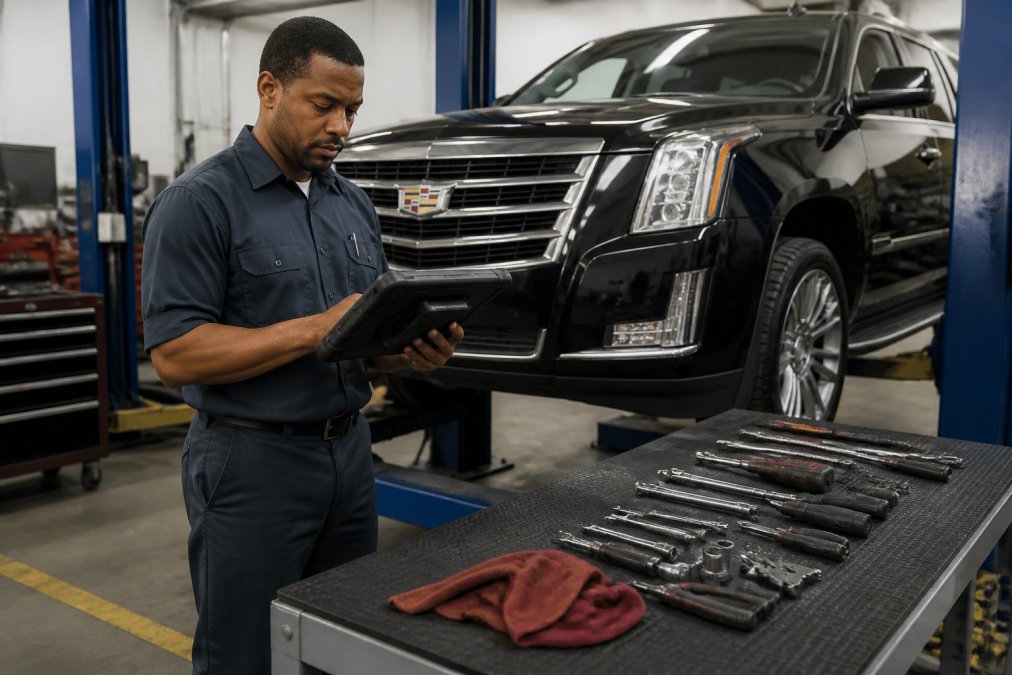
What sets TIPS apart is the combination of old-school honesty and modern diagnostic technology. Technicians explain what your vehicle needs in plain English, and they back recommendations with actual diagnostic data rather than guesswork.
The practical benefits matter too:
- Free pickup and drop-off within a 10-mile radius, so you’re not stuck waiting
- Same-day service for most repairs
- Emissions testing for 1996 and newer vehicles, with wait times usually 10 minutes or less
- Full factory-schedule maintenance, bumper to bumper
For GM owners dealing with a check engine light or a transmission concern, TIPS Automotive offers the diagnostic depth of a specialist without the dealership markup. Call now to schedule your service.
GM Certified Service: The Dealership Network
GM Certified Service is the official factory network, and it’s the safest choice if warranty compliance is your only concern. Every technician is factory-trained, every part is genuine OEM, and the work is documented in GM’s system.
The trade-offs are real. Pricing runs higher than independent shops, and you’ll typically wait longer for an appointment. For a vehicle still under powertrain warranty, that premium can be worth it. For an older GM vehicle past its coverage window, you’re paying dealership labor rates for work an independent shop can do just as well.
Use the GM Certified Service dealer locator to find the nearest participating center.
Mobile Mechanics: YourMechanic, Mini Boss, and NextGen
Mobile mechanics bring the shop to your driveway, and for routine maintenance on a GM vehicle, that convenience is genuinely useful. The catch is that a mobile setup is a van, not a bay, and that physical limit, not technician skill, determines what can actually be done in your driveway.
YourMechanic dispatches certified technicians to your home or workplace and offers a transparent online quote system before you book. The service covers hundreds of repair types, though anything requiring a lift, such as suspension alignment or major drivetrain service, is off the table.
Mini Boss Mobile Mechanic handles on-site diagnostics, tune-ups, and brake work. It’s a strong fit when your vehicle can’t be driven or you’d rather avoid a tow.
NextGen Auto Service covers oil changes, brake service, and mobile diagnostics at your location. Fast scheduling is the selling point.
| Service | On-Site Work | Best For | Limitation |
|---|---|---|---|
| YourMechanic | Most routine repairs | Busy professionals | No lift-dependent jobs |
| Mini Boss | Diagnostics, brakes, tune-ups | Undrivable vehicles | Weather dependent |
| NextGen | Oil, brakes, diagnostics | Quick maintenance | No major overhauls |
Why the Van Sets the Ceiling on What Gets Fixed
The limitation isn’t a marketing caveat, it’s mechanical. A mobile tech works from a van with hand tools, a floor jack, and jack stands. That’s enough for anything reachable from the top or the side of the engine bay. It is not enough for work that requires the vehicle raised on a two-post lift with the wheels free, the underbody accessible, and a drain pan positioned under a transmission or differential.
Practically, that splits GM work into two buckets:
- Van-friendly: oil and filter changes, battery replacement and testing, spark plugs on accessible engines, brake pads and rotors, cabin and engine air filters, serpentine belts, and OBD-II diagnostic scans.
- Shop-only: transmission fluid exchange, coolant flush with a vacuum fill, alignment, tire mounting and balancing, exhaust and catalytic converter work, fuel system service, and anything requiring a scan tool with GM-specific bidirectional controls.
A mobile tech can read a check engine light, but a general OBD-II reader only pulls the code. GM-specific diagnostics often require commanding individual modules, relearning a throttle body, or running a transmission adaptive relearn, functions a handheld scanner typically can’t perform.
The Real Trade-Off: Convenience vs. Diagnostic Depth
Mobile service wins on time. You don’t drive anywhere, you don’t sit in a waiting room, and you don’t lose your car for a day. For a 30,000-mile oil change and tire rotation, that’s a clean win.
It loses on diagnostic depth. If your check engine light traces to a misfire, a mobile tech can replace the coil or plug, but if the misfire is intermittent or tied to a module fault, you’ll likely end up at a shop anyway, having paid for the mobile visit. A common pattern is owners booking mobile service for a symptom, then booking a shop for the diagnosis.
Pro Tip
Before you book mobile service, ask two questions: does the tech carry a GM-capable scan tool, and what happens if the job turns out to need a lift? A good mobile provider will tell you upfront whether your repair is in scope, and won’t charge you a trip fee to find out it isn’t.
Before you book mobile service, ask two questions: does the tech carry a GM-capable scan tool, and what happens if the job turns out to need a lift? A good mobile provider will tell you upfront whether your repair is in scope, and won’t charge you a trip fee to find out it isn’t.
Mobile service works well for preventative maintenance. It does not replace a shop for transmission flush work or anything requiring a lift. If your GM vehicle needs diagnostic work rather than routine service, book a shop with GM-specific equipment from the start.
Independent Shops: Duncan Automotive and M&M Auto Services
Independent shops often deliver the best value for GM owners who’ve moved past their warranty period.
Duncan Automotive has built a reputation for honest mechanical troubleshooting and transparent repair practices. The shop’s limited digital presence means you’ll likely book by phone.
M&M Auto Services stands out for offering free price estimates before you commit to repairs. That’s a meaningful advantage if you’ve been burned by surprise invoices. The lack of a centralized website makes it harder to research upfront, but the local reputation is solid.
Neither shop publishes a full service menu online. Call ahead and ask directly about GM experience and diagnostic equipment.
Watch Out
A low hourly rate means nothing if the shop guesses at the problem. Ask how they diagnose before they quote. A shop that replaces parts until the light goes off will cost you more than one that charges a higher rate and fixes it once.
A low hourly rate means nothing if the shop guesses at the problem. Ask how they diagnose before they quote. A shop that replaces parts until the light goes off will cost you more than one that charges a higher rate and fixes it once.
Common Signs of GM Transmission Failure
Catching transmission trouble early is the difference between a fluid service and a full rebuild. Watch for these signals on any GM vehicle:
- Delayed engagement: a pause between shifting into drive and the transmission catching
- Slipping: engine RPMs climb while vehicle speed doesn’t
- Harsh or jerky shifts: especially between second and third gear
- Burning smell: overheated transmission fluid has a distinct, acrid odor
- Check engine light with transmission codes: often the first hard evidence
If you notice two or more of these, stop driving and get a diagnostic scan. Transmission problems rarely fix themselves, and continued driving can turn a repairable issue into a replacement.
The NHTSA recall and defect lookup is worth checking too. Some transmission concerns trace back to known defects covered under recall or extended warranty programs.
GM Maintenance Schedule Guide: 30K, 60K, and 90K Intervals
Sticking to the factory maintenance schedule is the single most effective way to protect your GM vehicle’s resale value and avoid premature failures. Here’s what the major intervals typically cover.
| Interval | Core Services | What to Watch |
|---|---|---|
| 30,000 miles | Oil and filter, tire rotation, fluid inspection, battery test | Brake pad wear, cabin filter |
| 60,000 miles | Transmission fluid exchange, coolant service, spark plugs on some engines | Suspension components, belts |
| 90,000 miles | Timing service where applicable, drivetrain inspection, emissions testing | Water pump, hoses, alignment |
Your owner’s manual is the final authority, since intervals vary by engine and model year. A certified mechanic for GM vehicles will pull the schedule specific to your VIN rather than applying a generic chart.
Key Takeaway
The 60,000-mile transmission fluid exchange is the interval most owners skip, and it’s the one that most often precedes a transmission failure. Fluid exchange is inexpensive compared to a rebuild.
The 60,000-mile transmission fluid exchange is the interval most owners skip, and it’s the one that most often precedes a transmission failure. Fluid exchange is inexpensive compared to a rebuild.
OEM vs. Aftermarket Parts: What Your Warranty Actually Requires
Your powertrain warranty does not automatically require OEM parts for every repair, but it does require that parts meet or exceed factory specifications. That distinction matters when you’re choosing between genuine GM components and aftermarket equivalents, and it’s where most GM owners get the decision wrong in both directions.
What the Warranty Rule Actually Says
Under the Magnuson-Moss Warranty Act, a manufacturer cannot void your warranty simply because an aftermarket part was used, unless the part caused the failure. The burden is on the manufacturer to show causation, not on you to prove innocence. That protection is real, and it’s why a dealer can’t blanket-deny a claim because you used a non-GM oil filter.
What the rule does not do is cover the cost of a failed aftermarket part. If a cheap aftermarket water pump fails at 40,000 miles and takes a belt and a pulley with it, the warranty covers the OEM parts it damaged, not the aftermarket pump, and not the labor to replace it a second time. That’s the gap the rule leaves open, and it’s the one that costs owners money.
A Decision Framework by Part Category
The right call depends on what the part does, not on brand loyalty. Three categories cover most GM repairs:
- Wear items, aftermarket is usually fine. Brake pads and rotors, batteries, tires, wiper blades, filters, and shocks. These are consumables with published specifications, and quality aftermarket brands meet or exceed them. The risk is quality variance between brands, so stick to established names rather than the cheapest listing.
- Powertrain internals, OEM is worth the premium. Engine internals, transmission components, timing components, and anything electronic tied to the drivetrain. These parts are matched to GM’s calibration and tolerances, and a mismatch can trigger a relearn, a drivability complaint, or a repeat failure.
- Electronics and sensors, match the part to the system. A mass airflow sensor, oxygen sensor, or throttle body that isn’t calibrated to GM’s software can set codes the vehicle didn’t have before. For anything that talks to a module, OEM or an OE-equivalent supplier is the safer bet.
The Cost Math Owners Actually Face
The OEM-versus-aftermarket gap is not uniform. On wear items, the difference is often modest, a set of aftermarket brake pads may run meaningfully less than the GM part number, and the performance difference on a daily-driven vehicle is small. On powertrain components, the gap widens, and the downside of a premature failure is a second labor charge on top of the part.
The calculation that matters is total cost of ownership, not sticker price. A part that costs less but fails early costs more once you add the second installation. A part that costs more but lasts the interval costs less per mile. For a vehicle you plan to keep past 100,000 miles, OEM on the critical systems is usually the cheaper decision over time.
Document Everything, Either Way
Whichever way you go, keep the receipts and ask the shop to note the parts used on the invoice, brand, part number, and whether it’s OEM or aftermarket. If a warranty claim ever comes up, that paper trail is what lets you show the part met specifications and didn’t cause the failure. A shop that documents parts as a matter of course is a shop that expects its work to hold up.
Watch Out
A dealer cannot void your entire warranty because you used an aftermarket part. But a dealer can deny a specific claim if it can show the aftermarket part caused the failure. The distinction is per-claim, not per-vehicle, and it’s why documentation matters more than brand loyalty.
A dealer cannot void your entire warranty because you used an aftermarket part. But a dealer can deny a specific claim if it can show the aftermarket part caused the failure. The distinction is per-claim, not per-vehicle, and it’s why documentation matters more than brand loyalty.
Where aftermarket makes sense: brakes, tires, batteries, suspension wear items. Where OEM is worth the premium: engine internals, transmission components, and anything electronic tied to the drivetrain. For warranty-sensitive repairs, ask the shop to document the parts used and keep your receipts either way.
Frequently Asked Questions
What does it mean for a mechanic to be GM certified?
GM certification means a technician completed factory training programs specific to GM platforms and has access to GM’s technical service bulletins and diagnostic software. ASE certification is separate and covers general automotive competency. A certified mechanic for GM vehicles typically holds both, which matters when your car needs electrical system troubleshooting or drivetrain service that follows manufacturer procedures.
How do I verify a mechanic’s certification status?
Ask to see their ASE credentials and check the ASE website for verification. For GM-specific training, ask whether they have current access to GM’s service information system. A legitimate shop will show you documentation without hesitation. If a shop claims certification but can’t produce proof, that’s a red flag worth taking seriously.
What are the common signs of GM transmission failure?
Watch for delayed engagement when shifting from park to drive, slipping between gears, shuddering at highway speeds, and a burning smell. A check engine light with transmission codes is another indicator. GM transmissions in certain model years have known issues documented in technical service bulletins. Early diagnosis at a shop with factory-trained technicians can prevent a minor fluid exchange from becoming a full rebuild.
How often should I schedule maintenance for my GM vehicle?
Follow the GM maintenance schedule guide in your owner’s manual, which typically calls for oil changes every 7,500 miles with full synthetic, tire rotation at the same interval, and a comprehensive vehicle inspection at 30,000, 60,000, and 90,000 miles. Brake fluid exchange, transmission flush, and coolant service usually fall at the 60K and 90K marks. Severe driving conditions shorten these intervals.
Are independent mechanics qualified to work on GM vehicles?
Many are, provided they have ASE certification, access to GM diagnostic tools, and experience with your specific platform. Independent shops often charge lower labor rates than dealerships while using OEM parts. The key is asking whether they can perform warranty-compliant repairs and whether they subscribe to GM’s technical service bulletin system. If they can, you get dealership-level capability without the dealership overhead.


Comments are closed