

Subtotal $0.00

Table of Contents
- Common Signs of GM Transmission Failure
- Whining and Grinding Noises in a GM Powertrain
- Delayed or Sticking Gear Shifts and Shift Flare
- Transmission Fluid Leaks, Burnt Fluid, and Contamination
- Engine Revving, Gear Slippage, and Limp Mode
- Control Valve, Torque Converter, and TCM Faults
- Which GM Transmissions Are Most Prone to Failure
- How to Check Transmission Fluid Level
- GM 8-Speed Transmission Shudder Fix
- Cost of GM Transmission Repair vs. Replacement
- Frequently Asked Questions
Last Updated: September 19, 2026
Common Signs of GM Transmission Failure
Most drivers notice the first warning long before the transmission quits: a shudder at 40 mph, a delayed shift into reverse, or a whine that wasn’t there last month. Recognizing the common signs of GM transmission failure early is the difference between a fluid service and a full rebuild. At TIPS Automotive, our certified technicians diagnose these symptoms daily, and the pattern is consistent: the drivers who catch the warning signs early spend far less than the ones who wait for a tow.
This guide covers the symptoms that matter most, from whining noises and shift flare to limp mode and TCM faults. We’ll also break down some units most prone to problems, show you how to check your own fluid, and walk through the repair-versus-replace math. Below, you’ll find diagnostic steps a shop uses, so you can walk in informed instead of guessing.
Key Takeaway
GM transmission failure almost never happens without warning. Whining, shuddering, delayed engagement, and burnt fluid all appear weeks or months before a unit fails completely. Treat any one of them as a reason to get the vehicle scanned, not a reason to keep driving.
GM transmission failure almost never happens without warning. Whining, shuddering, delayed engagement, and burnt fluid all appear weeks or months before a unit fails completely. Treat any one of them as a reason to get the vehicle scanned, not a reason to keep driving.
Whining and Grinding Noises in a GM Powertrain
Noise is the symptom owners describe most often, and it’s one of the most useful. A whining sound that rises and falls with vehicle speed usually points to worn planetary gears or a failing pump. Grinding or clunking, especially on engagement, suggests mechanical damage inside the gearbox rather than an electronic fault.
Where you hear the noise matters as much as the noise itself:
- Whine that tracks engine RPM: pump or torque converter issue
- Whine that tracks vehicle speed: gearset or bearing wear
- Grinding on startup or engagement: clutch pack or hard-part damage
- Clunking during downshifts: valve body or mount-related problem
Ignoring a whine is the most expensive mistake we see. A pump that’s failing contaminates the fluid, and contaminated fluid takes the rest of the transmission with it. If the noise started recently, a fluid inspection and a scan often catch the cause before internal damage sets in.
Delayed or Sticking Gear Shifts and Shift Flare
Shift flare is the brief spike in engine RPM between gears, and it’s a classic early sign of GM transmission failure. You press the accelerator, the engine revs, and a moment later the transmission catches. That delay means clutch packs are slipping or line pressure is dropping.
Watch for these related behaviors:
- A pause before the car moves when you shift into drive or reverse
- Harsh engagement when cold that smooths out once warm
- Hard downshifts when you slow for a stop
- The transmission holding a gear longer than it should
Delayed engagement when cold is common on higher-mileage units and often traces to low fluid or a worn seal. Shift flare under load is more serious. A common mistake is treating a sticking shift as a “quirk” of an older truck. In practice, flare that worsens over a few weeks usually ends in a rebuild.
Transmission Fluid Leaks, Burnt Fluid, and Contamination
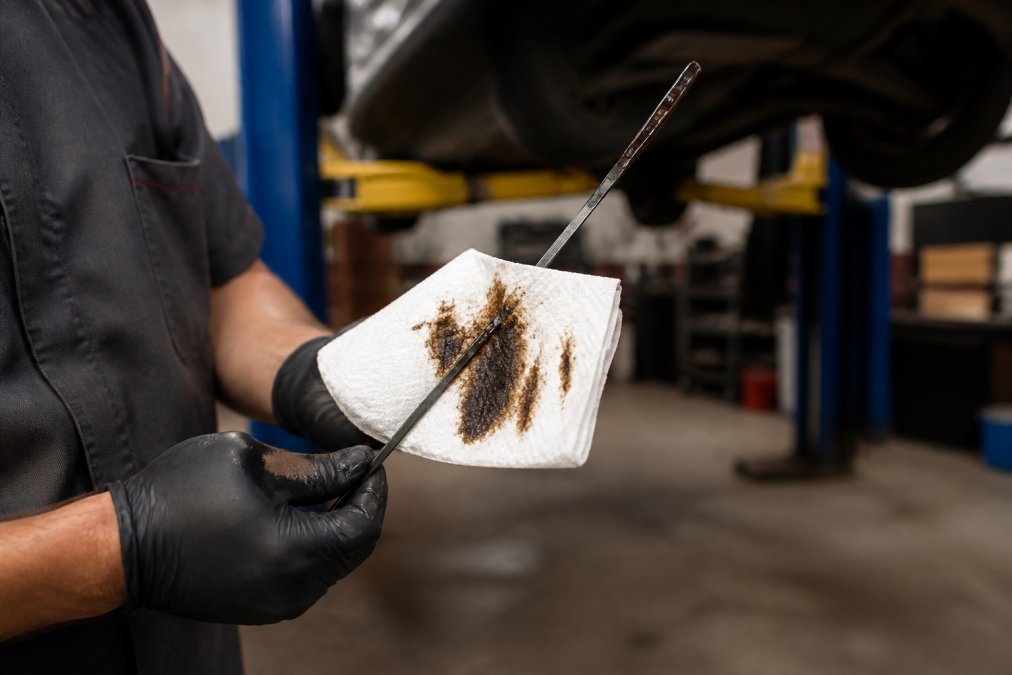
Fluid condition tells you more about transmission health than almost any other check. Healthy transmission fluid is red and translucent. Burnt fluid is dark brown or black and smells acrid, a sign the unit has been overheating. Metal shavings or a gritty texture in the pan mean internal parts are already wearing.
Leaks deserve the same attention. A slow drip from the pan gasket or a cooler line seems minor until the fluid level drops enough to cause slipping and overheating. Common leak points include:
- The transmission pan gasket and drain plug
- Cooler lines and fittings
- The front pump seal
- The rear output shaft seal
Low fluid from any of these sources accelerates wear across the whole unit. If you see red spots on the driveway, get the level checked before you drive further. A guide to checking automatic transmission fluid walks through the basic process, though the exact procedure varies by model.
Engine Revving, Gear Slippage, and Limp Mode
Gear slippage means the engine revs but the vehicle doesn’t accelerate in proportion. It’s the clearest sign that the transmission can no longer hold a gear under load. Slippage often shows up first on hills or during passing, when demand on the clutch packs is highest.
Limp mode is the transmission’s self-protection response. When the TCM detects a serious fault, it locks the unit into a single gear, usually second or third, to prevent further damage. You’ll notice hard shifts, limited speed, and a check engine light. Limp mode isn’t a failure by itself; it’s the computer telling you a failure is in progress.
Watch Out
Driving in limp mode “just to get home” can turn a repairable valve body issue into a full rebuild. The transmission is running with reduced pressure and no cooling control. If limp mode engages, have the vehicle towed or driven only a short distance to a shop.
Driving in limp mode “just to get home” can turn a repairable valve body issue into a full rebuild. The transmission is running with reduced pressure and no cooling control. If limp mode engages, have the vehicle towed or driven only a short distance to a shop.
Control Valve, Torque Converter, and TCM Faults
Many GM transmission problems are electronic or hydraulic, not mechanical, and that’s good news for your wallet. The valve body directs fluid pressure to shift gears. When a solenoid or valve sticks, you get harsh shifts, flare, or a gear that won’t engage. The torque converter, which couples the engine to the transmission, can develop a shudder or fail to lock up.
The transmission control module (TCM) is the computer that runs the show. Faulty TCMs cause erratic shifting, limp mode, and stored diagnostic trouble codes. An OBD-II scanner reads those codes, and they’re the fastest route to a real diagnosis. Look for P-codes related to shift solenoids, torque converter clutch, or TCM communication. A scanner can’t find worn clutch packs, but it will flag the electronic faults that mimic them.
Which GM Transmissions Are Most Prone to Failure
Some GM units have well-documented weak points, and knowing yours tells you which symptoms to watch for first. The three families that generate the most owner complaints are the 6L80/6L90 six-speed, the 8L90/8L45 eight-speed, and the 10L80/10L90 ten-speed. Each fails in a recognizable pattern, and each responds to a different first move.
6L80 and 6L90 (Six-Speed)
Used in trucks, SUVs, and full-size vans from roughly the late 2000s into the 2010s, the 6L80 is the unit most owners search for. Its two recurring failure points are the torque converter clutch and the valve body.
- Torque converter shudder: a light-throttle vibration, often between 35 and 55 mph, that feels like driving over rumble strips. It traces to the clutch lining degrading and contaminating the fluid.
- Hard or delayed shifts: worn valve body bores and sticking shift solenoids cause harsh 1-2 and 2-3 shifts, especially when cold.
- TCC slip codes: a scan often shows P0741 or P0894, which point to the converter clutch circuit rather than the gears themselves.
A common pattern is a 6L80 that shudders for months, then starts slipping under load. By the time it slips, the converter debris has usually circulated through the valve body, so the repair grows from a converter job into a converter-plus-valve-body job. Catching it at the shudder stage is the difference.
8L90 and 8L45 (Eight-Speed)
Found in newer trucks, performance models, and some crossovers, the eight-speed is best known for a shudder complaint that is frequently a fluid problem, not a hardware failure.
- Light-throttle shudder: typically 30 to 50 mph, felt as a vibration or a “fish-bite” sensation through the seat and steering wheel.
- Shift flare and harsh engagement: often tied to fluid condition or an outdated TCM calibration.
- Converter clutch codes: TCC-related trouble codes appear alongside the shudder in many cases.
The important distinction is that a large share of 8L90 shudder cases resolve with a fluid exchange using the correct current specification plus a TCM recalibration. Jumping straight to a converter replacement before trying fluid and software is the most common and most expensive mistake on this platform.
10L80 and 10L90 (Ten-Speed)
Used in newer trucks, SUVs, and performance applications, the ten-speed is the newest of the three and its complaints skew toward shift quality rather than hard-part failure.
- Harsh or delayed shifts: often a calibration or fluid-level issue rather than a mechanical fault.
- Hesitation when cold: a brief pause before engagement that smooths out once warm.
- Software-related drivability quirks: many cases are addressed with an updated calibration from the dealer.
Because the ten-speed is newer, high-mileage wear patterns are less established than on the 6L80. The practical takeaway is that shift-quality complaints on this unit should be checked for software and fluid level before anyone opens the transmission.
| Transmission | Signature Symptom | Typical First Check |
|---|---|---|
| 6L80 / 6L90 | Converter shudder, hard 1-2 shift | Fluid condition, TCC codes |
| 8L90 / 8L45 | Light-throttle shudder, flare | Fluid service, TCM calibration |
| 10L80 / 10L90 | Harsh or delayed shifts | Software update, fluid level |
Key Takeaway
Model matters. A shudder on an 8L90 often means fluid and software; the same shudder on a 6L80 more often means the converter. Knowing your unit tells you whether to start with a service or prepare for a repair.
Model matters. A shudder on an 8L90 often means fluid and software; the same shudder on a 6L80 more often means the converter. Knowing your unit tells you whether to start with a service or prepare for a repair.
If you own one of these units, treat any new shudder or shift change as a signal. These platforms respond well to early fluid service and software recalibration. They respond poorly to being ignored.
How to Check Transmission Fluid Level
Checking your own fluid is the fastest way to catch a problem early, and it takes about ten minutes. Most modern GM vehicles use a sealed transmission with a check plug rather than a dipstick, so confirm your model’s procedure first. For dipstick-equipped vehicles, follow these steps:
- Park on level ground and let the engine reach normal operating temperature
- Leave the engine running in park with the parking brake set
- Pull the dipstick, wipe it clean, and reinsert it fully
- Pull it again and read the level against the hot marks
- Note the color and smell: red and sweet is healthy, dark and burnt is not
If the level is low, top off with the fluid type listed in your owner’s manual. Using the wrong fluid causes its own shifting problems. If the level is correct but the fluid looks burnt, the unit has been overheating and needs a professional look.
GM 8-Speed Transmission Shudder Fix
The 8-speed shudder fix usually starts with fluid, not hardware. Shudder at light throttle, often between 30 and 50 mph, is the signature complaint on 8L90-equipped vehicles. It frequently traces to the fluid itself rather than a failed part, which is why a fluid service and a TCM recalibration are the standard first steps.
Here’s the order a shop typically follows:
- Scan for stored codes and check for TCC-related faults
- Inspect fluid condition and level
- Perform a fluid exchange with the correct specification
- Apply the latest TCM calibration if available
- Road-test to confirm the shudder is gone
If shudder returns after a proper fluid service and calibration, the torque converter becomes the suspect. A common mistake is jumping straight to a converter replacement before trying fluid and software. In practice, many 8-speed shudder cases resolve at the fluid stage.
Cost of GM Transmission Repair vs. Replacement
The cost of GM transmission repair depends on what is actually wrong, and the spread between the cheapest and most expensive outcome is wide. Most shops quote in tiers rather than a single number, and knowing the tiers helps you sanity-check any estimate you receive.
The Four Cost Tiers
- Diagnostic and fluid service: the lowest tier. A scan, a fluid level check, and a fluid exchange with the correct specification. This is where 8L90 shudder cases often resolve.
- Component repair: solenoids, a valve body, a torque converter, or a TCM. The transmission stays in the vehicle and only the failed part is replaced.
- Rebuild: the unit is removed and internal wear parts, clutch packs, seals, bearings, sometimes the pump, are replaced. This is the middle-to-high tier and the usual answer for a worn but rebuildable unit.
- Replacement: a remanufactured or used unit is installed. This is the highest tier and is typically reserved for a unit with multiple faults or a cracked case.
Because pricing varies by model, labor rates, and parts availability, we recommend getting a written, itemized estimate rather than relying on a generic number. Ask the shop to separate parts, labor, fluid, and any software calibration so you can see what you are actually paying for. For current pricing, please contact TIPS Automotive directly.
How to Run the Repair-vs-Replace Math
The decision framework is straightforward once you have a real estimate:
- Get the vehicle’s current value. Use a reputable valuation tool, not a guess.
- Get a written repair estimate that names the failed components.
- Compare the repair cost to the vehicle’s value. A common rule of thumb is that a repair approaching or exceeding half the vehicle’s value is worth a hard second look.
- Factor in what else the vehicle needs. If the transmission is the only major issue and the rest of the vehicle is sound, a rebuild often makes sense. If the transmission is one of several expensive problems, replacement of the vehicle may be the smarter spend.
- Check coverage before paying out of pocket. An extended warranty, a service contract, or a manufacturer recall may cover part or all of the work.
When a Rebuild Beats a Replacement
- The unit has a single failed component and the rest of the internals are within spec.
- You plan to keep the vehicle for several more years.
- The vehicle is otherwise in good condition and its value supports the investment.
When Replacement Beats a Rebuild
- The unit has multiple faults or a cracked case.
- The vehicle is high-mileage and other major systems are also due for repair.
- The repair cost approaches the vehicle’s value.
A consumer resource on transmission repair costs and your shop’s itemized estimate will give you the real numbers for your vehicle. For a vehicle worth keeping, a rebuild often beats replacement. For a high-mileage unit with multiple faults, replacement may be the smarter spend.
Pro Tip
Ask any shop to show you the diagnostic codes and the fluid condition before approving work, and to put the estimate in writing with parts and labor separated. A shop that can explain the “why” in plain English is a shop worth trusting. That transparency is exactly what we built our service around at TIPS Automotive.
Ask any shop to show you the diagnostic codes and the fluid condition before approving work, and to put the estimate in writing with parts and labor separated. A shop that can explain the “why” in plain English is a shop worth trusting. That transparency is exactly what we built our service around at TIPS Automotive.
Frequently Asked Questions
Which GM transmissions are most prone to failure?
The 8L90 and 8L45 8-speed automatics used in Cadillac, Chevy, and GMC vehicles from roughly 2015 to 2019 are the most commonly reported for shudder and hard shifts. The 6L80 and 6L90 6-speeds from 2007 to 2013 also show torque converter and valve body issues. Newer 10-speed units have fewer complaints. If your GM transmission failure symptoms match these models, have a certified technician scan the TCM for stored codes before assuming the worst.
Can low transmission fluid mimic the signs of total failure?
Yes. Low or burnt fluid can cause delayed engagement, slipping, shuddering, and hard downshifts that look identical to internal mechanical failure. Before authorizing a rebuild, ask the shop to check fluid level and condition. Topping off or replacing fluid on a GM 8-speed sometimes resolves shudder entirely, which is far cheaper than a rebuild. If symptoms persist after a fluid service and TCM relearn, internal wear is more likely.
What are the first signs of transmission failure?
Early warnings usually appear as a slight shudder at highway speeds, a one-second delay when shifting from park to drive, or a whining sound that rises with engine speed. A check engine light with a P0700 or P0741 code is another early flag. Catching these signs of GM transmission failure at this stage gives you time to try a fluid service or TCM update before clutch packs and the torque converter are damaged.
How much does GM transmission repair cost?
The cost of GM transmission repair depends on what fails. A fluid and filter service or TCM recalibration costs far less than a torque converter replacement, and a full rebuild or remanufactured unit is the largest expense of all. Because pricing depends on your specific model, mileage, and diagnosis, contact TIPS Automotive for a current quote rather than relying on generic online estimates.


Comments are closed