

Subtotal $0.00

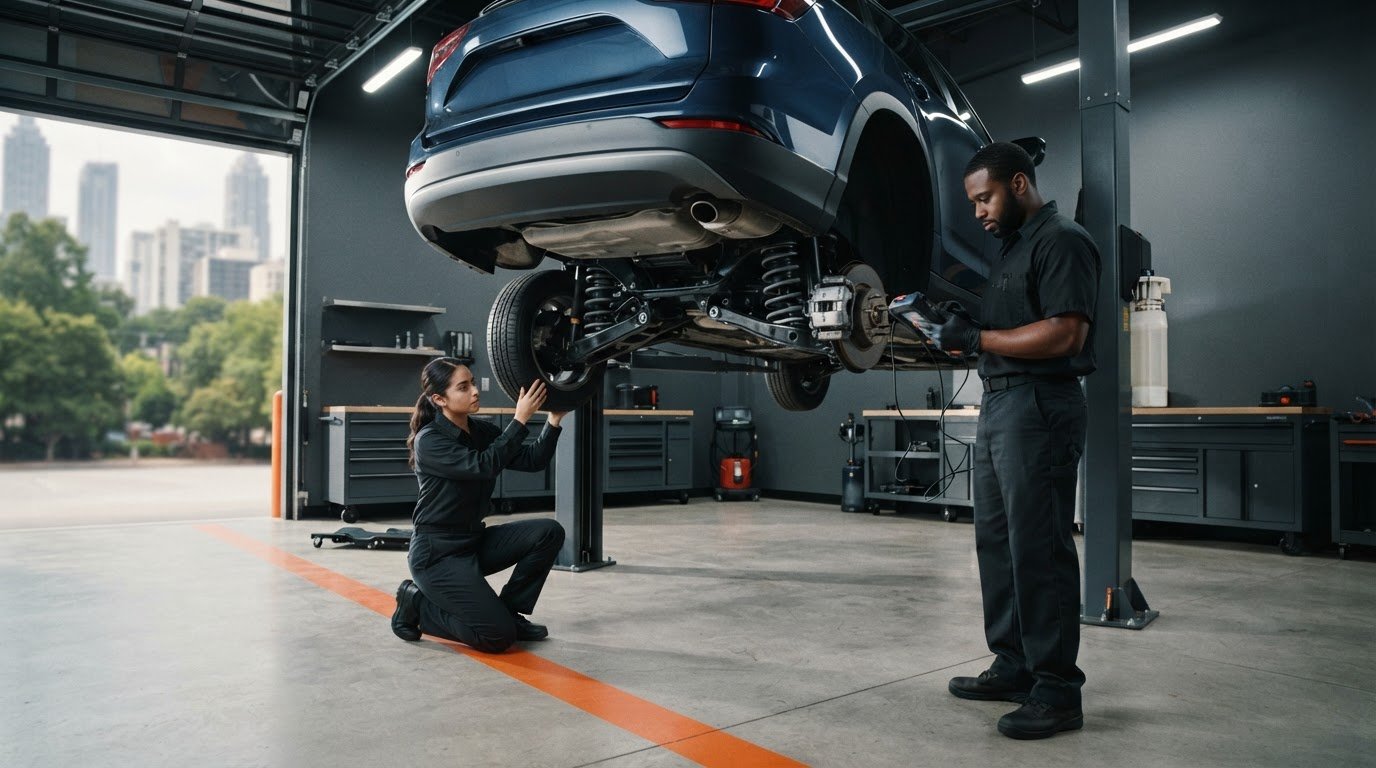
That sudden metallic clunk you hear over neighborhood speed bumps isn’t just annoying; it’s a direct warning sign from your chassis. Between jarring expansion joints on the Downtown Connector and rough steel plates scattered along I-75 and I-85, finding dependable suspension repair Atlanta drivers can count on has become a tactical necessity. We know how exhausting it feels to endure an uncomfortable, jittery commute every day while worrying about escalating repair bills and vague mechanical explanations.
You deserve clear answers about what is happening beneath your vehicle and dependable solutions that restore your car’s factory-level comfort and safety. In this complete 2026 guide, you’ll master the essentials of vehicle suspension, learn how our city’s unique driving conditions wear down key components, and discover how a diagnostic-first approach prevents unnecessary part replacements. Below, we break down common warning symptoms, local road hazards, and practical tips to help you choose the right repair shop with complete confidence.
Key Takeaways
- Learn how to recognize early chassis warnings, from sudden brake dive at busy intersections to telltale fluid leaks on shock bodies.
- Understand the vital difference between springs and dampers so you can accurately assess repair estimates without feeling overwhelmed.
- Discover why a diagnostic-first approach to suspension repair Atlanta drivers trust protects your wallet from unnecessary part replacements.
- Find out how choosing complete assemblies can save valuable labor time and why post-repair wheel alignments are critical for long-term safety.
- See how local NW Atlanta expertise keeps family commutes smooth and dependable across rough local highway surfaces and neighborhood streets.
Recognizing Suspension Failure on Atlanta’s Challenging Roads
When approaching a red light along Northside Drive, does the front of your car lurch forward and dip sharply toward the pavement? That severe nose dive indicates your front struts can no longer manage dynamic weight transfer. Dampers do much more than absorb surface impacts; modern automotive suspension systems stabilize your entire chassis during hard braking and cornering. Knowing when to seek professional suspension repair Atlanta drivers trust prevents subtle handling quirks from snowballing into severe mechanical hazards. A faint clunk over neighborhood speed humps often points to loose sway bar links or worn ball joints. Left unaddressed, that slight play distorts steering geometry, chews through tire tread, and can cause sudden steering knuckle separation at speed.
You can assess damper health right in your driveway using two straightforward evaluations. First, perform a bounce test: push down firmly on each corner of your vehicle and quickly let go. If the body oscillates more than once before settling, the internal valving is spent. Second, check shock condition using a visual inspection and coin check: wipe a clean rag across the shock body. If you spot fresh fluid film caked in road grime, or if physical pitting along the piston rod is deep enough to catch the edge of a penny, the hydraulic seal has failed and replacement is necessary.
Common Symptoms of a Worn Suspension
Watch for these clear chassis warnings during your daily commute:
- Excessive oscillation: The chassis bounces repeatedly after clearing a dipped storm drain or bridge transition.
- Drifting and wander: The car veers toward one side on flat asphalt or requires constant steering corrections through sweeping turns.
- Corner sag: One wheel arch rests noticeably lower than the others while parked on level pavement, signaling a cracked coil spring or collapsed mount.
Local Factors: Why Atlanta Roads Accelerate Wear
While factory dampers are built to last up to 100,000 miles under ideal conditions, local driving cuts that timeline dramatically. Thick steel utility plates throughout Midtown and Buckhead act as rigid curb strikes, sending violent impact energy straight through control arm bushings and strut mounts. In North Atlanta, steep elevation changes force lower control arms to bear continuous, heavy lateral loads during tight uphill switchbacks. Add the high friction of stop-and-go Perimeter traffic, where sustained low-speed friction heats damper fluid, and it becomes easy to see why timely suspension repair Atlanta commuters depend on is essential for everyday safety.
Understanding Your Vehicle’s Suspension System Components
Your vehicle’s chassis relies on a delicate balance of mechanical linkages to isolate cabin passengers from harsh road impacts. At its core, the system divides labor between springs and dampers. Coil springs support the vehicle’s entire static weight and compress to absorb bumps, while dampers regulate that kinetic energy so your car does not bounce uncontrollably. Connecting these heavy parts to the steel frame are dense rubber bushings, which absorb high-frequency road vibrations before they reach your steering wheel. If you suspect your undercarriage is struggling, reviewing standard car suspension components and functions provides helpful clarity on how each piece protects your daily commute.
Ball joints serve as the pivotal hip joints of your front steering assembly. They feature a polished steel ball encased in a lubricated socket, allowing the wheel hubs to pivot horizontally for steering while moving vertically with the road. When navigating local commutes, seeking timely suspension repair Atlanta technicians recommend keeps these critical pivot points from wearing loose and compromising wheel alignment. If you notice unusual looseness through the steering column, an inspection from a trusted shop like TIPS Automotive can pinpoint worn parts before minor play creates larger handling hazards.
Shocks vs. Struts: What’s the Difference?
Shock absorbers function strictly as independent dampers to control rebound, whereas a strut combines a heavy coil spring, upper mount, and internal damper into a single structural member that directly supports vehicle weight. Most passenger sedans and modern crossovers utilize MacPherson struts on the front axle for compact packaging, while larger rear-wheel-drive SUVs often pair standalone shocks with separate coil or leaf springs. A strut integrates the spring and damper into one structural assembly that carries the vehicle’s weight while controlling vertical motion.
The Role of Control Arms, Bushings, and Ball Joints
Control arms act as the hinged metal framework that guides vertical wheel travel while keeping tires squarely aligned with the road surface:
- Hinged movement: Upper and lower control arms swing smoothly to keep the tire’s contact patch flat during hard cornering and braking.
- Atlanta road noise: Rubber bushings pressed into the arm eyes dry out and tear over time, creating a hollow drumming sound inside the cabin over rough pavement.
- The death wobble: Severe ball joint play allows the steering knuckle to oscillate violently at highway speeds, causing aggressive front-end shuddering until the vehicle slows down.
Choosing the Right Replacement Parts: A Buyer’s Framework
Reviewing a repair quote does not have to feel overwhelming. A standard estimate breaks down into three distinct categories: individual hardware, labor hours, and a required post-installation wheel alignment. Resist the temptation to cut corners with economy-grade parts. Low-grade metal castings and thin rubber boots fail rapidly under urban stress, forcing you to pay for the exact same labor twice. According to AAA vehicle pothole damage research, severe road defects create billions in structural vehicle damage annually. When scheduling suspension repair Atlanta drivers should always replace dampers in axle pairs. Swapping only a single worn strut produces uneven rebound rates, causing the vehicle to pull under heavy braking and disrupting your anti-lock braking system.
Choosing the right tier of hardware depends on how long you intend to keep your vehicle and how you drive it daily. Reliable shops guide you through component tiers so you can make an informed, budget-conscious choice without sacrificing your family’s safety on high-speed bypasses.
OEM vs. High-Quality Aftermarket Components
Original Equipment Manufacturer (OEM) components provide guaranteed factory ride height and familiar handling characteristics. In contrast, premium aftermarket manufacturers often re-engineer parts to eliminate known factory weak points, offering greaseable ball joints or reinforced steel control arm stampings. Avoid generic, unbranded “white box” parts found on discount websites. These low-cost alternatives lack stringent quality control, meaning their internal seals degrade quickly when exposed to summer heat and heavy stop-and-go driving.
Performance Upgrades: When to Consider Heavy-Duty Options
Upgraded hardware makes sense under specific driving demands, but each upgrade comes with practical trade-offs for daily use:
- Heavy-duty dampers: Upgraded monotube shocks offer superior thermal capacity for trucks and SUVs that frequently haul heavy work gear or tow trailers across town.
- Bushing materials: Standard rubber provides exceptional noise isolation. Firm polyurethane bushings sharpen cornering response, but they transmit significant road harshness directly into the cabin.
- Adjustable systems: Complex aftermarket coilovers allow custom height tuning, but their rigid valving rarely makes sense for comfortable commuting across unpaved construction zones.

What to Expect During a Professional Suspension Repair
Quality mechanical work begins with accurate troubleshooting rather than throwing unneeded parts at a mysterious noise. A disciplined diagnostic approach identifies the root mechanical issue before a single bolt turns, preventing the frustrating cycle of replacing good components. When scheduling suspension repair Atlanta motorists can generally plan on a same-day service for standard shock, strut, or sway bar link replacements. Once installation finishes, a dedicated road test over real pavement verifies that harsh vibrations and unwanted noises are gone. Addressing chassis wear promptly also yields an immediate financial ripple effect: stabilizing your ride keeps tires planted evenly, protecting your long-term tire repair Atlanta budget from rapid tread cupping and scalloping.
The Diagnostic Phase: Beyond the Visual Inspection
Modern suspension evaluation demands specialized tools alongside careful physical checks. Skilled technicians utilize comprehensive car diagnostic service Atlanta equipment to detect chassis sensor anomalies, stability system faults, and electronic damping errors. Mechanics inspect inner and outer tie rod ends, idler arms, and steering racks using precision dial indicators to spot microscopic play. Crucially, vehicles undergo a loaded suspension inspection. Inspecting control arms and ball joints on a drive-on lift while the chassis supports its own weight reveals binding bushings and hairline cracks that completely disappear when the wheels hang freely on a two-post frame lift.
Post-Repair Alignment: Why It’s Non-Negotiable
Replacing any major suspension component inevitably shifts your vehicle’s steering geometry. Even a fraction of an inch change in strut positioning throws camber and toe angles out of factory specification. Neglecting an alignment can scrub away thousands of miles of tire tread in just a few weeks. Modern vehicles also integrate advanced driver assistance systems (ADAS), such as lane-keep assist and automated emergency braking. Re-aligning the wheels ensures these radar sensors and forward cameras read the road accurately relative to your restored ride height.
If your vehicle handles loosely or clunks over rough pavement, schedule an expert suspension evaluation with our Bolton Road diagnostic team today.
Expert Suspension Solutions at TIPS Automotive in Atlanta
For 25 years, TIPS Automotive has served as a reliable pillar of the local motoring community. Since opening our doors in 2001, we have built lasting relationships with drivers across Northwest Atlanta by delivering honest evaluations, careful workmanship, and clear communication. Choosing an independent repair shop gives you direct access to the technicians working on your vehicle, eliminating the impersonal service and inflated markups typical of large corporate franchises. When your vehicle requires suspension repair Atlanta commutes demand, our core philosophy remains straightforward: we identify the underlying problem and fix only what is broken, saving you time and avoiding needless expense.
Our workshop pairs mechanical precision with neighborly warmth. We take the mystery out of chassis maintenance by walking you through every line of your repair plan before work begins, providing the peace of mind that comes from a dependable, well-maintained automobile.
Our Comprehensive Diagnostic-First Approach
Our deep background as an engine and transmission shop Atlanta drivers rely on gives us a clear diagnostic advantage. Complex drivetrain vibrations often mimic worn chassis parts, and our technicians know how to isolate the true origin of unwanted chassis feedback. Using sensitive electronic listening tools and chassis ears, we pinpoint erratic popping sounds and metal friction during dynamic load tests. You receive a digital inspection report complete with clear photos of torn rubber boots, weeping seals, and uneven component play so you can see the wear for yourself.
Serving the Bolton Road and NW Atlanta Community
Conveniently located at 2081 Bolton Rd NW, our shop provides fast access for drivers traveling along Marietta Boulevard and South Cobb Drive. We take pride in serving our neighbors across Riverside, Whittier Mill Village, and surrounding West Atlanta neighborhoods with targeted suspension repair Atlanta motorists can trust. Living and working here means our team understands the daily beating local roads deliver to your vehicle’s subframe, whether you commute across the Chattahoochee bridges or navigate unpaved industrial bypasses.
Ready for a smoother ride? Schedule your suspension inspection at TIPS Automotive and let our experienced team restore your vehicle’s original comfort and stability.
Restore Your Driving Comfort and Peace of Mind
Surviving daily travel across the metro area doesn’t mean enduring jarring impacts or living with mysterious front-end rattles. Recognizing symptoms early, choosing dependable hardware over bargain alternatives, and ensuring a precision post-repair alignment will protect your vehicle’s safety and tire life for years to come. When you need dependable suspension repair Atlanta drivers trust, working with a team that emphasizes root-cause diagnostics ensures you solve the real problem the first time.
Serving Atlanta since 2001, TIPS Automotive is proud to be an A+ rated independent local shop dedicated to keeping your family safe on the road. Our specialized chassis diagnostics and complete in-house alignment capabilities ensure your car receives thorough, honest care without unnecessary component markups or guessed repairs. You don’t have to settle for a bone-jarring commute. Book your suspension diagnostic at TIPS Automotive today and get back to enjoying a quiet, controlled ride.
Frequently Asked Questions
How much does suspension repair typically cost in Atlanta?
Total repair costs depend on whether your vehicle needs minor hardware like sway bar links or major assemblies like complete MacPherson struts. Pricing also varies based on whether your car uses standard hydraulic dampers or complex adaptive air suspension. When planning for suspension repair Atlanta drivers should remember that component designs differ across makes and models. Starting with a comprehensive physical inspection ensures an accurate estimate tailored to your vehicle.
Can I drive my car with a broken shock or strut?
Driving with a broken shock or strut is unsafe and strongly discouraged. A failed damper drastically reduces tire grip, increases emergency stopping distance, and makes lane changes unpredictable. While the vehicle might still roll forward, everyday road impacts transfer directly into your chassis and steering components. Continuing to commute this way risks bending wheel hubs, damaging expensive control arms, and destroying your tires.
How long does a suspension repair take at your Atlanta shop?
Most standard suspension replacements finish on the same business day. Replacing common wear items like stabilizer links, ball joints, or pre-assembled strut units typically takes just a few hours. Vehicles with pneumatic air suspensions, heavily corroded bolts, or electronic ride controls may require extra diagnostic time. Operating Monday through Friday, our Bolton Road facility keeps you informed throughout each stage of service.
Do I always need an alignment after suspension work?
Yes, a four-wheel alignment is mandatory whenever you replace primary suspension hardware. Unbolting struts, control arms, or tie rods changes your vehicle’s factory toe and camber angles. Even slight misalignments will cause your car to pull sideways and scrub away tire tread in just a few weeks. Completing an alignment directly after your suspension repair Atlanta service guarantees safe handling and protects your tire investment.
What is making that clunking noise when I go over speed bumps?
A clunking sound over speed bumps usually points to worn sway bar bushings or loose stabilizer links. These parts absorb twisting forces when both front tires compress over an obstacle. If internal rubber bushings rot away, the metal sway bar knocks directly against the vehicle frame. Other frequent culprits include worn upper strut mount bearings, loose ball joints, and degraded control arm bushings.
How often should I have my suspension inspected?
You should have your suspension inspected at least once a year or every 12,000 to 15,000 miles. Pairing a chassis check with routine oil changes or tire maintenance allows technicians to spot weeping fluid seals and hairline rubber cracks before parts fail completely. If you strike a severe pothole or feel unexpected looseness in the steering wheel, schedule an evaluation immediately.
Is it better to replace shocks and struts in pairs?
You should always replace shocks and struts in axle pairs across both sides of the vehicle. Dampers wear out at nearly identical rates. Installing a single new damper creates uneven rebound resistance, causing the car to pull during hard stops and unsettling the electronic stability control. Replacing dampers in pairs keeps chassis response predictable and balanced during sudden lane changes.
Will new shocks improve my car’s gas mileage?
While new dampers do not alter engine operation, they indirectly support better fuel economy by keeping your tires firmly planted. Worn dampers cause tires to bounce and scrub across road imperfections, creating excessive rolling resistance. Restoring proper suspension damping and completing a precise wheel alignment helps tires glide smoothly over asphalt, minimizing drag and supporting optimal highway mileage.

