

Subtotal $0.00

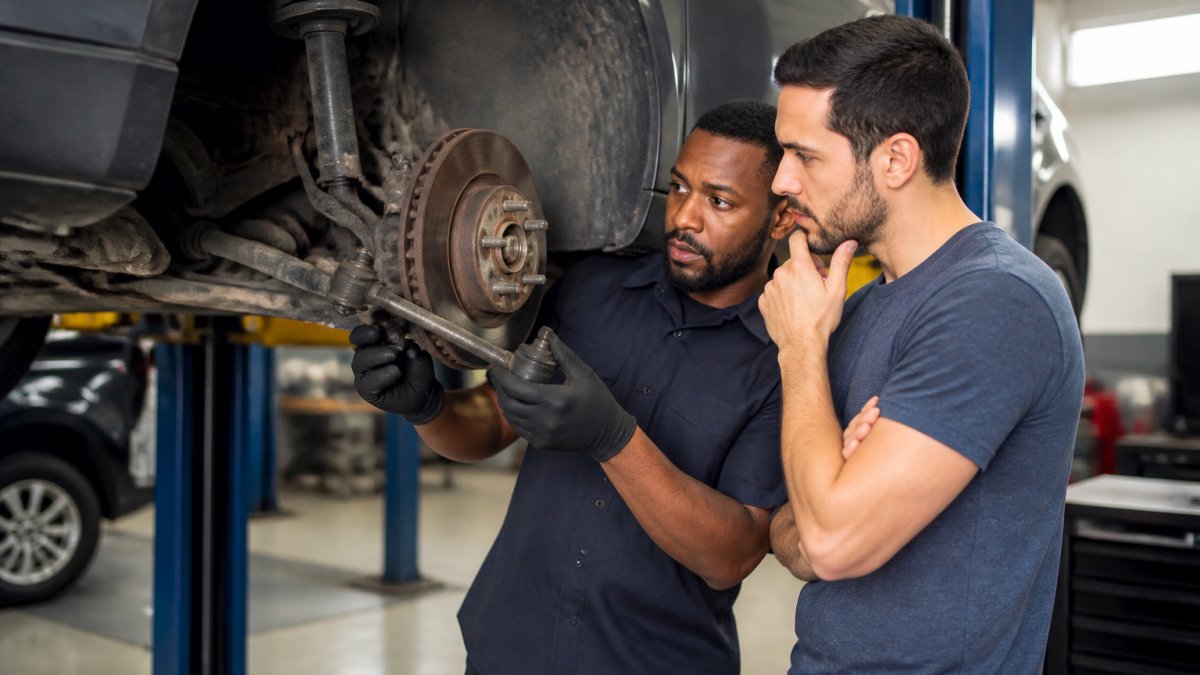
Table of Contents
- Why Suspension Repair Costs Vary So Much
- Signs of Suspension Failure You Should Know
- How to Get a Second Opinion on Car Repairs
- Questions to Ask a Mechanic Before Suspension Work
- Understanding Average Cost of Suspension Repair
- How to Shop Around for Quotes Without Getting Scammed
- Aftermarket vs. OEM Parts: What You Actually Need
- Red Flags That Spell Overcharging
- How to Avoid Hidden Fees and Protect Your Wallet
- Frequently Asked Questions
Last Updated: September 27, 2026
Why Suspension Repair Costs Vary So Much
To avoid overcharging suspension repair, understand that suspension repair pricing isn’t standardized. Two shops can quote dramatically different amounts for the same work. The difference comes down to labor rates, parts quality choices, diagnostic methods, and how transparent each shop is about what you’re actually paying for.
Suspension work involves multiple interconnected components, struts, shock absorbers, control arms, ball joints, and steering components. One shop might recommend replacing everything; another might fix only what’s broken. Neither approach is necessarily wrong, but the cost difference is real, with quotes varying $500 or more between shops for identical repairs.
Labor rates vary by location and shop type. Independent mechanics typically charge less than dealerships, but cheaper labor doesn’t guarantee better value, it depends on technician skill and diagnostic accuracy. Parts markup also varies: OEM components cost more than aftermarket parts (30-50% less), which may not last as long. Understanding these variables helps you avoid overcharging suspension repair and protects against overpaying.
Pro Tip
Request an itemized invoice before any work starts. It should list each part separately, labor hours for each task, and the shop’s hourly rate. Vague invoices like “suspension repair: $1,200” hide the actual breakdown and make comparison shopping impossible.
Request an itemized invoice before any work starts. It should list each part separately, labor hours for each task, and the shop’s hourly rate. Vague invoices like “suspension repair: $1,200” hide the actual breakdown and make comparison shopping impossible.
Signs of Suspension Failure You Should Know
Learning to recognize suspension failure signs helps you catch problems early and avoid unnecessary repair work.
A clunking noise when hitting a bump usually means worn struts or shock absorbers rattling inside their housings. Get a diagnostic, but don’t let a shop convince you to replace parts that aren’t actually damaged.
Uneven tire wear signals alignment issues. A proper alignment costs less than replacing tires prematurely, so catch this early.
Your car pulling to one side or bouncing excessively after bumps indicates suspension or alignment issues warranting professional inspection, though not every sign requires replacing everything.
Watch Out
If your steering feels loose or unresponsive, stop driving immediately. This suggests a serious steering component or suspension failure. Loose steering is a safety issue, not just a comfort problem. Get a diagnostic right away.
If your steering feels loose or unresponsive, stop driving immediately. This suggests a serious steering component or suspension failure. Loose steering is a safety issue, not just a comfort problem. Get a diagnostic right away.
How to Get a Second Opinion on Car Repairs
Getting a second opinion protects you from unnecessary work and inflated costs. Reputable shops expect it and welcome the scrutiny.
Take your car to a different shop and describe the problem without mentioning the first diagnosis. Let them perform their own diagnostic (typically $75-150). Yes, you’ll pay for two diagnostics, but the protection is worth it.
Compare the written estimates side by side. Look for differences in:
- Which parts each shop recommends replacing
- Labor hours quoted for the same task
- Parts quality (OEM vs. aftermarket)
- Warranty coverage on the work
If diagnostics match, you have confidence in the recommendation. If they differ significantly, you’ve caught a potential overcharge attempt. Some shops waive the diagnostic fee if you authorize repairs, so ask.
Ask the mechanic to show you the damaged part before and after removal, or provide photos. A reputable shop will document damage visually. If a mechanic resists, that’s a red flag.
Questions to Ask a Mechanic Before Suspension Work
“What specific parts are damaged, and why?” Demand specificity: “Your right front strut is leaking hydraulic fluid” or “Your left ball joint has excessive play.”
“Can you show me the damaged parts?” A mechanic should show you the problem or provide photos. If they won’t, ask why. Evasion is suspicious.
“What’s your hourly labor rate, and how many hours?” Cross-reference the rate with other shops and labor hours against the vehicle’s service manual.
“Are you using OEM or aftermarket parts?” Ask about warranty coverage. OEM parts typically carry longer warranties.
“What’s your warranty, and for how long?” Suspension repairs should carry at least a 12-month warranty on labor.
“Will you provide a written estimate before starting work?” Never authorize repairs based on a phone call or verbal estimate. Get it in writing.
Understanding Average Cost of Suspension Repair
Suspension repair costs depend on which components need work, how many, and where you have the work done. Understanding labor rates and parts costs helps you spot inflated quotes.
Labor Rate Benchmarks
Independent mechanics typically charge $85-$150/hour; dealerships $120-$200/hour. A shop charging $250+/hour for routine work without specialized certification warrants questioning.
Replacing a single strut takes 1-2 hours; both front struts take 2-3 hours; a full overhaul takes 6-10 hours. Cross-reference the shop’s estimate against the vehicle manufacturer’s service manual. If significantly higher, ask why.
Parts Cost Breakdown
OEM struts cost $250-$500 per unit; aftermarket $100-$300. A full front strut replacement with OEM parts totals $600-$1,200 in parts, plus $200-$300 labor, for a final bill of $800-$1,500.
Control arms cost $150-$400 each; ball joints $50-$200; sway bar links $30-$100. A full suspension refresh can reach $2,000-$4,000 in parts, plus $400-$800 labor.
Why Quotes Vary So Much
Two shops can differ by $500-$1,000 for legitimate reasons: diagnostic accuracy (one shop replaces one strut; another replaces both for balance), parts quality (OEM vs. aftermarket), labor efficiency (experienced vs. less experienced technician), and overhead (high-rent vs. low-rent location).
The “Show Me” Method for Cost Verification
Before authorizing work, ask the mechanic to show you the damaged part and explain why replacement is necessary. If they can’t show damage or explain the failure mechanism, question whether replacement is truly necessary.
Key Takeaway
Get written estimates from at least two shops that include hourly labor rate, estimated labor hours, specific parts with OEM/aftermarket designation, and parts cost per unit. Compare these side by side. A quote that’s 30% higher than competitors deserves investigation, it may reflect better parts, more thorough work, or padding. A quote that’s 30% lower may indicate cheap parts or inexperienced labor.
Get written estimates from at least two shops that include hourly labor rate, estimated labor hours, specific parts with OEM/aftermarket designation, and parts cost per unit. Compare these side by side. A quote that’s 30% higher than competitors deserves investigation, it may reflect better parts, more thorough work, or padding. A quote that’s 30% lower may indicate cheap parts or inexperienced labor.
How to Shop Around for Quotes Without Getting Scammed
Shopping around is your strongest defense against overcharging. Diagnostic fees cost money upfront, but the protection saves far more. Reputable shops expect it and welcome the scrutiny.
The Second Opinion Protocol: Step by Step
Tell the first shop you want a second opinion. Say: “I’d like a second opinion before authorizing work. Can you provide a written estimate?” Reputable shops comply. If a shop refuses or pressures you immediately, that’s a red flag.
Take the estimate to a second shop. Describe symptoms without mentioning the first diagnosis. Let the second mechanic perform their own diagnostic independently ($75-$150).
Ask the second shop to provide a written estimate. Request the same level of detail as the first shop: specific parts, labor hours, hourly rate, and warranty terms.
Compare the two estimates side by side. Look for alignment and discrepancies (see “Interpreting Diagnostic Differences” below).
If diagnostics match, authorize repairs with the shop offering better value. If they differ significantly, consider a third opinion or ask the first shop to explain the discrepancy.
Interpreting Diagnostic Differences
Suspension diagnosis involves judgment calls. One shop may recommend replacing both struts for balance; another only the leaking one. One may recommend replacing a worn control arm; another monitoring it. Ask each shop to justify recommendations and show measurements.
If one shop recommends replacing five components and another recommends replacing two, ask each shop to justify the difference. A good mechanic can explain why they recommend what they do. Vague answers like “it’s just safer” or “you’ll have problems later” without specifics are warning signs.
When to Walk Away
Certain diagnostic patterns suggest overcharging or unnecessary work:
Massive cost difference with no explanation: If one shop quotes $1,200 and another quotes $2,800 for the same symptoms, ask both shops to explain the difference. If the higher-priced shop can’t justify the extra cost with specific parts or labor, walk away.
Recommendation to replace everything: If a shop recommends replacing struts, control arms, ball joints, sway bar links, and bushings all at once without showing you damage on each component, get a second opinion. Sometimes a full suspension overhaul is necessary, but it’s rare.
Pressure to decide immediately: A shop that says “I can only hold this price until today” or “We need your decision now” is using pressure tactics. Reputable shops give you 24-48 hours to decide. Walk away from high-pressure situations.
Refusal to show you the damaged part: A mechanic who won’t show you the problem before or after repair is hiding something. Ask for photos if the part is already removed. If they refuse, that’s a dealbreaker.
Comparing Quotes: The Checklist
When you have two or more written estimates, compare them systematically:
| Factor | Shop A | Shop B | Notes |
|---|---|---|---|
| Parts list | (List each part) | (List each part) | Are they recommending the same components? |
| OEM vs. aftermarket | (Specify) | (Specify) | Which shop is using which? Cost difference? |
| Labor hours | (e.g., 2.5 hrs) | (e.g., 2.5 hrs) | Do they estimate the same time? |
| Hourly rate | (e.g., $110/hr) | (e.g., $125/hr) | Is the rate reasonable for your area? |
| Total labor cost | (hours × rate) | (hours × rate) | Which is lower? Why? |
| Total parts cost | (sum of parts) | (sum of parts) | Which is lower? Why? |
| Warranty on labor | (e.g., 12 months) | (e.g., 12 months) | What’s covered? For how long? |
| Warranty on parts | (e.g., 24 months) | (e.g., 12 months) | Does the parts warranty match the labor warranty? |
| Timeline | (e.g., 3 days) | (e.g., 1 week) | When can they start? How long will it take? |
| Total estimate | (sum) | (sum) | Which is lower? By how much? |
A lower total price is appealing, but don’t choose based on price alone. A shop quoting $1,000 using cheap aftermarket parts with a 12-month warranty may cost you more in the long run than a shop quoting $1,400 using quality parts with a 36-month warranty.
Red Flags in Quotes
Certain patterns in written estimates signal overcharging or low-quality work:
- Vague descriptions: “Suspension repair: $1,200” tells you nothing. Legitimate estimates list each part and labor task separately.
- Missing labor hours: An estimate that shows “Labor: $400” without specifying hours or hourly rate is incomplete. Ask for the breakdown.
- No parts breakdown: If the estimate doesn’t list specific parts and their individual costs, ask for it. Shops that hide the parts breakdown are hiding their markup.
- Significantly lower prices than competitors: If one shop quotes $800 and others quote $1,200-$1,400 for the same work, ask why. Sometimes they’re more efficient. Sometimes they’re using cheap parts or inexperienced labor.
- Pressure to authorize additional work: If a shop calls mid-repair claiming they “found more damage,” ask for photos and a written estimate before approving. Don’t let them pressure you into authorizing work over the phone.
Watch Out
Never authorize repairs based on a phone call or verbal estimate. Always get it in writing. A written estimate protects you by creating a record of what was promised and what you agreed to pay.
Never authorize repairs based on a phone call or verbal estimate. Always get it in writing. A written estimate protects you by creating a record of what was promised and what you agreed to pay.
Aftermarket vs. OEM Parts: What You Actually Need
Aftermarket parts cost less but may not last as long. OEM parts are more expensive but match your vehicle’s original specifications exactly. Understanding the trade-off helps you make an informed choice.
OEM parts are manufactured by your vehicle’s maker or an authorized supplier. They’re guaranteed to fit and function exactly like the original components. They typically carry longer warranties (24-36 months vs. 12 months for aftermarket). You pay premium prices for this certainty.
Aftermarket parts are made by third-party manufacturers. They’re engineered to meet the same specifications as OEM parts, but quality varies by brand. Some aftermarket parts are excellent. Others are cheap and fail quickly. A reputable shop can guide you toward quality aftermarket options.
For suspension work, the choice matters. Struts and shock absorbers take constant stress. A low-quality aftermarket strut might fail in 30,000 miles. A quality OEM strut might last 80,000 miles. Over the life of your vehicle, OEM is often cheaper despite the higher upfront cost.
Ask your mechanic which brands they trust. A shop that stands behind its work will recommend parts it’s confident in. If a shop pushes the cheapest option without explaining the trade-off, that’s a sign they’re prioritizing margin over your satisfaction.
Red Flags That Spell Overcharging
Certain warning signs indicate you’re being overcharged or steered toward unnecessary work. Learning to spot them protects your wallet.
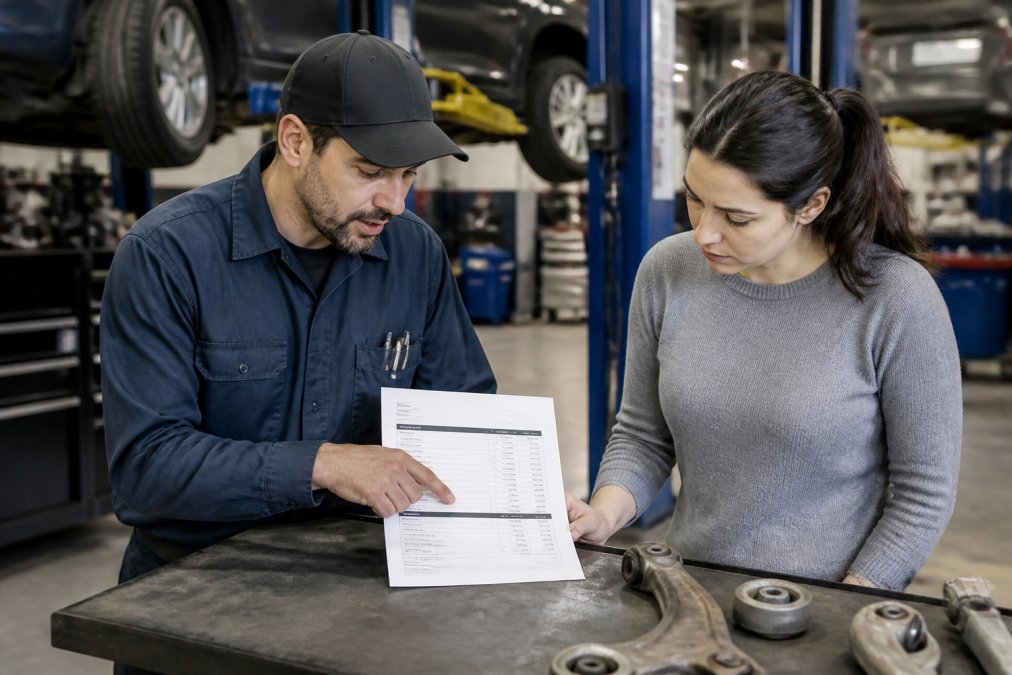
Vague descriptions on the estimate. “Suspension work: $1,500” tells you nothing. A legitimate estimate lists each part, labor hours, and hourly rate. Vagueness hides the breakdown and makes comparison shopping impossible.
Pressure to authorize additional work immediately. A shop calls mid-repair claiming they “found more damage” and need approval to proceed. Sometimes this is legitimate. Sometimes it’s a tactic to lock you into additional charges. Ask for photos and a written estimate before authorizing extra work.
Refusal to show you the damaged part. A reputable mechanic will show you the problem before and after repair. Photos count. If a shop won’t document the damage, question why.
Significantly higher quotes than competitors. One quote at $2,500 when others are $1,200 for the same work deserves investigation. Ask why the difference. Sometimes higher quotes reflect better parts or more thorough work. Sometimes they reflect padding.
Hourly rates that don’t match local standards. Research what independent shops and dealerships charge in your area. A rate significantly higher than the local average needs justification.
No written warranty on the work. Reputable shops guarantee their labor for at least 12 months. If a shop won’t put the warranty in writing, that’s a red flag.
Pressure to use their parts supplier. Some shops require you to use their parts. This isn’t inherently wrong, but it prevents you from shopping for better prices elsewhere. Transparent shops let you source your own parts or explain why their supplier is necessary.
How to Avoid Hidden Fees and Protect Your Wallet
Hidden fees inflate your final bill beyond the original estimate. Learning where they hide helps you catch them before you’re charged.
Diagnostic fees. A diagnostic fee is legitimate, it covers the mechanic’s time to identify the problem. But some shops charge excessive diagnostic fees ($150+) then pressure you to authorize repairs immediately. Ask upfront what the diagnostic costs. Reputable shops often waive it if you authorize repairs.
Shop supplies and environmental fees. These small charges add up. A $50 “shop supplies” fee plus a $25 “environmental disposal” fee plus a $15 “tire rotation” fee can add $100 to your bill. Ask what these fees cover. Some are legitimate. Others are padding.
Upsells during the repair. The most common hidden fee comes mid-repair when the shop calls claiming they found additional damage. Sometimes this is real. Sometimes it’s an upsell tactic. Always ask for photos and a written estimate before authorizing extra work.
Inflated labor hours. The service manual specifies how long a job should take. Some shops estimate higher hours than the manual allows. Cross-reference the estimate against the manual. Many online resources show standard labor times for your vehicle.
Parts markup. Some shops mark up parts 50-100% above cost. Transparent shops disclose their markup or let you source parts yourself. If a shop refuses to disclose markup, that’s suspicious.
Warranty disclaimers. Read the fine print on your warranty. Some shops warranty only the parts, not the labor. Others exclude certain conditions. Understand what’s covered before you sign.
The best protection is a written, itemized estimate before work starts. It should list every part, labor hours, hourly rate, and any additional fees. Compare it to estimates from other shops. If something doesn’t match, ask before authorizing the work.
Suspension repairs are expensive, and the costs vary dramatically between shops. The difference often comes down to transparency and honesty. At TIPS Automotive, our certified technicians provide detailed diagnostics, itemized estimates, and transparent communication throughout the repair process. We handle suspension work with the same care we give to every repair. Call now and schedule your suspension inspection.
Frequently Asked Questions
How can I tell if a mechanic is overcharging me for suspension work?
Watch for vague invoices that don’t itemize parts and labor separately, pressure to replace entire assemblies when only one component failed, and quotes that jump dramatically from shop to shop without explanation. Request a written estimate before work begins and ask the mechanic to show you the damaged parts using the ‘Show Me’ method. A reputable shop will explain exactly which suspension components (struts, shock absorbers, control arms, ball joints) need replacement and why.
What questions should I ask a mechanic before suspension work begins?
Ask for a written estimate with itemized labor hours and parts costs clearly separated. Request they explain which specific suspension system components are failing and why replacement is necessary. Ask about their diagnostic fee and whether it applies toward the final repair cost. Inquire about warranty coverage on parts and labor. Ask if they use OEM or aftermarket parts and the price difference. Finally, ask about their shop rate per hour so you understand labor costs.
How do I get a second opinion on car repairs without seeming difficult?
Simply tell the first mechanic you’d like to get a second opinion before approving major work. Most reputable shops expect this and won’t take offense. Request a copy of their diagnostic findings and written estimate to share with another independent mechanic. A second opinion costs far less than paying for unnecessary repairs. Compare what each shop recommends, their itemized invoices, and their reasoning for parts replacement. If recommendations differ significantly, ask each mechanic to explain the discrepancy.
What is a typical average cost of suspension repair?
Suspension repair costs depend heavily on which components need replacement, your vehicle’s make and model, and whether you choose OEM or aftermarket parts. A single strut or shock absorber replacement typically costs less than replacing control arms or ball joints. Labor hours also vary: some repairs take 1-2 hours while others require 4-6 hours. Rather than guess at costs, get written estimates from multiple shops in your area. Request a diagnostic fee upfront so you know exactly what you’re paying for inspection versus parts and labor.


Comments are closed