

Subtotal $0.00


Table of Contents
- Why Drivers Look for a Wrights Car Care Alternative for Maintenance
- Quick Comparison: Top Car Care Alternatives for Maintenance
- TIPS Automotive: Full-Service Maintenance With Free Pickup and Drop-Off
- Openbay: Compare Local Quotes Before You Book
- Kwik Kar: National Chain With ASE-Certified Technicians
- Kelley Blue Book Repair Advisor: Verify Quotes Before You Pay
- Midas International: Nationwide Access to Routine Maintenance
- When to Choose Aftermarket vs OEM Parts for Maintenance
- Average Cost of Car Maintenance: What Drives the Price
- How to Find an Honest Mechanic: A Vetting Checklist
- DIY vs Professional Maintenance: What You Can Safely Handle
- Warranty Preservation: Keeping Your Coverage Intact
- Conclusion
- Frequently Asked Questions
Last Updated: September 13, 2026
Why Drivers Look for a Wrights Car Care Alternative for Maintenance
Drivers searching for a Wrights car care alternative for maintenance usually aren’t chasing a lower price. They want a shop that explains the work before doing it, quotes honestly, and doesn’t treat every visit like a sales opportunity. That’s the gap a good car care alternative fills.
At TIPS Automotive, we hear the same concern constantly: “How do I know you’re not just going to tell me I need a bunch of work I don’t actually need?” It’s a fair question. Maintenance is one of the few purchases where the seller also diagnoses what you’re buying, and that imbalance is exactly why so many owners start comparing shops.
The practical fix isn’t loyalty to any single brand. It’s understanding what each type of provider does well, what it costs, and how to vet the person turning the wrench. Below, we break down the real options, the pricing models behind them, and the checklist that separates an honest shop from a pushy one.
Quick Comparison: Top Car Care Alternatives for Maintenance
The best car care alternative depends on what you value most: convenience, price transparency, national consistency, or a relationship with a local mechanic who knows your vehicle. There is no single winner for every driver, and anyone who tells you otherwise is selling something.
Here’s how the main options stack up before we dig into each one.
Comparison Table: Services, Pricing Model, and Best For
| Provider | Services | Pricing Model | Best For |
|---|---|---|---|
| TIPS Automotive | Full-service maintenance, diagnostics, emissions testing | Quote-based, transparent | Drivers wanting local, honest full-service care |
| Openbay | Quote comparison marketplace | Free to compare; subscription tier | Comparing local prices before booking |
| Kwik Kar | Oil changes to mechanical repair | Fee-for-service | Standardized, warranty-backed work |
| KBB Repair Advisor | Cost benchmarks and repair advice | Free tool | Verifying whether a quote is fair |
| Midas | Brakes, tires, oil, inspections | Fee-for-service | Routine maintenance with national access |
Notice what this table reveals: only one of these is a shop that actually touches your car. The rest are tools, marketplaces, or chains. That distinction matters more than most drivers realize.
TIPS Automotive: Full-Service Maintenance With Free Pickup and Drop-Off
TIPS Automotive is a full-service auto repair center that handles everything from routine oil changes to complex mechanical repairs, check engine diagnostics, and emissions testing. For drivers who want one shop that can cover the whole vehicle, it removes the hassle of juggling three different providers for three different problems.
The convenience angle is real. Free pickup and drop-off within a 10-mile radius means you don’t have to rearrange your day around a service appointment. Same-day service helps too, especially for commuters dealing with a check engine light that won’t wait.
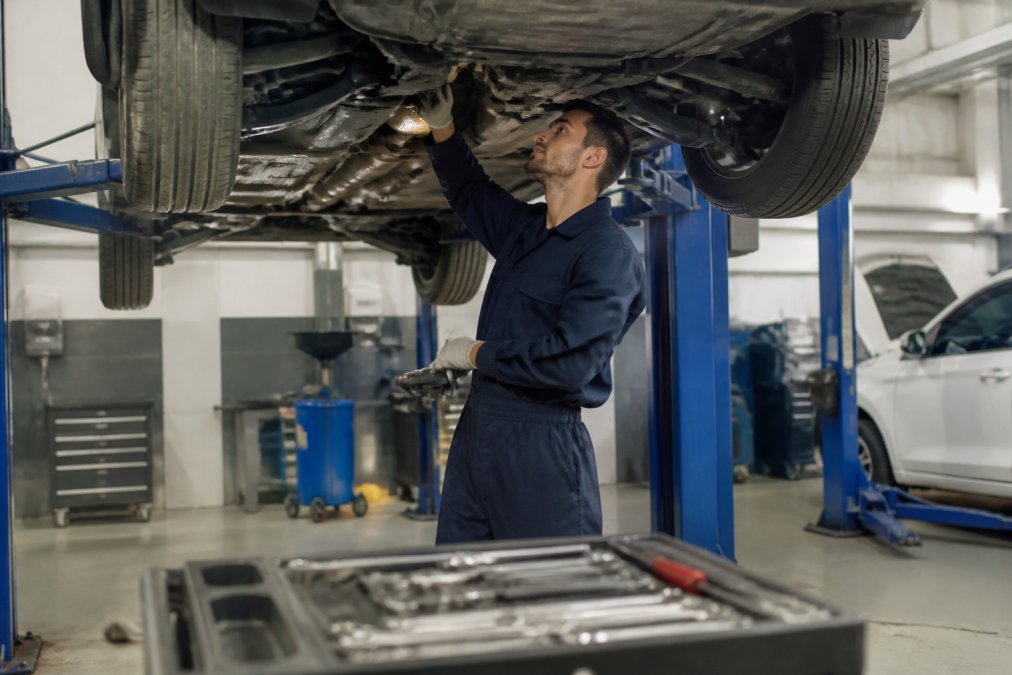
What sets it apart is the combination of old-school honesty and modern diagnostic technology. Our technicians are trained and certified, and the shop handles factory-scheduled maintenance as well as bumper-to-bumper repairs.
Pros and Cons
Pros:
- Certified technicians for diagnostic, maintenance, and repair work
- Free pickup and drop-off within a 10-mile radius
- Same-day service and flexible scheduling
- Emissions testing for 1996 and newer vehicles, usually 10 minutes or less
- Transparent approach that prioritizes trust over upselling
Cons:
- Service area is limited to the local region, so it won’t help drivers outside the pickup radius
- As an independent shop, it doesn’t carry the national brand recognition of a franchise chain
The honest limitation here is geography. If you’re outside the service area, the pickup perk disappears. But for local drivers, that trade-off is easy to accept.
Openbay: Compare Local Quotes Before You Book
Openbay is an online marketplace that lets you compare auto repair and maintenance pricing from local mechanics and book an appointment through the platform. If your main worry is overpaying, it gives you a way to see competing quotes side by side before committing.
The model is straightforward: free to compare, with an optional Openbay+ subscription that offers additional discounts on maintenance. For drivers who like to shop around, it’s a reasonable starting point.
Pros and Cons
Pros:
- Simplifies finding competitive local pricing
- Provides access to verified service providers
- Free to use for basic quote comparison
Cons:
- The number of participating shops depends heavily on your geographic area
- It’s a middleman, not a shop, so you still have to evaluate the actual mechanic
The Gap Quote Marketplaces Don’t Close
Here’s the problem with treating a quote marketplace as your answer: a low quote is not the same as a fair quote, and a fair quote is not the same as a correct diagnosis. Marketplaces compete on price visibility, not on diagnostic honesty. Two shops can quote the same brake job at $180 and $340, and the cheaper one may be quoting pads only while the other is quoting pads, rotors, and a fluid flush. The number on the screen doesn’t tell you which.
That’s why the vetting framework below matters more than the quote itself. Use the marketplace to gather data points, then apply the same criteria you’d apply to any shop.
Vetting Criteria for a Reliable Mechanic
Before you book through any marketplace, run the shop through this framework. It’s the same one you’d use on a local independent or a chain:
- Certifications: Look for ASE certification (Automotive Service Excellence). ASE certifies technicians across eight main areas, including brakes, electrical, engine repair, and heating/air conditioning. A shop with multiple ASE-certified techs has verifiable, tested competency, not just a sign on the wall.
- Equipment: Ask whether they have factory-level scan tools or only generic OBD-II readers. A generic reader pulls codes; a factory-level tool reads live data, bidirectional controls, and manufacturer-specific parameters. For anything beyond a basic check engine light, this distinction changes the diagnosis.
- Transparency: Request a written estimate that separates parts and labor, and ask them to show you the failed part or explain the diagnostic code in plain English before authorizing work.
- Warranty: Ask what the shop warrants, parts only, labor only, or both, and for how long. A 12-month/12,000-mile warranty is a common baseline; anything shorter deserves a question.
- Reviews: Read for patterns, not star ratings. One angry review is noise; five reviews mentioning the same upsell tactic is a signal.
Cost-Benefit: Independent Shop vs. Dealership
Most quote-comparison tools push you toward independents because their labor rates are lower. That’s usually true, independent labor rates commonly run below dealership rates in the same market, but the full comparison is more nuanced:
- Dealership advantages: Factory-trained technicians, manufacturer-specific diagnostic tools, OEM parts as default, and warranty work handled in-house. For a vehicle still under factory warranty, or for a complex electronic or transmission issue, this can be worth the premium.
- Independent advantages: Lower labor rates, more flexibility on aftermarket parts, and often a direct relationship with the owner or lead tech. For routine maintenance and out-of-warranty repairs, the savings are real.
- The hidden variable: Diagnostic accuracy. A cheaper shop that misdiagnoses costs more than an expensive shop that gets it right the first time. This is where vetting beats price-shopping.
The practical move: use a marketplace to see the range of quotes, then use the vetting criteria above to pick the shop you’d actually trust with the keys, not just the one with the lowest number.
Pro Tip
Ask each shop the same three questions before booking: “Are your techs ASE-certified?”, “What scan tool do you use for my vehicle?”, and “What’s your parts and labor warranty?” The answers will separate the shops faster than any price comparison.
Ask each shop the same three questions before booking: “Are your techs ASE-certified?”, “What scan tool do you use for my vehicle?”, and “What’s your parts and labor warranty?” The answers will separate the shops faster than any price comparison.
Kwik Kar: National Chain With ASE-Certified Technicians
Kwik Kar is a national chain of auto repair and maintenance centers staffed by ASE-certified technicians, offering everything from oil changes to complex mechanical repairs. The appeal is consistency: the same standards, roughly the same experience, wherever you drive.
Warranty-backed repair services add a layer of reassurance, and face-to-face consultations mean you’re not left guessing about what’s happening under the hood. For drivers who move frequently or travel, that predictability has value.
Pros and Cons
Pros:
- Consistent service standards across locations
- Strong focus on certified professional expertise
- Warranty-backed repairs
Cons:
- Pricing may run higher than independent local shops
- Quality can still vary by individual location and staff
The trade-off is familiar: you pay a bit more for the brand and the warranty, and you give up some of the personal relationship a local shop provides.
Kelley Blue Book Repair Advisor: Verify Quotes Before You Pay
The Kelley Blue Book Repair Advisor is a free digital tool that provides fair market pricing estimates for common vehicle repairs and maintenance. It won’t fix your car, but it will tell you whether the quote in your hand is reasonable.
That’s a genuinely useful function. If a shop quotes you a number and you have no reference point, you’re negotiating blind. KBB’s repair-vs-replace insights and cost comparisons against your vehicle’s Blue Book value give you a benchmark.
Pros and Cons
Pros:
- Provides objective, data-driven cost benchmarks
- Free to use
- Helps prevent overpaying for routine services
Cons:
- Does not offer booking or connect you to local shops
- Estimates are general and may not reflect your specific market
Treat it as a sanity check, not a final answer. Local labor rates vary, and a benchmark is only as good as the inputs behind it.
Midas International: Nationwide Access to Routine Maintenance
Midas International is a large-scale automotive service franchise offering brakes, tires, oil changes, and comprehensive inspections through a nationwide network. If you want a familiar name and easy access, it delivers both.
Standardized maintenance packages and online appointment scheduling make it simple to book, and the sheer number of locations means you’re rarely far from one.
Pros and Cons
Pros:
- High accessibility with numerous locations
- Well-established reputation for routine maintenance
- Online scheduling and standardized packages
Cons:
- Service quality can vary by franchise ownership
- Less suited to specialized or complex diagnostics
Franchise variation is the real caveat. Two Midas shops can feel like two different companies depending on who owns them.
When to Choose Aftermarket vs OEM Parts for Maintenance
The short answer: aftermarket parts are usually fine for wear items like brake pads, filters, and batteries, while OEM parts make more sense for sensors, electronic components, and anything tied to a warranty or factory calibration. When you’re weighing when to choose aftermarket vs OEM parts, match the part to the job rather than defaulting to one category.
Here’s the practical breakdown:
- Aftermarket is the better call for: brake pads and rotors, filters, wiper blades, batteries, and most suspension wear items. You often get equal or better quality at a lower price.
- OEM is worth the premium for: oxygen sensors, mass airflow sensors, transmission components, and anything a manufacturer specifies for a factory schedule.
- Always check your warranty first: some coverage requires OEM parts for certain repairs.
A common mistake is assuming OEM is always superior. It isn’t. For many wear items, a quality aftermarket part performs identically and costs less. The reverse mistake, cheaping out on a critical sensor, can trigger a check engine light and a repeat visit.
Average Cost of Car Maintenance: What Drives the Price
The average cost of car maintenance varies widely based on your vehicle, your region, and the type of shop you choose. Rather than chase a single national number, it helps to understand what actually moves the price up or down, and how to tell whether a quote is fair.
The Four Levers That Move Your Bill
1. Labor rate. This is the hourly rate a shop charges for technician time, and it’s the single biggest swing factor between providers. Dealerships typically charge the highest labor rates in a market, national chains sit in the middle, and independent shops usually charge the least. The rate is posted or available on request, ask for it before you approve any work. A shop that won’t tell you its labor rate is a shop to skip.
2. Book time vs. actual time. Most shops quote from a labor guide (commonly Mitchell 1 or MOTOR), which assigns a standard number of hours to each job regardless of how long it actually takes. That’s normal and industry-standard. What matters is whether the shop is quoting the correct operation. A brake job quoted at 1.0 hour may be pads only; the same job with rotors and a fluid flush is a different operation with a different book time. Ask what operation is being quoted.
3. Parts sourcing. OEM parts cost more than quality aftermarket equivalents, sometimes substantially. For wear items, brake pads, filters, batteries, wiper blades, a quality aftermarket part often performs identically at a lower price. For sensors, electronic components, and anything tied to factory calibration, OEM is usually the safer call. The parts line on your estimate should name the brand or at least the tier (OEM, OE-equivalent, or economy).
4. Vehicle complexity. Luxury and specialized vehicles often require more labor time, specialized tools, and sometimes a dealer-only scan tool for certain procedures. A job that books at 1.5 hours on a mainstream sedan can book at 3.0 hours on a European luxury model. This isn’t a shop upcharging, it’s the labor guide reflecting real differences in access and procedure.
How to Benchmark a Quote Before You Approve It
You don’t need to memorize prices. You need a reference point. Here’s a practical process:
- Get the quote in writing with parts and labor separated.
- Check it against a benchmark tool. Kelley Blue Book’s Repair Advisor and similar free estimators provide fair-market ranges for common repairs. They’re general, not market-specific, but they’ll flag a quote that’s wildly out of range.
- Call one competing shop and read them the same operation. Ask for their quote on the identical job. Two data points beat one.
- Ask what’s included. Does the brake quote include a fluid flush? Does the oil change include a filter and a multi-point inspection? Comparing a bare quote to a bundled one is apples to oranges.
The Cost of Skipping Maintenance
The cheapest maintenance bill is the one you pay on schedule. Skipping an oil change interval doesn’t save money, it accelerates wear and can lead to sludge, oil consumption, and eventually engine damage that costs many times the skipped service. The same logic applies to transmission fluid, coolant, and brake fluid. These are the services most often deferred and the ones most likely to produce a large repair bill later.
A common pattern: a driver defers a $120 transmission fluid service, then faces a transmission replacement years later. The math isn’t close. Scheduled maintenance is the highest-return spending you can do on a vehicle.
Key Takeaway
The honest answer to “what should this cost?” is: get a written quote, benchmark it against a free estimator, and compare it to one competing shop on the identical operation. That three-step process catches overpricing without requiring you to become a mechanic.
The honest answer to “what should this cost?” is: get a written quote, benchmark it against a free estimator, and compare it to one competing shop on the identical operation. That three-step process catches overpricing without requiring you to become a mechanic.
Because pricing depends on your specific vehicle and market, the honest move is to request a written quote and compare it against a benchmark tool before you approve any work.
How to Find an Honest Mechanic: A Vetting Checklist
Finding an honest mechanic comes down to verification, not vibes. The shops worth your trust will happily answer questions, show you the problem, and put the estimate in writing before they start.
Use this checklist before you hand over your keys:
- Confirm the shop’s technicians are certified, and ask to see proof
- Request a written estimate that separates parts and labor
- Ask them to show you the failed part or explain the diagnostic code in plain English
- Check whether they offer a warranty on parts and labor
- Look for clear, itemized invoices rather than vague line items
- Ask how they handle work that’s discovered mid-repair
- Read recent reviews for patterns, not just star ratings
If a shop dodges the “show me the part” request or refuses to itemize, that’s your answer. Walk away.
Pro Tip
Ask the shop to photograph the worn or failed part and text it to you before authorizing the repair. Honest shops do this without hesitation, and it gives you a record if you ever need to dispute a charge.
Ask the shop to photograph the worn or failed part and text it to you before authorizing the repair. Honest shops do this without hesitation, and it gives you a record if you ever need to dispute a charge.
DIY vs Professional Maintenance: What You Can Safely Handle
Some maintenance genuinely belongs in your driveway, and some of it doesn’t. Knowing the line saves you money on the easy jobs and prevents expensive mistakes on the hard ones.
Safe to DIY:
- Wiper blade replacement
- Air filter and cabin filter changes
- Checking and topping off fluids
- Battery terminal cleaning
- Tire pressure checks and basic bulb swaps
Better left to a professional:
- Brake system inspection and repair
- Electrical system diagnostics
- Transmission service
- Suspension and undercarriage work
- Anything that triggers a check engine light
The line isn’t about difficulty alone. It’s about consequences. A botched oil change is annoying; a botched brake job is dangerous. When a repair involves safety systems, electronic diagnostics, or factory calibration, a certified technician with the right equipment is the cheaper choice in the long run.
Watch Out
Clearing a check engine light by disconnecting the battery doesn’t fix anything. It wipes the diagnostic codes, hides the real problem, and can mask an issue that’s actively damaging your engine. Get the code read properly instead.
Clearing a check engine light by disconnecting the battery doesn’t fix anything. It wipes the diagnostic codes, hides the real problem, and can mask an issue that’s actively damaging your engine. Get the code read properly instead.
Warranty Preservation: Keeping Your Coverage Intact
You can maintain your vehicle at an independent shop without voiding your warranty, provided you follow the manufacturer’s specified service intervals and keep records. This is one of the most misunderstood points in auto maintenance, and it costs drivers money every year.
To protect your coverage:
- Follow the factory maintenance schedule in your owner’s manual
- Keep every receipt and invoice, including dates and mileage
- Use parts that meet or exceed the manufacturer’s specifications
- Document any diagnostic work, not just the repairs
The key phrase is “meets specification.” A shop that uses quality parts and logs the work correctly keeps your warranty intact. What voids coverage is neglect, not the name on the building. If you’re ever unsure, ask the shop to note the parts used and the mileage on your invoice.
Conclusion
The real challenge with car maintenance isn’t finding a shop. It’s finding one that diagnoses honestly, quotes transparently, and stands behind the work. That’s the standard every driver deserves, and it’s the reason so many owners start looking for a better alternative in the first place.
At TIPS Automotive, that standard is the whole point. Our certified technicians handle everything from routine oil changes to complex diagnostics and emissions testing, with same-day service and free pickup and drop-off within a 10-mile radius. We combine old-school honesty with modern diagnostic technology, and we explain every recommendation in plain English before you approve it.
Call now and schedule your service with TIPS Automotive, and get maintenance you can actually trust.
Frequently Asked Questions
What is the $3000 rule for car repairs?
The $3000 rule is a general guideline some drivers use: if a repair estimate exceeds $3,000, it may be worth evaluating whether the vehicle’s value justifies the cost. This threshold is not universal. A better approach is to compare the repair cost against your car’s current market value using a tool like Kelley Blue Book. If the repair costs more than 50% of the vehicle’s value, replacement may make more financial sense. Always get a second opinion before making that call.
How do I know if a mechanic is being honest about repairs?
Ask for a written estimate with parts and labor broken down separately. A trustworthy shop will explain why each repair is needed in plain language and show you the failed component when possible. Cross-check the quote against fair market pricing tools. Look for shops that offer transparent communication and do not pressure you into same-day decisions on non-urgent work. Reviews mentioning honesty and clear explanations are a strong signal.
What is the difference between OEM and aftermarket parts for maintenance?
OEM parts are manufactured by the same company that built your vehicle and meet factory specifications. Aftermarket parts are made by third-party companies and vary widely in quality. For critical components like brake pads or timing belts, OEM or high-quality aftermarket parts are worth the cost. For filters, wiper blades, and similar wear items, quality aftermarket options work well and often cost less. Check your warranty terms before choosing aftermarket for covered repairs.
What are the benefits of choosing an independent auto repair shop over a dealership?
Independent shops often charge less for the same maintenance because their overhead is lower than dealership service departments. You typically get more direct communication with the technician working on your car. Many independent shops, like TIPS Automotive, offer same-day service and free pickup and drop-off. They can also handle factory-scheduled maintenance, so you do not lose warranty coverage by going independent. The key is choosing a shop with certified technicians and transparent pricing.
How much does routine car maintenance cost on average?
The average cost of car maintenance depends on your vehicle type, the service needed, and where you go. Oil changes, tire rotations, and inspections are the most common recurring expenses. Costs rise for services like brake replacement, transmission fluid exchange, or suspension repair. Dealerships typically charge more than independent shops for identical work. Request an itemized quote from any shop before authorizing work, and compare it against fair market estimates to avoid overpaying.


Comments are closed