

Subtotal $0.00

Table of Contents
- Why Unnecessary Car Repairs Happen
- Step 1: Follow the Owner’s Manual, Not the Shop’s Script
- Step 2: Learn the Common Upsold Car Maintenance Services
- Step 3: Spot the Signs a Mechanic Is Overcharging You
- Step 4: Use Digital Diagnostics to Verify the Problem
- Step 5: How to Read a Car Repair Estimate Line by Line
- Step 6: Get a Second Opinion Without Burning Bridges
- Common Mistakes That Lead to Unnecessary Repairs
- Build a Preventative Maintenance Schedule That Saves Money
- Your Action Plan for Honest Auto Repair
- Frequently Asked Questions
Last Updated: September 7, 2026
Why Unnecessary Car Repairs Happen
Unnecessary car repairs are work a shop recommends but your vehicle does not need, costing American drivers billions each year. The root cause is an information gap: you know less than the mechanic, and some shops exploit that imbalance.
You do not need to become a certified technician to protect yourself, just a repeatable system for evaluating recommendations and communicating clearly. At TIPS Automotive, we built our practice around transparency.
Below are six concrete steps to avoid unnecessary car repairs, plus common mistakes that lead to overpaying and how to build a preventative maintenance schedule that saves money.
Step 1: Follow the Owner’s Manual, Not the Shop’s Script
Your owner’s manual is the single most authoritative document for your vehicle’s maintenance needs, and it should be your first reference before any service decision. Manufacturers engineer vehicles with specific service intervals based on testing, and deviating from those intervals without cause is where most unnecessary work begins.
The conflict arises when a shop’s “recommended maintenance” does not match your manual’s schedule. A service advisor might suggest a transmission fluid flush at 30,000 miles when your manual specifies 60,000 miles, or recommend fuel injector cleaning as part of a routine oil change. When you hear a recommendation that contradicts your manual, ask the advisor to show you the manufacturer’s requirement in writing.
Keep a copy of your maintenance schedule in your glove box or a photo on your phone. When an advisor makes a recommendation, reference the schedule and ask why their suggestion differs from the factory spec, this filters out unnecessary car repairs before they reach your invoice.
Watch Out
Never authorize work based on a verbal “it’s due for this” without seeing the factory interval in writing. Shops that cannot point to a manufacturer recommendation for a service are often relying on upselling rather than actual vehicle need.
Never authorize work based on a verbal “it’s due for this” without seeing the factory interval in writing. Shops that cannot point to a manufacturer recommendation for a service are often relying on upselling rather than actual vehicle need.
Step 2: Learn the Common Upsold Car Maintenance Services
The most common unnecessary car repairs fall into a predictable set of high-margin services: fuel injector cleaning, transmission fluid flushes, engine oil flushes, and “complete” cooling system services are frequently sold to drivers who do not meet the mileage or condition thresholds.
Understanding what these services do helps you evaluate the pitch. Fuel injector cleaning is only necessary when injectors are clogged, producing symptoms like rough idling or poor acceleration; a shop recommending it without diagnostic findings is working from a script. Transmission fluid flushes are valuable at the right interval, but doing them too early can disrupt the fluid’s chemical balance.
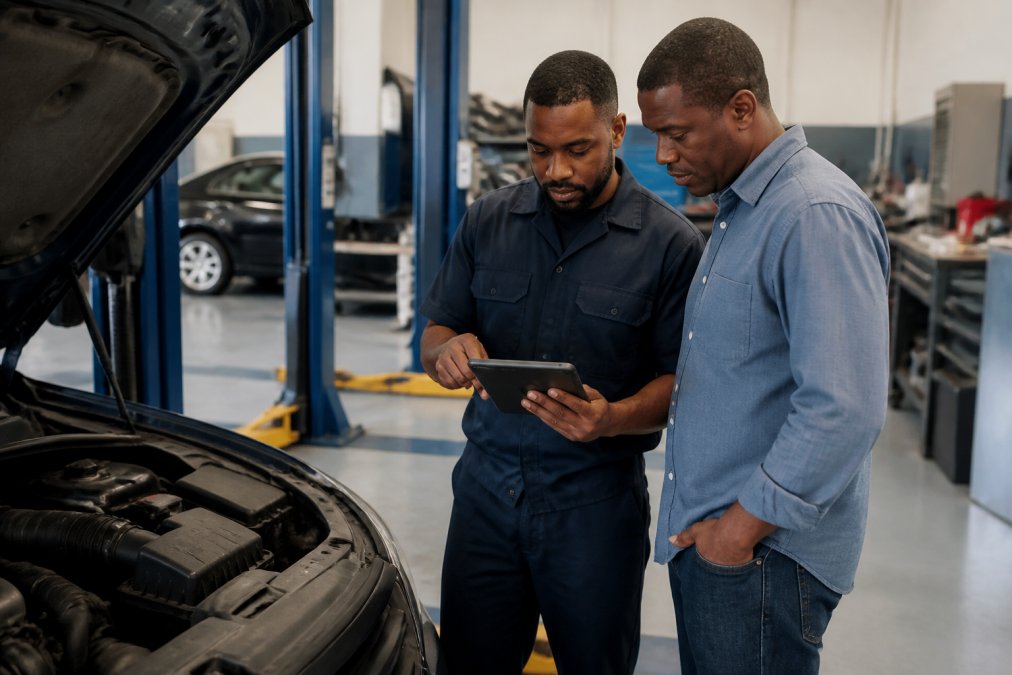
Categorize any recommended service into three buckets: factory-scheduled maintenance (follows your manual), condition-based repairs (address a verified symptom or code), and discretionary services (question these, they are often sold on convenience rather than necessity).
| Service | Typical Pitch | What to Ask | When It Is Legitimate |
|---|---|---|---|
| Fuel injector cleaning | “Part of routine maintenance” | “What diagnostic test showed clogging?” | Rough idle or misfire codes present |
| Transmission fluid flush | “Every 30,000 miles” | “What does my manual specify?” | Mileage matches factory interval |
| Engine oil flush | “Removes sludge” | “Is sludge actually present?” | Severe maintenance neglect documented |
| Cooling system service | “Prevents overheating” | “What is the condition of the coolant?” | Coolant contaminated or interval reached |
Step 3: Spot the Signs a Mechanic Is Overcharging You
The signs a mechanic is overcharging are often visible before you see the bill. A shop that refuses to show old parts, pressures you with “do it now or risk damage” language, or gives vague answers is signaling that profit matters more than your vehicle’s health.
The Visual Verification Method: Know What “Worn” Actually Looks Like
The single most effective way to cut through upselling is to ask to see the part and know what a genuinely failed component looks like. Most advisors will back down when you ask for visual proof. Here is a quick reference for common “wear items”:
- Brake Pads: A healthy pad has at least 3/32 of an inch of friction material remaining. If you can see the pad through the wheel spokes, look for a flat surface. If it is down to the metal backing plate or you see deep grooves, it is genuinely worn. A common upsell is replacing pads at 50% life, which is unnecessary.
- Air Filter: Hold it up to the sun or a bright light. If light passes through the pleats easily, it is fine. If it is so dark and clogged that light barely penetrates, it needs replacing. A filter with a few dead bugs or light dust is not a “severe” condition.
- Serpentine Belt: Look for cracks on the ribbed side of the belt. Small, superficial cracks are normal. You need a new belt only if you see missing chunks, frayed edges, or a shiny, glazed surface. If the belt is merely dry, it does not need immediate replacement.
- Coolant: If the shop recommends a flush, ask to see the coolant in the overflow tank. Healthy coolant is bright green, orange, or pink (depending on the type). If it looks rusty, muddy, or has particles floating in it, that is a legitimate reason for service.
Pro Tip
When a shop recommends a replacement, say: “Can you show me the part and point out the specific defect?” A technician who is confident in their diagnosis will walk you to the bay and show you. A shop that hesitates or gives you a story about “shop policy” is likely relying on your inability to verify.
When a shop recommends a replacement, say: “Can you show me the part and point out the specific defect?” A technician who is confident in their diagnosis will walk you to the bay and show you. A shop that hesitates or gives you a story about “shop policy” is likely relying on your inability to verify.
The “Cascade” and the “Urgency” Scripts
A clear warning sign is a recommendation that escalates quickly, you bring the car in for an oil change and leave with four additional services. A sudden cascade without diagnostic evidence should raise your suspicion.
When you hear the urgency pitch, use this script to slow the conversation down without being confrontational:
“I appreciate you flagging this. Before I authorize anything, I want to do a quick visual check myself and compare this against my owner’s manual schedule. Can you write up the estimate with the specific part numbers and the diagnostic code or measurement that supports this? I’ll make a decision today, but I need to see the evidence first.”
This response signals you are not an impulse buyer, forces a written itemized justification, and gives you time away from the service desk. A legitimate shop will have no problem with this; an overcharging shop will become defensive or guilt you into acting.
Labor Time: The Hidden Inflation Point
Another tactic is quoting excessive labor times. Brake pad replacement typically takes one to two hours; a shop quoting several is inflating the cost. Ask for the book labor time on any significant repair and expect the advisor to explain their calculation.
Most common jobs have a standard “book time”: a front brake pad replacement on a typical sedan is often 1.5 to 2.0 hours; an alternator replacement might be 1.5 to 2.5 hours. If the estimate shows double that, ask the advisor to explain, they may have a legitimate reason, but they should articulate it.
Watch Out
Be wary of shops that quote a flat “diagnostic fee” that is non-refundable if you decline the repair. While some diagnostic time is legitimate, a fee that is used as a penalty for not authorizing work is a coercive tactic. Ask upfront what the diagnostic fee covers and whether it is applied to the repair cost if you proceed.
Be wary of shops that quote a flat “diagnostic fee” that is non-refundable if you decline the repair. While some diagnostic time is legitimate, a fee that is used as a penalty for not authorizing work is a coercive tactic. Ask upfront what the diagnostic fee covers and whether it is applied to the repair cost if you proceed.
Combining visual verification with calm, specific questions transforms you from a passive customer into an informed inspector, the most effective defense against an inflated bill.
Step 4: Use Digital Diagnostics to Verify the Problem
A modern OBD-II scanner is the most cost-effective tool for avoiding unnecessary car repairs, letting you verify what your car reports before authorizing work. It plugs into a port under your dashboard and reads the diagnostic trouble codes that trigger your check engine light.
Many auto parts stores read codes for free, and basic scanners are inexpensive. When a shop says you need a new oxygen sensor or catalytic converter, ask for the specific code and research it. P0420, for example, indicates a converter efficiency issue but can also be caused by a failing oxygen sensor or exhaust leak, far cheaper repairs.
Arriving with information changes the conversation. Instead of “the check engine light is on,” say “I pulled code P0301, a cylinder 1 misfire. What did your diagnostic process find beyond that?” This forces the advisor to explain their reasoning.
Step 5: How to Read a Car Repair Estimate Line by Line
Learning to read a car repair estimate is one of the most valuable skills you can develop, because the estimate is where unnecessary car repairs become official. Every estimate should list specific parts, labor, and the reason for the repair; vague line items like “general maintenance” warrant clarification before you sign.
A legitimate estimate breaks into parts, labor, and shop supplies. Parts should list specific names and whether they are OEM or aftermarket; labor should show hours and hourly rate; shop supplies should be modest, not a significant portion of the total.
For each line item, ask: What specific part or service is being performed? What diagnostic evidence supports it? Is it necessary for safe operation or preventative? The answers reveal whether it is a necessary repair or an upsell.
Step 6: Get a Second Opinion Without Burning Bridges
Getting a second opinion on a significant repair is smart, and you can do it without offending the original shop by framing it as a financial decision. “This is a larger expense than I expected, and I want to compare pricing before I commit” keeps the relationship professional.
The 3-Step Second Opinion Protocol
A second opinion is about validating the diagnosis, not just price. Follow this three-step protocol:
Step 1: The Phone Call. Before you even bring your car to a second shop, call them and describe the situation. Do not just say “I need a second opinion.” Instead, say:
“I have a written estimate from another shop for a [specific repair, e.g., catalytic converter replacement] on a [year, make, model]. The estimate is for $1,200. I’m not questioning the diagnosis, but I want a second set of eyes on the vehicle before I spend that much. Can you do a diagnostic check and give me a written quote? What is your diagnostic fee?”
This call filters out uninterested shops, sets clear expectations, and lets you gauge professionalism before investing time in a visit.
Step 2: The Visit. Bring the original estimate and diagnostic codes, but do not hand them over immediately. Let the technician perform their own inspection first, then show them the first estimate and ask:
“Here is what the other shop recommended. Based on your inspection, do you agree with this diagnosis? Is the scope of work appropriate, or is there anything on this list that you would consider optional or premature?”
This phrasing invites a technical critique rather than a price comparison. A reputable shop will tell you if the first shop over-prescribed or missed something.
Step 3: The Decision. With two independent assessments, if both agree on the core repair, proceed with confidence, choosing the better combination of price, warranty, and convenience. If they disagree, ask the second shop to explain why; trust the one with more concrete evidence.
What to Do If the Second Opinion Is Cheaper
Taking a lower quote back to the original shop rarely causes friction, and in most cases you do not need to go back. If you prefer to stay but want them to match the price, say:
“I had a second shop look at this, and they quoted me a lower price for the same work. I would prefer to have you do the repair, but I need you to come closer to that number. Can you review the estimate and see if there is any flexibility on the labor rate or parts?”
This is normal negotiation. Many shops will match a competitor’s price to keep your business, especially if the difference is significant. If they refuse, you have your answer.
The “Second Opinion” on Preventative Services
The second opinion is also valuable for vague, preventative recommendations that accompany routine maintenance. If a shop recommends a service not in your owner’s manual (like a fuel injector cleaning at 30,000 miles), call another shop and ask:
“I was told I need a fuel injector cleaning on my [year, make, model] at 30,000 miles. My manual doesn’t mention it. Is this a standard service for this vehicle, or is it condition-based?”
This question often reveals the service is a discretionary upsell, saving you from an unnecessary expense.
Key Takeaway
The goal of a second opinion is not to find the cheapest mechanic; it is to find the most accurate diagnosis. By structuring your request around technical validation rather than just price, you get the information you need to make a confident decision without damaging your relationship with any shop.
The goal of a second opinion is not to find the cheapest mechanic; it is to find the most accurate diagnosis. By structuring your request around technical validation rather than just price, you get the information you need to make a confident decision without damaging your relationship with any shop.
This protocol turns a potentially awkward conversation into a routine, professional process, protecting your budget and ensuring the repairs you authorize are the ones your vehicle actually needs.
Common Mistakes That Lead to Unnecessary Repairs
Several common mistakes make drivers vulnerable to unnecessary car repairs, mostly from a lack of preparation or fear of sounding uninformed. Ignoring your check engine light, skipping routine maintenance, and authorizing work without asking questions are the biggest contributors.
Ignoring the check engine light is costly because small problems become large ones. A minor oxygen sensor failure can damage your catalytic converter, turning a few hundred dollar repair into a few thousand dollar one. Skipping oil changes can lead to catastrophic engine damage.
The other common mistake is authorizing work out of fear. When an advisor says a failing component could “leave you stranded,” it is natural to feel pressured, but a legitimate shop will give you time, explain the evidence, and offer options. Shops that manufacture urgency count on your anxiety.
Build a Preventative Maintenance Schedule That Saves Money
A preventative maintenance schedule based on your owner’s manual is the most reliable way to avoid unnecessary car repairs and expensive failures from neglect. The goal is not more maintenance, but the right maintenance at the right intervals.
Record your mileage and note the next service interval for each major item: oil changes, tire rotation, air filter replacement, brake inspection, and fluid checks. Your manual provides a schedule; severe conditions like frequent short trips may require more frequent oil changes, but the manual will specify.
Check tire pressure monthly and rotate tires at the recommended interval to extend tire life and improve fuel economy. Follow your manual’s brake inspection schedule, but also watch for warning signs like squealing or a pulsating brake pedal.
Key Takeaway
The most cost-effective maintenance strategy is simple: follow your owner’s manual, track your mileage, and address warning signs early. This approach prevents the catastrophic engine damage and premature parts replacement that drive up repair costs over a vehicle’s lifetime.
The most cost-effective maintenance strategy is simple: follow your owner’s manual, track your mileage, and address warning signs early. This approach prevents the catastrophic engine damage and premature parts replacement that drive up repair costs over a vehicle’s lifetime.
Your Action Plan for Honest Auto Repair
Unnecessary car repairs are avoidable when you approach maintenance with the same diligence as any major purchase. The six steps covered, following your manual, recognizing upsells, spotting overcharging, using digital diagnostics, reading estimates, and seeking second opinions, give you a complete system for protecting your budget.
Information is your best defense. Every time you authorize a repair, understand what is being done, why it is necessary, and what evidence supports it. When a shop cannot provide that clarity, take your business elsewhere.
At TIPS Automotive, we combine certified technician expertise with modern digital diagnostics to give you the transparency you deserve. We handle everything from routine oil changes to complex repairs, explaining our recommendations in plain English before we begin. Our goal is long-term relationships, so we only recommend what your vehicle actually needs.
The challenge is finding a shop that treats you as a partner rather than a transaction. TIPS Automotive was built on the principle that honest, transparent service is the foundation of a lasting relationship. Our certified technicians use digital diagnostics, and we offer same-day service with free pickup and drop-off within a 10-mile radius. Call now to experience the difference that honest auto repair makes.
Frequently Asked Questions
What is the $3000 rule for car repairs?
The $3000 rule is a general guideline suggesting that if a repair costs more than $3,000 or exceeds the car’s current market value, it’s time to consider replacing the vehicle. This rule helps you avoid sinking money into a car that isn’t worth the investment. Before applying it, get a written repair estimate and compare it to your car’s resale value. Remember, a single major repair is different from a series of small ones that keep your car reliable.
How can I tell if a mechanic is being honest with me?
An honest mechanic explains the problem in plain English, shows you the worn parts, and provides a written estimate before starting work. They recommend services based on your owner’s manual, not a generic checklist. Ask if they use digital diagnostics and request to see the live data. A trustworthy shop will also respect your decision to get a second opinion. These behaviors are the opposite of the common signs a mechanic is overcharging you, like vague explanations or pressure to approve work immediately.
Are dealership maintenance packages worth the cost?
Dealership maintenance packages are only worth the cost if the services align with your owner’s manual and your driving habits. Many packages bundle common upsold car maintenance services like fuel injector cleaning or transmission fluid flushes at intervals that are shorter than necessary. Compare the package price against an independent shop’s quote for the same work. Often, an independent shop with certified technicians provides the same factory-scheduled service for less money.
What does the service interval vs. dealer recommendation mean?
The service interval is the manufacturer’s official schedule for maintenance, found in your owner’s manual. Dealer recommendations often suggest shorter intervals or additional services beyond that schedule. When a service advisor recommends work that isn’t in the manual, ask them to show you the specific interval that applies to your vehicle. If they can’t, it’s likely an upsell. Following the manual protects your warranty and prevents unnecessary car repairs.


Comments are closed