

Subtotal $0.00

Table of Contents
- Why Look for a Motor City South Alternative for Repairs?
- Quick Comparison: The Best Motor City South Alternatives
- TIPS Automotive: Full-Service Honesty with Modern Diagnostics
- Adamson Automotive: Decades of Independent Experience
- RepairPal: Estimate Tool to Compare Fair Costs
- Openbay: Compare Quotes and Book Online
- AAA Approved Auto Repair: Vetted Shops Nationwide
- How to Spot an Honest Mechanic Before You Hand Over the Keys
- When to Choose Aftermarket vs OEM Parts
- Auto Repair Labor Rates Atlanta: What’s Fair and How to Compare
- Which Alternative Is Right for Your Car?
- Conclusion: Find a Repair Shop You Can Trust
- Frequently Asked Questions
Last Updated: September 8, 2026
Why Look for a Motor City South Alternative for Repairs?
Finding a reliable repair shop often feels like a gamble. You drop off your car, wait for a call, and brace yourself for an estimate that may or may not reflect what your vehicle actually needs. This uncertainty is why many drivers in the Atlanta area are actively searching for a motor city south alternative for repairs that prioritizes transparency over upselling.
At TIPS Automotive, we understand that skepticism firsthand. Our team has spent years building a practice around the opposite approach: explaining every recommendation in plain English, showing you the worn parts before replacing them, and letting the work speak for itself. The frustration we hear most from new customers isn’t about mechanical failures; it’s about feeling talked down to or overcharged by shops that treat customers as an inconvenience.
The good news is that you have better options than settling for a high-pressure environment or paying dealership markups. Independent shops across the metro area now combine factory-grade diagnostic equipment with the personalized attention that chains simply cannot match. Before you book your next service appointment, it pays to understand what separates a trustworthy independent shop from the rest.
Below, we’ll explain what to look for when vetting any mechanic before you commit. We’ll also break down fair labor rates and the aftermarket versus OEM parts decision so you walk into your next appointment informed.
Quick Comparison: The Best Motor City South Alternatives
Choosing where to take your car depends on your priorities: cost transparency, convenience, brand specialization, or the peace of mind that comes from a vetted national network.
| Option | Best For | Key Strength | Consider If |
|---|---|---|---|
| TIPS Automotive | Full-service care with honest diagnostics | Certified technicians, same-day service, free local pickup/drop-off | You want a one-stop shop that explains everything clearly |
| Adamson Automotive | Long-established independent service | Decades of community trust and experience | You prefer a legacy shop with deep roots |
| RepairPal | Comparing fair prices before you commit | Standardized cost estimates nationwide | You want a baseline to avoid overpaying |
| Openbay | Digital-first quote comparison | Compare multiple local quotes online | You like managing the process from your phone |
| AAA Approved Auto Repair | Vetted, quality-assured shops | Strict inspection standards and national backing | You want third-party verification of quality |
TIPS Automotive: Full-Service Honesty with Modern Diagnostics
TIPS Automotive is a full-service repair center built on a simple premise: combine old-school honesty with modern digital technology. We handle everything from routine oil changes and brake service to complex transmission repair and engine diagnostics, covering your vehicle bumper to bumper.
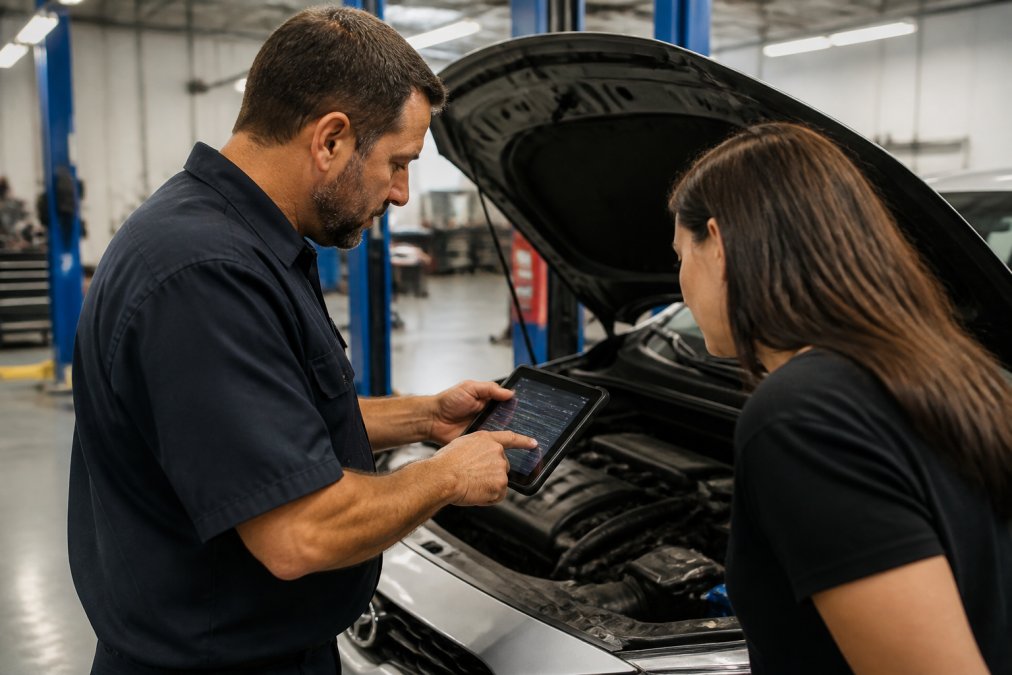
What sets us apart is how we approach the customer relationship. Our certified technicians are trained to explain issues in plain language, not jargon. If your suspension needs attention or your check engine light points to a failing sensor, you will see the diagnostic readout and understand exactly why the repair matters. We also offer same-day service for most maintenance work and free pickup and drop-off within a 10-mile radius, which removes the biggest hassle of car ownership: getting the vehicle to the shop.
For drivers with GM vehicles, including Cadillac models, our team brings specialized knowledge that generalist chains often lack. We handle factory-scheduled maintenance, emissions testing for 1996 and newer vehicles with wait times usually around 10 minutes, and everything from battery replacement to fluid exchange.
Pro Tip
Ask any shop whether they will show you the failed part before you authorize the repair. A shop that hesitates or refuses is usually protecting a markup, not your wallet.
Ask any shop whether they will show you the failed part before you authorize the repair. A shop that hesitates or refuses is usually protecting a markup, not your wallet.
Our service area is focused on West Atlanta and Riverside. If you live outside that radius, the convenience of free pickup may not apply.
Adamson Automotive: Decades of Independent Experience
Key Takeaway
RepairPal: Estimate Tool to Compare Fair Costs
RepairPal’s certified network and estimate methodology
Watch Out
Never use an online estimate as a fixed price guarantee with a shop that is not part of that network. A general estimate from a database cannot account for the specific condition of your vehicle, and holding an independent shop to an online number will only create conflict.
Never use an online estimate as a fixed price guarantee with a shop that is not part of that network. A general estimate from a database cannot account for the specific condition of your vehicle, and holding an independent shop to an online number will only create conflict.
Openbay: Compare Quotes and Book Online
AAA Approved Auto Repair: Vetted Shops Nationwide
AAA Approved [Auto Repair(/transparent-pricing-auto-repair-services/) program standards and facility requirements | aaa.com]
How to Spot an Honest Mechanic Before You Hand Over the Keys
Beyond the general advice about written estimates and certification displays, the most reliable way to evaluate a shop’s honesty is to examine how they use diagnostic technology. A shop that treats diagnostics as a revenue center rather than a problem-solving tool will reveal itself quickly during a phone call or walk-in visit.
The Diagnostic Fee Question
Ask any shop directly: “What does your diagnostic fee include, and does it apply toward the repair if I authorize the work?”
A shop operating in good faith will typically charge a flat diagnostic fee and apply that amount as a credit toward the repair you approve. This structure signals that the shop uses diagnostics to find the actual problem, not to generate standalone revenue. A shop that charges a diagnostic fee and then requires a separate teardown fee for disassembly work is building in a second charge that often surprises customers.
Ask About the Scan Tool, Not Just the Code
A common pattern among less scrupulous shops is to plug in a generic OBD-II scanner, read a trouble code, and immediately recommend a part replacement without further investigation. That approach is how customers end up paying for three oxygen sensors before the actual wiring fault is found.
A competent independent shop will describe their process differently. They should mention using a professional-grade scan tool, such as a Snap-on, Autel, or Bosch unit, that provides bidirectional controls and live data streaming, not just code retrieval. When you ask what the scan showed, an honest technician will explain that the code is a starting point and that they verified the circuit, checked voltage drops, or performed a component test before recommending a replacement. If the shop cannot articulate what they checked beyond “the computer said so,” that is a red flag.
The Visual Evidence Standard
During your first visit, ask whether you can see the failed part before authorizing a repair. A shop with nothing to hide will walk you to the bay or show you a photo of the worn brake rotor, the cracked belt, or the corroded battery terminal. This practice is common among shops that have invested in digital inspection tools, tablet-based systems that photograph and annotate worn components for the customer’s review.
Shops that use digital inspection reports will often send you a link with photos and explanations before you approve work. This is not just a convenience; it is a structural safeguard against unnecessary repairs. If a shop cannot produce visual evidence of a failed part, you are relying entirely on their verbal claim, and that is where padding happens.
The Warranty Paperwork Test
Before you authorize any significant repair, ask to see the warranty terms in writing. A reputable shop will provide a warranty that covers both parts and labor for a defined period, commonly 12 months or 12,000 miles for independent shops, with some offering 24 months on major components. The warranty document should name the warranty administrator (often the parts supplier or a third-party warranty company) and explain the claims process.
Be cautious of shops that say “we warranty everything” without producing documentation. If the shop cannot articulate who backs the warranty and how you file a claim, the warranty may be worth less than it sounds.
The Follow-Up Question That Separates Shops
Finally, ask this question before you commit: “If you recommend a repair and it does not fix the problem, what happens?”
An honest shop will explain their diagnostic process and stand behind their work, typically by waiving the diagnostic fee if their recommended repair did not resolve the issue, or by covering the additional diagnosis at no charge. A shop that hedges, deflects, or says “that does not happen” is not prepared to take responsibility for a misdiagnosis. Every technician misdiagnoses occasionally; the difference is whether the shop owns the mistake or bills you for their learning curve.
Key Takeaway
Use the diagnostic fee question as your first filter. A shop that applies the diagnostic fee toward the approved repair and can explain what their scan tool actually showed is far more likely to be honest than one that treats diagnostics as a profit center.
Use the diagnostic fee question as your first filter. A shop that applies the diagnostic fee toward the approved repair and can explain what their scan tool actually showed is far more likely to be honest than one that treats diagnostics as a profit center.
This approach gives you a concrete, repeatable vetting process that works regardless of whether you are visiting a dealership, a national chain, or an independent shop, and it is the same standard we hold ourselves to at TIPS Automotive.
When to Choose Aftermarket vs OEM Parts
The decision between aftermarket and OEM (Original Equipment Manufacturer) parts significantly affects both your repair cost and your vehicle’s long-term reliability. OEM parts are manufactured by your vehicle’s brand or its licensed suppliers, matching the exact specifications of the parts that came with your car. Aftermarket parts are produced by third-party manufacturers and may offer comparable quality at a lower price.
Choosing OEM makes sense in several situations. If your vehicle is still under factory warranty, using OEM parts protects that coverage. For safety-critical components like brake calipers, steering components, and suspension parts, OEM parts guarantee the exact engineering tolerances your vehicle was designed around. European and some luxury domestic vehicles also tend to be sensitive to non-OEM electronics.
Aftermarket parts are a smart choice for older vehicles where the cost of OEM parts approaches the vehicle’s value. Many aftermarket brands now manufacture parts to OEM specifications at a fraction of the cost, particularly for routine items like brake pads, filters, and belts. The key is buying from reputable aftermarket brands rather than the cheapest option available.
Your best strategy is to ask your mechanic which parts they recommend and why. A shop that automatically defaults to OEM without checking your vehicle’s age and warranty status is not looking out for your budget. Conversely, a shop that pushes aftermarket parts exclusively may be chasing higher profit margins on parts markup.
Auto Repair Labor Rates Atlanta: What’s Fair and How to Compare
Understanding what you should pay for labor is the single most effective way to avoid overpaying for auto repairs. Yet most drivers walk into a shop with no frame of reference for what a fair rate looks like, and that information asymmetry is exactly what allows some shops to pad their estimates.
The Range You Will Actually See in the Atlanta Metro
Labor rates in the Atlanta area cluster into three tiers based on shop type and overhead structure. These are general market observations, not guarantees, your specific quote will depend on the shop’s location, technician experience level, and equipment investment.
- Dealerships typically charge the highest rates, often in the $150 to $190 per hour range. This premium reflects factory-specific training, specialized tooling, and the overhead of a branded facility. You are paying for the assurance that a technician has been trained on your specific make, but you are also paying for the showroom, the loaner car fleet, and the marketing budget.
- Independent full-service shops in the metro area generally fall between $95 and $140 per hour. Shops at the higher end of that range have typically invested in modern diagnostic equipment and employ ASE-certified technicians with specialized training. Shops at the lower end may have lower overhead but may also use older diagnostic tools or employ technicians with less specialized experience.
- National chains and quick-service operations often advertise lower hourly rates, sometimes $80 to $110, but frequently make up the difference through parts markups, bundled service packages, or recommended maintenance that goes beyond what your vehicle actually needs.
Why the Hourly Rate Is Only Half the Story
The hourly rate alone does not determine your total cost. The labor time quoted matters just as much. Most reputable shops use industry-standard labor guides, such as those published by Mitchell1 or ALLDATA, that specify how many hours a particular repair should take based on the vehicle’s make, model, and year.
For example, a standard front brake pad and rotor replacement on a mainstream sedan typically carries a labor time of 1.5 to 2.5 hours in these guides. A shop quoting 4 hours for the same job is either using an inflated time estimate or planning to bill you for inefficiency. When you receive a written estimate, ask to see the labor time breakdown. A shop that can show you the guide they used and explain the time is being transparent. A shop that says “that’s just what it takes” without reference to a standard is leaving room to pad.
The Parts Markup Factor
Labor rates are only one component of your total bill. Parts markup is where many shops quietly increase their profit margin. A shop may charge you the dealership list price for a part they purchased wholesale at 30 to 40 percent below that price. This practice is legal and common, but it means you should compare the total estimate, parts plus labor, rather than focusing exclusively on the hourly rate.
A useful comparison method: get written estimates from two independent shops and one dealership for the same repair. If the independent shops are within 10 to 15 percent of each other on total cost, you are likely seeing fair market pricing. If one estimate is dramatically lower, ask what parts brand they plan to use and whether the labor time matches the industry standard. A significantly lower estimate often signals lower-quality aftermarket parts or a shop that plans to find “additional issues” once your car is on the lift.
How to Use RepairPal and Openbay for Labor Rate Benchmarks
Before you visit any shop, use RepairPal’s estimate tool to establish a baseline for what a specific repair should cost in the Atlanta area. The tool draws on a national database of repair transactions and adjusts for regional labor rates. This gives you a defensible number to compare against written quotes. If a shop’s estimate is more than 20 percent above the RepairPal range for your vehicle and repair type, ask the service advisor to explain the difference, whether it is premium parts, additional diagnosed issues, or a higher labor rate.
Openbay serves a similar benchmarking function by letting you request quotes from multiple participating shops simultaneously. The quotes you receive will reflect each shop’s labor rate and parts pricing, giving you a side-by-side comparison without making phone calls. Just remember that the lowest quote is not automatically the best value, check the parts brand and the shop’s reviews before you book.
The Written Estimate Rule
A fair shop will provide a written estimate that itemizes parts and labor separately, names the parts brand (OEM, aftermarket brand, or remanufactured), and lists the labor hours. This document is your protection against surprise charges. If a shop discovers additional issues during the repair, they should call you for approval before proceeding, and the revised estimate should be provided in writing before the additional work begins.
Pro Tip
When comparing estimates, ask each shop to quote the same parts category, for example, OEM parts or a specific aftermarket brand like ACDelco or Bosch. Comparing an OEM quote against a budget aftermarket quote will make one shop look cheaper without telling you anything about the actual value.
When comparing estimates, ask each shop to quote the same parts category, for example, OEM parts or a specific aftermarket brand like ACDelco or Bosch. Comparing an OEM quote against a budget aftermarket quote will make one shop look cheaper without telling you anything about the actual value.
What This Means for Your Decision
For most routine repairs, brakes, alternators, suspension components, and similar jobs, a reputable independent shop will deliver comparable quality to a dealership. The key is to verify that the independent shop uses current diagnostic equipment, employs certified technicians, and provides a written warranty, the same standards we meet at TIPS Automotive.
Which Alternative Is Right for Your Car?
Your choice of repair shop should align with your vehicle’s age, condition, and your own priorities. TIPS Automotive combines certified expertise across all major systems with the convenience of same-day service and free local pickup. If you drive a GM vehicle, particularly a Cadillac, our specialization adds another layer of confidence.
| Your Situation | Recommended Option | Why It Works |
|---|---|---|
| Need routine maintenance with honest explanations | TIPS Automotive | Certified technicians, transparent process, same-day service |
| Drive a Cadillac or GM vehicle requiring specialized care | TIPS Automotive | Specialized GM knowledge and factory-scheduled maintenance |
| Want to verify fair pricing before visiting any shop | RepairPal | Standardized estimates from national repair data |
| Prefer managing quotes and booking entirely online | Openbay | Digital marketplace for local quotes and scheduling |
| Want a vetted shop with national backing | AAA Approved Auto Repair | Strict facility inspection and member protections |
| Value a long-established, family-owned local shop | Adamson Automotive | Decades of community trust and personalized service |
Conclusion: Find a Repair Shop You Can Trust
The search for a dependable repair shop comes down to one question: will this business treat my car and my budget with equal respect? The options above each answer that question differently, but they all share a commitment to transparency that you will not find at a shop that profits from confusion.
At TIPS Automotive, we built our entire practice around honest diagnostics and clear communication. Our certified technicians handle everything from routine oil changes to complex transmission repair, and we back our work with the convenience of same-day service and free pickup and drop-off within a 10-mile radius. We also specialize in GM and Cadillac vehicles, so you get expertise tailored to your car, not a one-size-fits-all approach.
Call TIPS Automotive today to schedule your service and experience the difference that honest, expert care makes for your vehicle.
Frequently Asked Questions
What should I look for in a full-service auto repair center?
Look for certified technicians, transparent estimates, and clear communication. Check that the shop offers the services you need, like diagnostics, brake work, and routine maintenance. Read reviews and ask about warranty coverage. A good full-service shop will explain repairs in plain English and give you a written estimate before starting work. TIPS Automotive, for example, provides same-day service and free pickup within 10 miles, making it a convenient choice.
How do I know if an auto repair shop is honest?
An honest mechanic will show you the worn parts, explain why a repair is needed now versus later, and give you a detailed written estimate. They won’t pressure you into extra work and will stand behind their repairs with a warranty. Check online reviews for mentions of fair pricing and clear communication. Ask how they handle unexpected findings during a repair; a trustworthy shop will call you before doing any additional work.
What is the difference between OEM and aftermarket parts?
OEM (Original Equipment Manufacturer) parts are made by the same company that built your car, so they match factory specifications exactly. They cost more and are often required to keep a new car’s warranty intact. Aftermarket parts are made by third-party companies and are usually cheaper, with quality varying by brand. For older cars or non-critical repairs, quality aftermarket parts can be a cost-effective choice. Ask your mechanic for their recommendation based on your car’s age and condition.
Is $100 an hour fair for mechanic labor?
Auto repair labor rates depend on the shop and the complexity of the work. The key is to compare the total estimate, not just the rate. Ask for a breakdown of parts and labor, and check if the shop uses OEM or aftermarket parts, as this affects the final price.


Comments are closed